
 +66 98 432 7651


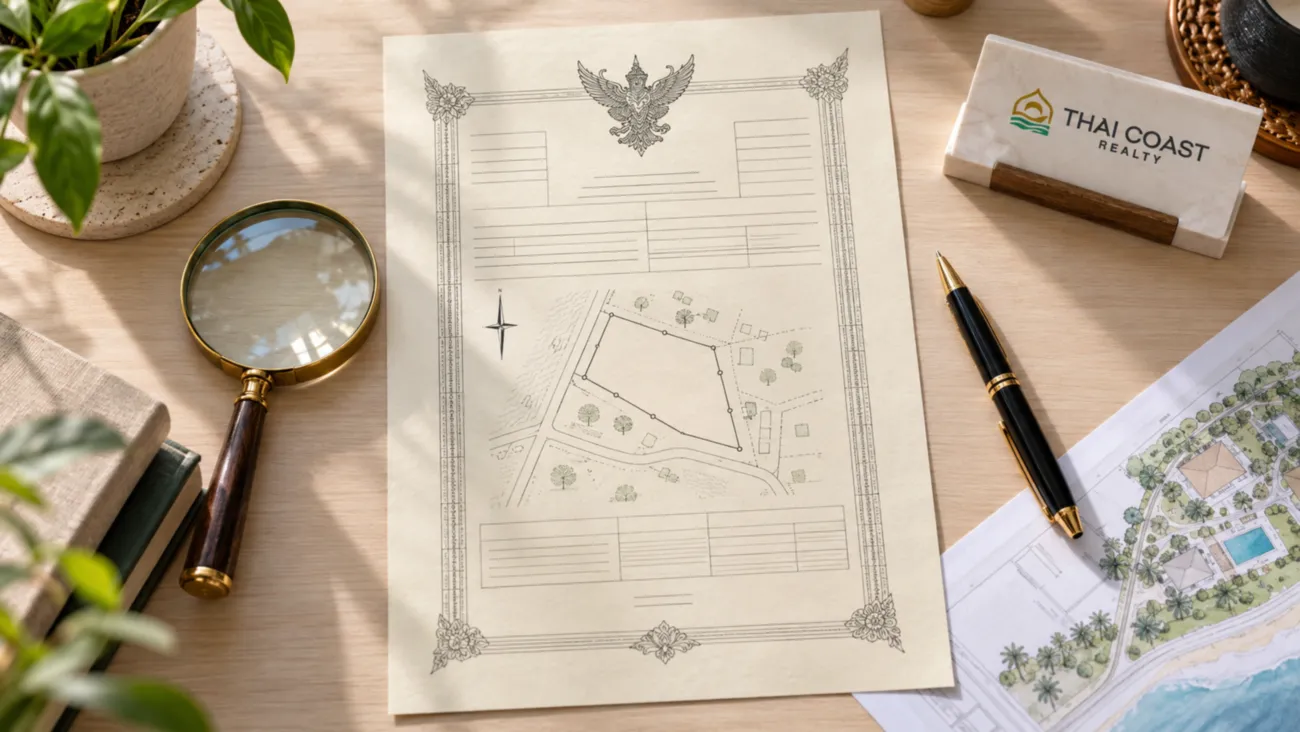
Imagine this: You’re choosing a villa in Phuket, and the agent sends you a photo of the land title document—the Chanote—and explains that everything is in order. But what exactly does this document confirm? Does it guarantee the legality of the transaction? And what should a foreign buyer do with it?
A Chanote (โฉนดที่ดิน, Chanote) is a full title to land in Thailand, which confirms the registered ownership of a specific parcel of land. This is the most reliable type of land title document in the country. However, a chanot alone does not eliminate all legal risks associated with a transaction: it does not confirm the absence of encumbrances, the legality of a built villa, a foreigner’s right to own the land, or that the actual boundaries match the cadastral boundaries.
In this guide, you'll learn what a chanot looks like, what's written in it, how it differs from other land documents, how to verify it, and what additional questions to ask before making a deposit.
Chanot in Thailand: The Highlights in 30 Seconds
Chanote (Nor Sor 4 Jor) is a Thai government land title that certifies registered ownership of a parcel of land. It contains information about the owner, the area, the boundaries, and registered rights. For a real estate buyer, this is one of the most important documents, but it does not guarantee the absence of legal issues.
| Question | Short answer |
|---|---|
| What does Chanot confirm? | Ownership of a Land Plot |
| Who issues it? | Department of Lands through the Land Office |
| How is it denoted? | Chanote / Nor Sor 4 Jor |
| Can a foreigner buy land? | As a general rule, no, except for limited legal exceptions |
| Can a foreigner buy an apartment? | Yes, in a registered condominium, provided that the foreign ownership quota is observed |
| Foreign Quota | No more than 49% of total apartment area in the condominium |
| Maximum standard term for a land lease | 30 years |
| When should you register a lease? | To secure a term of more than 3 years, a written agreement and registration are required |
| Where can I check the chanot? | At the Land Office where the parcel is located |
| Can I check it online? | Partially, via LandsMaps; current rights and encumbrances are verified separately |
| Does Chanot guarantee the legality of the villa? | No, construction documents are reviewed separately |
Key point for foreign buyers: A chanot confirms ownership of the land, but does not mean that the land can be registered in your name. When purchasing a villa, you must separately verify the land title, ownership of the building, and the legal structure of ownership.
What is a chanot?
The official Thai name of the document is — Land Title Deed (Chanote, Chanod). In the state registration system, it is designated as Nor Sor 4 Jor (N.S. 4(j)). It is issued and registered by the Department of Lands of Thailand through local Land Offices.
Chanot confirms that the plot has been entered into the state cadastral registry, its boundaries have been determined through an official survey and are reflected in the land documentation, and the title to the property has been registered in the official registry. It is the registration in this registry—not the physical existence of a paper document—that constitutes a legally significant fact.
A chanot refers exclusively to a parcel of land. It is not a title deed for a building, a building permit, or the equivalent of a condominium unit certificate. The legal status of a villa must be verified separately from the land title. Depending on the circumstances, ownership of the building may belong to the landowner or to another party, and additional documents may be required to confirm ownership of the structure. For an apartment in an officially registered condominium, a separate document of ownership for the apartment is provided— Condominium Unit Title Deed (หนังสือกรรมสิทธิ์ห้องชุด). It differs from a land chanota. Tabien Baan (ทะเบียนบ้าน) is a household registration book that, in and of itself, does not establish ownership.
As a general rule, a foreign national cannot purchase a land parcel as direct ownership—Thai law imposes fundamental restrictions. Possible legal structures and limited exceptions are discussed below.
A chanot confirms the registered land title of a specific owner, but does not imply that a foreign buyer automatically has a right to that land.
What does a chanot look like?
The document is printed on the official letterhead of the Department of Land and contains information in Thai. Virtually every element of the document is important when inspecting the property.
Front Side
The front side features:
- The Garuda Emblem (Garuda) — a national symbol used on official land documents in Thailand. However, its presence alone does not confirm the authenticity of the document presented: the information must be verified against the records at the Land Office.
- Chanota Number (Title Deed Number, เลขที่โฉนด) — the registration number of the title deed. It is used to identify the document along with information about the province and the relevant land office. It should not be confused with the land parcel number (Land Number, เลขที่ดิน) or the survey page number (Survey Page, หน้าสำรวจ). When verifying, it is necessary to cross-check all identifiers, not just a single number.
- Land Parcel Number (Land Parcel Number) — a unique cadastral identifier within a district.
- Examination Number (Survey Page) — one of the identifiers used in land parcel documentation to refer to an entry in the state land registry.
- Province, district, and subdistrict (ตำบล/แขวง) — the administrative designation of the area.
- Lot area — is specified in Thai units: rai, ngan, and square wah.
- Site Plan — a simplified site plan showing neighboring lots and landmarks.
- Information about the registered owner — the copyright holder's first and last name as of the date of the most recent entry.
Thai units of area and their conversions:
- 1 rai = 1,600 m²
- 1 ngan = 400 m²
- 1 square wah = 4 m²
Example: A plot of land measuring 1 rai, 1 ngan, and 20 square wah is equal to 1,600 + 400 + 80 = 2,080 m².
The Other Side
The reverse side contains the history of the lot's legal status. All registered events are recorded here:
- Transfers of Ownership including dates and information about the parties to the transaction.
- Registered Mortgage — the existence of collateral in favor of a bank or a private lender.
- Lease Agreements — A real estate lease for a term exceeding three years must be in writing and registered with the government in order to ensure legal protection of the right for a term exceeding three years.
- Easements — registered third-party rights of way, right of passage, or the right to install utilities.
- Usufruct (Usufruct, สิทธิเก็บกิน) — the right of another person to use real property and derive benefits from it within the limits of the law and the terms of the established right. A registered usufruct may significantly limit the buyer’s ability to use the property.
- Superficius (Superficies, สิทธิเหนือพื้นดิน) — the right to own buildings, structures, or plantings on a parcel of land belonging to another person. This right is particularly important when purchasing a villa, where the landowner and the building owner are not the same person.
- Other Restrictions and Encumbrances by court order or as part of administrative proceedings.
The copy of the land register provided by the seller reflects the entries as of the date the copy was made. The current status of the land register can only be verified at the Land Office.

What to See in Chanota
| Document Element | What does that mean? | What Buyers Should Check | Potential risk |
|---|---|---|---|
| Chanot Number, Plot Number, and Survey Page | Identification in the State Registry | Consistency with the contract and public cadastral data | A mismatch means that the document pertains to a different section |
| Area in rai/ngan/wah | Officially Registered Area | Compare with the actual dimensions of the lot on site | The actual area may differ from the registered area |
| Owner Information | Who is the copyright holder? | Verification of the seller's identity and documents | The seller may not be the owner |
| Notes on the back | History of Transfers of Rights and Encumbrances | Existence of mortgages, leases, easements, usufruct, superficies, and registered encumbrances | A registered mortgage may remain in effect upon a change of ownership unless it is paid off or discharged in accordance with established procedures |
| Site Plan | Mapping Boundaries and Landmarks | Accuracy in Reflecting the Actual Layout on the Ground | The actual boundaries may not match the diagram |
| The Garuda Emblem and the Land Office Seals | The Official Origin of the Document | Verification against current data from the state registry | This document may be an outdated copy |
No single element should be verified in isolation. Only by comparing all data with the current information in the registry can one assess the registered rights and encumbrances; however, this does not replace an inspection of the actual condition of the parcel and other legal circumstances.
Types of Land Documents
In Thailand, there are several categories of land titles, each conferring fundamentally different rights. It is important for any buyer to understand these differences, since the term “land title” does not automatically imply full ownership rights.
Chanote / Nor Sor 4 Jor (Land Title Deed) — one of the main types of land titles in Thailand, confirming full ownership. The boundaries of the plot are defined through an official survey. The transfer of ownership and other registration procedures required by law are processed through the Land Office.
Nor Sor 3 Gor (N.S. 3 G.) — a certificate of ownership and use of a plot of land, the boundaries of which are defined based on official aerial photographs. The accuracy of the boundary definitions and the legal status differ from those of a Chanote. Transactions are registered, but the accuracy of the boundaries may be lower until the land is converted to Chanote status. Conversion to Chanote is possible, but it is an administrative procedure subject to certain conditions—it is not an automatic consequence of the owner’s desire.
Nor Sor 3 (น.ส. 3) — the right to use a plot of land, with the option to transfer it. The boundaries are defined less precisely. When registering certain transactions involving Nor Sor 3, a public notice procedure applies; the specific procedure depends on the type of registration and the characteristics of the document.
Sor Kor 1 (s.k. 1) — a historical document establishing the right to initial development of the plot. It is not a title deed and is not subject to a registered transfer of rights in the standard sense. The possibility of obtaining a document of a higher category requires a separate review.
Sor Por Kor 4-01 (S.P.K. 4-01) — a document related to the granting of land use rights as part of agricultural reform. Such plots are subject to specific restrictions on their use and the transfer of rights. Starting in 2024, eligible land users will be able to obtain a special agricultural title (โฉนดเพื่อการเกษตร). This document should not be equated with a standard Chanote, which grants full ownership rights. Before any transaction, it is necessary to verify the specific type of document and any applicable restrictions.
Por Bor Tor 5 (ภ.บ.ท. 5) — a tax document confirming payment of land tax. It is not a title to the land and does not establish ownership or possession. Sellers sometimes present this document for plots of land without higher-level title documents, which requires particular caution.
Chanot and Other Land Documents
| Document | What right does this affirm? | Transfer of Rights | Characteristics of Borders | What Buyers Should Consider |
|---|---|---|---|---|
| Chanote / Nor Sor 4 Jor | Full ownership | Registered with the Land Office | Official land surveying with high precision | Requires a comprehensive review of encumbrances and zoning |
| Nor Sor 3 Gor | Right of Possession and Use | Registered with the Land Office | Based on aerial photographs, less accurate than Chanote | Verify the actual boundaries; upgrading to Chanote is a separate process |
| Nor Sor 3 | Right of Use and Transfer | Requires a notification procedure | Approximate | The procedure for a transaction depends on the type of registration action |
| Sor Kor 1 | Right of First Development | Cannot be conveyed in the standard way | There is no accurate land registry | Not suitable for a standard purchase |
| Sor Por Kor 4-01 | Right to Use Agricultural Land | Restricted by specific legislation | According to the distribution plan | Non-agricultural use is restricted; starting in 2024, a special title that is not equivalent to a standard Chanote may be available |
| By Bor Tor 5 | Proof of Tax Payment | The law does not confirm | No | Is not a land title document |
In practice, buyers of villas or plots of land primarily look for a Chanote; however, it is important to understand that the mere existence of a document in any of these categories does not in itself mean that there are no encumbrances or that a foreigner can register a title.
How to Check a Chanot
This is the practical core of the article. When a buyer receives a photo of a chanot from an agent or seller, it is only a starting point. The actual inspection consists of several sequential steps.
1. Obtain a copy of both sides of the document. The front side alone does not provide complete information. Insist on receiving both sides.
2. Verify the identifiers. The parcel number, survey page, province, and district within the chanot must match the information in the contract, promotional materials, and other documents.
3. Verify the identity of the registered owner. Compare the information on the receipt with the seller's passport or ID card. Any discrepancy is a reason to investigate the cause before making a payment.
4. Check the Land Office for the most up-to-date information on encumbrances. The landowner holds the official copy of the Chanote, while the corresponding registration copy is kept at the Land Office. During the verification process, the document provided by the seller must be compared with the Land Office’s current records, including registered transfers of title and encumbrances. A photograph or photocopy of the Chanote does not confirm the current legal status of the property. The results of a current verification of registered rights and encumbrances at the Land Office are the only reliable source of this information. Some information is accessible only to the rights holder or an authorized representative; the scope of available data and the procedure for obtaining it depend on the type of request and the applicant’s authority. For a comprehensive verification, it is recommended to engage a Thai lawyer with a proper power of attorney.
5. Use the Department of Land's mapping services. The department provides a public mapping service called LandsMaps, which allows users to find a parcel by its identifiers and match the cadastral map to its actual location. This is a useful tool for initial orientation, but it does not replace the verification of registered rights: Viewing a plot of land on a map and obtaining official information about its legal status are fundamentally different actions.
How to Check a Plot's Location Using LandsMaps
Official service: LandsMaps — Department of Lands
LandsMaps is a public mapping service provided by the Thai Department of Lands. It allows users to search for a plot of land using its registration details and view its location on a map.
- Open the official LandsMaps service.
- Select the province and administrative district where the plot is located.
- Enter the land title number or use the available tools to search for a parcel.
- Compare the plot you found with the seller's document: location, number, area, and boundary configuration.
- Please verify that the location of the site matches the promotional materials, the project plan, and the actual inspection site.
- Save the data for later review by a lawyer at the Land Office.
Things that cannot be verified solely through LandsMaps: the seller’s current authority to sell, the full list of registered encumbrances, the legal validity of contracts, the legality of construction, and the absence of any potential disputes.
If the property cannot be found in the service or the information does not match the seller's document, this is grounds for further verification, not automatic proof of forgery.
The official Department of Lands lists LandsMaps among its public services.
6. Check the cadastral boundaries on-site. Visit the property with the map. Make sure that the boundary markers, fences, and actual boundaries match the diagram in the document. If necessary, commission an independent survey.
7. Check access to the site. The existence of a chanot does not guarantee a legally established right of way to the property. The property may be surrounded by neighboring lands without a properly registered easement.
8. Compare the data in this table with the building's documentation. If a villa has been built on the property, check the building permit, verify that the building conforms to the approved plans, and review the documents confirming the legality of the building’s use, if such documents are required for this type of property. Ownership of the building and the land title may be held by different parties.
9. Seek an independent legal opinion. A qualified Thai attorney will review not only the paper documents but also the current records at the Land Office, the zoning of the plot, and the compliance of the transaction structure with applicable law.
10. Double-check the information before registering the transaction. Even if a lawyer has already reviewed the land title before the deposit is made, circumstances may change between the initial review and registration: a new encumbrance, restriction, or other registered right may arise. Therefore, immediately before closing the transaction, you should recheck the current records at the Land Office, confirm the seller’s authority, and agree on the procedure for removing existing encumbrances.
The first review helps determine whether it is worth entering into a contract. The second review ensures that the terms of the transfer of rights have not changed by the time of registration.

To understand the full scope of a pre-sale inspection of a property, we recommend the following resource: "Real Estate Due Diligence When Buying in Thailand"
How much does a Chanota check cost in Thailand?
The cost depends on the scope of the review, the region, whether land surveying is required, the number of parcels, and the services provided by the specialists involved. It is important to distinguish between government fees and the commercial cost of a lawyer’s or surveyor’s services.
| Service | How is the cost determined? | When it is necessary |
|---|---|---|
| Search for a plot on LandsMaps | Public Online Search | For an initial check of the layout |
| Verification of Registration Information at the Land Office | Based on applicable government rates and the type of request | Before buying land or a villa |
| Obtaining Official Copies of Documents | Based on the rates for the corresponding service | For a legal opinion |
| Boundary Survey by a Surveyor | Based on a separate estimate that takes the site into account | If you have any doubts about the boundaries |
| Checking Zoning and Restrictions | It depends on the method used to obtain the information and the scope of work | Before Building or Buying a Villa |
| Comprehensive due diligence | Under an agreement with a law firm | Before signing and making any substantial payments |
Before ordering an inspection, request a written estimate. Clarify whether it includes government fees, the specialist’s on-site visit, review of building documents, translation of documents, and preparation of a written legal opinion.
Have you already chosen a property but aren't sure about the paperwork?
Submit a request to discuss which documents you need to request from the seller and what due diligence should be conducted before the purchase. If necessary, an independent specialist in Thai law will conduct a legal review. Find a property and discuss the documents
Find a Property
What Risks Does Chanot Pose?
Chanot is an essential part of the verification process, but it is not a universal guarantee of security. There are situations where a document is genuine, but the transaction requires further analysis or a temporary hold.
Discrepancy in the actual boundaries. The cadastral map in the document may not match what is physically fenced off on the ground. This is a common source of disputes between neighbors.
Registered mortgage. If a lien is recorded on the title or in the registry, it may remain in effect upon a change of ownership unless it has been discharged and removed in accordance with established procedures. If there is a registered mortgage, the procedure for its repayment and removal of the encumbrance must be agreed upon with the lender either prior to the transfer of title or simultaneously with the registration of the transaction.
Registered lease. As a general rule, a change in ownership does not terminate a valid real estate lease agreement. The scope of the tenant’s protected rights is determined by law, the lease agreement, and the fact of registration.
No registered access to the road. A parcel of land cannot be legally separated without a properly executed and registered easement. A neighbor’s simple written consent is not an equivalent substitute for a registered real property right.
Zoning Restrictions. A plot’s designation under the master plan determines what can be built on it. The existence of a plot designation does not imply permission to construct a residential or commercial building.
Problems with the building permit. The villa may be built without the proper permits or with deviations from the plans, which creates administrative and legal risks.
A discrepancy between the seller and the owner. The seller may be acting without a valid power of attorney or may not be the sole legal owner.
Problem — Consequences — Solution
| Problem Identified | Why is it dangerous? | What to Request or Check | When You Can't Continue Without an Explanation |
|---|---|---|---|
| Registered Mortgage | A lien may remain in effect even if the property changes hands | Approval and Documentation of the Procedure for Mortgage Repayment and Removal of the Encumbrance | Until the repayment and withdrawal procedure is confirmed |
| Seller ≠ owner as listed in the registry | A Transaction with an Unauthorized Person | A current power of attorney or a statement explaining the transfer of rights | Always, until authority is confirmed |
| Border Discrepancies | The Risk of a Legal Dispute with Neighbors | Surveying | In the event of a significant discrepancy with the document |
| Lack of legally established access to the road | Inability to use normally | Documents confirming lawful access to the road; if access crosses another person’s property, verify that the easement has been properly established and registered | In the absence of a confirmed legal right of passage |
| There is no building permit for the villa | Administrative Claims and the Risk of Demolition | Building permit, project compliance, and documents verifying lawful use | Until the legality of the structure is confirmed |
| Zoning Restrictions | The planned project cannot be implemented | Information on land use from local authorities | If the land use plan is not in compliance |
What to Do Based on the Results of the Chanota Test
| The Situation | What does that mean? | Recommended Action |
|---|---|---|
| Chanote, owner verified, no encumbrances found | The basic registration information is being finalized | Continue with the remaining inspections of the building, boundaries, zoning, and the contract |
| Chanote with a registered mortgage | The property is encumbered by a lien | Document the procedure for paying off and releasing the mortgage |
| Chanote with a registered lease | A tenant's rights may be preserved upon sale | Check the term, conditions, and consequences for the buyer |
| Nor Sor 3 Gor instead of Chanote | Right of possession and use has been confirmed, but not full title to the property | Verify the boundaries, transferability, and prospects for obtaining a Chanote |
| The seller is not the copyright holder | Authorization for the transaction has not been confirmed | Suspend payments until the power of attorney or other legal basis has been verified |
| There is no confirmed access to the road | There may be restrictions on the use of the property | Determine the legal basis for access and whether it can be formalized |
| The document is not found in the registration data being checked | It is not possible to verify the claimed rights | Do not enter into any financial commitments until the legal status has been established |
Even a positive result from the chanot review does not mean automatic approval of the transaction: for a foreign buyer, the permissible legal form of ownership must be determined separately.
Let’s consider a possible scenario: a buyer receives a photo of the chanot, verifies that the document exists, pays a deposit—and then discovers that the villa was built in a way that deviates from the approved plans, and the only access road to the property runs through a neighbor’s land without any registered right of way. The chanot is genuine in this case. But the legal risks of the transaction have not gone away.
Chanot and a Foreign Buyer
Buying an Apartment
An apartment in a registered condominium is a separate legal entity. Its legal status is governed by the Condominium Act, not by land laws. The land on which a building in a registered condominium stands is classified as the common property of the apartment owners. When purchasing an apartment as freehold property, the buyer also acquires a corresponding share in the common property of the building in accordance with the procedures set forth in the Condominium Act. However, the buyer is not issued a separate title deed for a portion of the land; ownership of the apartment is evidenced by a Condominium Unit Title Deed.
A foreign citizen is entitled to purchase an apartment in such a condominium in Freehold provided that the foreign ownership quota requirement is met. The quota means that, in total, foreign owners may hold no more than 49% of the total area of all residential units in a specific condominium.
When purchasing an apartment under the foreign quota, the buyer must confirm compliance with the requirements of the Condominium Act and provide documentation regarding the source of funds. For most foreign buyers purchasing an apartment with funds transferred from abroad, a bank confirmation of the foreign currency transfer is required, specifying that the payment is for the purchase of real estate. For certain categories of buyers, including foreign nationals with permanent resident status, other acceptable grounds and documents apply. Buyers should verify the requirements with their bank and the Land Office before transferring funds.
Check out residential real estate in Thailand




 Phuket, Rawai
 from 30m²
 Phuket, Katufrom 23.75m²
 Phuket, Layanfrom 24.71m²

Buying a Villa
When purchasing a villa, foreign buyers most often encounter a situation where the building and the land have different legal statuses. As a general rule, foreign nationals are not permitted to purchase land in Thailand as freehold property. The Land Code provides for limited exceptions, including certain cases of inheritance and the acquisition of land for residential purposes with the permission of the competent authorities, subject to the fulfillment of specific investment requirements. These exceptions do not grant foreigners a general right to freely purchase land parcels.
One specific exception is provided for in Section 96 bis of the Thai Land Code. Subject to meeting the established conditions and obtaining approval from the competent authorities, a foreign national may be eligible to purchase a residential plot of land with an area of no more than 1 rai (1,600 m²). The legal framework stipulates investment requirements, including a minimum investment of 40 million THB and the maintenance of such investments for a specified period, typically no less than five years.
This is an exceptional authorization mechanism, not the standard procedure for a foreigner to purchase land. Meeting the investment requirement alone does not guarantee that a permit will be issued: the type of investment, the location of the plot, the land’s designated use, and other requirements are also taken into account.
Some legal structures used by foreign villa buyers:
- Long-term lease (Leasehold): A foreign national enters into a land lease agreement with a Thai landowner. As a general rule, the term of a standard real estate lease in Thailand may not exceed 30 years (Section 540 of the Civil and Commercial Code). A lease for a term exceeding three years must be in writing and registered with the Land Office to ensure legal protection of the right for the term exceeding three years (Section 538). Upon expiration of the term, a new agreement may be entered into; however, a promise of renewal does not automatically equate to an additional 30 years of registered tenure. Whether such a promise is binding on the parties and subsequent owners requires a separate legal analysis.
- Thai company: The land is registered in the name of a legal entity with Thai shareholders. Ownership of land through a Thai company is permitted only if all legal requirements are met, including the rules for determining foreign control. Setting up a structure with nominal Thai shareholders to circumvent restrictions is not permitted and carries serious legal risks.
Ownership of the building may be registered separately. The legal distinction between rights to the building and rights to the land requires a detailed analysis of each specific transaction.
The title to the lot and the title to the villa built on it may have different legal statuses and belong to different parties—this must be verified before signing the contract.
Villas in Thailand
 Phuket, Rawaistarting at 38.3 m²
 Phuket, Bang Taofrom 272m²
 Phuket, Thalangfrom 388m²
 Phuket, Thalangfrom 303.50m²
 Phuket, Nai Yangfrom 187m²
 Phuket, Bang Taofrom 269.92m²
Chanot, Freehold, and Leasehold
These three concepts are often confused in descriptions of assets, even though each one describes a distinct aspect of a transaction.
Chanot — This is a document that identifies a parcel of land and contains information about the registered owner. It does not mean that any potential buyer has the right to register the parcel in their own name.
Freehold — Freehold: The buyer registers ownership of the property for an indefinite period. With regard to land in Thailand, this form of ownership is available primarily to Thai citizens and legal entities that meet the requirements of the law. A foreigner may own a condominium unit under freehold title within the established quota.
Leasehold — a leasehold right for a term specified in the lease agreement and under Thai law. The extent of the tenant’s protection depends on the registration of the right, the terms of the contract, its duration, and the applicable provisions of Thai law. The landowner’s possession of a chanot confirms their right to lease the land, but does not make the tenant a landowner.
Three scenarios to help you understand the difference:
- Thai citizen He purchases a plot of land with a cottage on it. He registers the title at the Land Office. This is a freehold title to the land.
- Foreigner purchases an apartment in a registered condominium under the foreign quota. This is a freehold title to the apartment, along with a corresponding share in the condominium’s common property, including the land on which the building stands. However, the buyer is not issued a separate title deed for the portion of the land.
- Foreigner enters into a 30-year lease agreement for a plot of land with a partner, registers it with the Land Office, and builds a villa. This consists of a leasehold interest in the land and a separately registered right to the structure.
Not every property labeled “Chanote” grants freehold title to a foreigner. And not every leasehold implies weak protection—much depends on the terms of the contract, whether it is registered, and the applicable provisions of the Civil and Commercial Code.
Not sure whether to choose freehold or leasehold?
Find an apartment or villa in Thailand based on your budget, region, purpose of purchase, and preferred form of ownership. The legal status of each property is verified individually prior to the transaction.
Take the real estate selection quiz
Chanot in Different Regions
The main provisions of land law apply throughout Thailand. However, urban planning, environmental, and building restrictions may vary depending on the region and the specific plot of land. Therefore, when reviewing a chanota, it is necessary to consider not only national requirements but also local land use and building regulations.
What to Check in Different Regions
| Region | A Typical Verification Task | What documents are important? | What is missing from the solution? |
|---|---|---|---|
| Phuket | Legality of development on slopes, nature conservation areas, access to the road | Chanot, building permit, zoning, registered easement | A single chanota without verifying zoning and permits |
| Samui | Topography, Access Roads, Utilities, Approved Construction | Chanot, documents for utility connections, access, zoning | Chanota without verifying the actual availability of the plot |
| Pattaya | Rights to lots for villas, residential developments, and condominiums | Chanot / Condominium Unit Title Deed, Permits, Legal Structure of Ownership | Marketing materials without document verification |
| Bangkok | Individual Titles to Apartments, Legal Status of Non-Residential Properties | Condominium Unit Title Deed, ownership share, proof of funds | Verbal assurances from the developer without verification of the quota |
Where to Check Permitted Land Use
In addition to verifying the land title, the buyer should determine what restrictions apply to the specific parcel. To do so, you can use the services of the Department of Public Works and Town & Country Planning (DPT).
Official DPT Land Use Verification Service provides for several verification options:
- online preview of urban planning data;
- submitting a request for official confirmation of the permissible use of the plot;
- Obtaining cartographic information regarding the urban development plan.
The online map helps you assess potential restrictions in advance, but it does not replace official confirmation for a specific construction project. Additional environmental, coastal, and other special requirements may apply.

Common Risks and Mistakes When Verifying Documents
Let's take a look at the mistakes foreign buyers should avoid when reviewing land documents.
Mistake 1: They only check the front side. Information about encumbrances, registered mortgages, and leases is on the back. Without it, the picture is incomplete.
Mistake 2: Taking a single instance of chanota as confirmation of the current status. Even the official copy of the land title presented by the owner must be verified against the current registration records. A photograph or copy of the document may not reflect subsequent changes in the legal status of the parcel; therefore, a verification at the Land Office is required before the transaction.
What should you do if the seller refuses to show you the full deed? Ask for legible copies of both sides of the document and information that allows you to identify the property. If the seller is unwilling to provide documents for independent verification, you should not transfer the deposit based solely on a photograph, a promotional brochure, or verbal assurances from the agent. The next step is to find out the reason for the refusal and arrange for verification through an authorized representative at the Land Office.
Mistake 3: Failing to compare the cadastral boundaries with the actual parcel. There may be a significant discrepancy between what is shown in the diagram in the document and what is enclosed by the fence. This is a source of costly disputes.
Mistake 4: The belief that a chanot grants a foreigner the right to land. The fact that the seller holds a land title does not alter the legal restrictions applicable to a foreign buyer.
Mistake 5: Confusing land title with ownership of the villa. A chanot is a document certifying ownership of a plot of land. The right to a house may belong to another person or require separate legal documentation.
Mistake 6: Making a deposit before completing the basic checks. The terms for refunding a deposit depend on the contract and the circumstances surrounding the termination of the transaction. Before transferring funds, you should verify whether a refund is provided for in the event of legal issues with the property, encumbrances, violations of building codes, or the inability to complete the agreed-upon registration of title.
Before entering into any financial obligations, you must obtain: the results of a current search of registered rights and encumbrances at the Land Office, confirmation of the seller's authority, information on zoning and building permits, and an independent legal opinion.
Pre-Purchase Checklist
Save this list and use it when viewing a property or talking to a real estate agent.
Document:
- Both copies of the chanota (or other land document) have been received
- The identifiers match those in the contract and the cadastral records
- A current verification of registered rights and encumbrances has been requested from the Land Office
Owner:
- The seller's identity matches the information in the registry
- If a power of attorney is provided, its validity and scope of authority are verified
Encumbrances:
- There is no mortgage, or the procedure for its repayment and release has been agreed upon and documented
- We verified the existence of any registered leases held by third parties and assessed their impact on the rights being acquired.
- No judicial or administrative restrictions were identified
Borders:
- The cadastral map has been compared with the actual layout
- The boundary markers have been verified on-site
- If necessary, an independent survey was commissioned
Access:
- Access to the road, which has been properly documented and registered, has been confirmed
Building Permits:
- A building permit has been issued
- The building has been inspected to ensure it complies with the approved plans
- Documents confirming the lawful use of the building have been reviewed
Zoning:
- Permitted use of the lot has been confirmed
Form of ownership:
- The legal structure for the foreign buyer has been determined
- For leases—the term, terms and conditions of the contract, and the procedure for possible renewal have been reviewed by a lawyer
Agreement:
- The terms and conditions regarding deposit refunds are clearly outlined, including in the event that legal issues are discovered
- The payment schedule and milestones correspond to the audit plan
Legal review:
- An opinion from an independent Thai attorney has been received prior to payment
What's Important to Remember
The chanot is the central element of land documentation in Thailand. Its existence means that the plot has been entered into the government’s cadastral records and that the title has been registered in the official registry. This is important, but it is not enough.
The document does not repeal the legal restrictions on foreign buyers and does not automatically confirm the absence of encumbrances, the legality of the structure, the right to access the lot, or the feasibility of carrying out the planned project. All of these matters require separate verification.
A well-informed purchasing decision is based on three elements: Up-to-date registered information from the Land Office, the actual condition of the property on-site, and the legal structure of the transaction that corresponds to the specific buyer’s legal status.
Thaicost specializes in real estate in Pattaya, Koh Samui, Bangkok, and Phuket and is familiar with the unique characteristics of properties in each of these regions. The information in this article is for informational purposes only: the terms of a specific transaction—including documents, ownership structure, and risks—must be reviewed with a qualified specialist in Thai law.
Official sources: Department of Lands, Thailand — registration of land rights and cadastral information; Section for International Customers — restrictions on ownership, special cases of acquisition, and exceptions to the general rule; Thailand.go.th — Documents and requirements for real estate registration by foreign nationals.
 Real estate in Georgia
 Real estate in Cyprus
 Real estate in UAE
 Real estate in Bali
 Real estate in Montenegro
 Real Estate in Spain
 Real Estate in Saudi Arabia
 Real Estate in Turkey
 Real Estate in Zanzibar
 +66 98 432 7651
 hello@thaicost.com
 Boat Lagoon Marina, 22/1 Moo 2, Thepkasattri Rd, Koh Kaew, Phuket 83000, Thailand




 Get TOP-7 catalog of objects