
 +66 98 432 7651



Before choosing a neighborhood, calculating returns, and comparing floor plans, foreign buyers need to understand one fundamental question: on what basis will you actually own real estate in Thailand? This is where two terms come into play: “Freehold” and “Leasehold.” They determine exactly what you’re getting with your purchase: freehold title registered in your name, or a long-term right of use limited by a contract and a lease term.
The difference between these formats affects everything: how you can resell the property, pass it on to your heirs, rent it out, and exit the investment. The rules also vary depending on the type of property—a condo unit and a villa with land are regulated in fundamentally different ways. And what the seller refers to as “Freehold” or “Leasehold” doesn’t always mean exactly what you expect.
This article is a practical guide for foreign buyers who are considering real estate in Pattaya, Koh Samui, Bangkok, or Phuket. You won’t find legal jargon here just for the sake of it. Instead, you’ll find explanations, comparisons, checklists, and scenarios to help you ask the right questions before you put down a deposit.
Check out what you can buy in Thailand


 Pattaya
 from 24m²

 Phuket, Bang Taofrom 272m²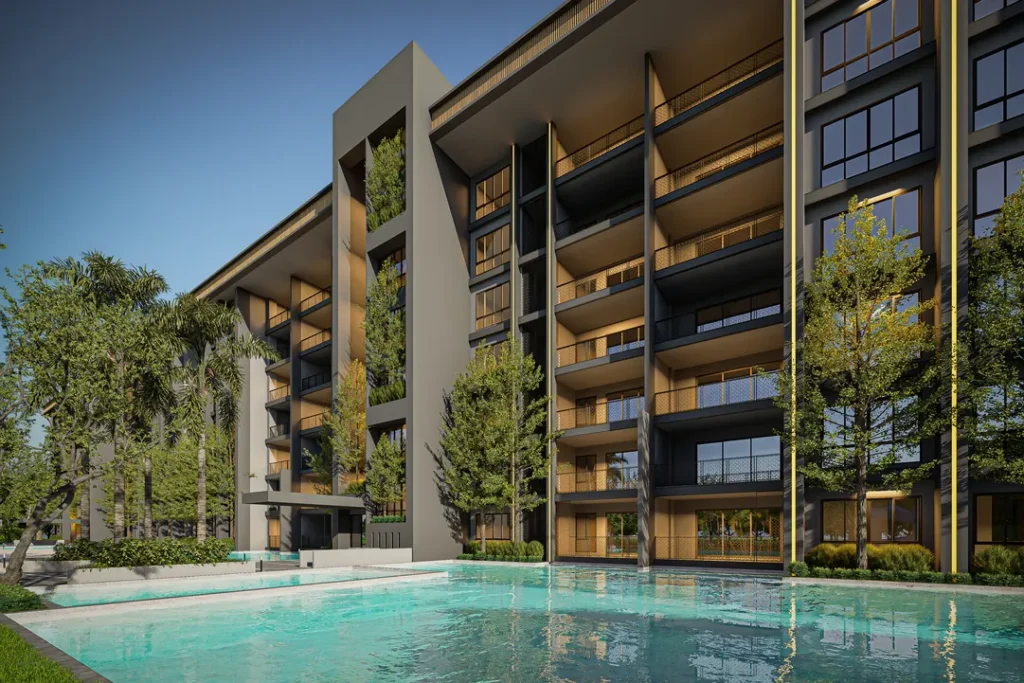
In a nutshell: What's the difference?
To put it very simply: for a foreigner Freehold In Thailand, this most often refers to ownership of a condominium unit in a registered condominium complex within the foreign quota, registered at the Land Office in the buyer's name. Leasehold — This is a long-term right to use a property or land. In the case of land or a villa with a plot, the owner of the land remains a Thai individual or legal entity. If the property in question is a leasehold unit in a building, it is necessary to determine separately who owns the building and on what basis the right of use is granted. In villa transactions, the structure may be mixed: the land is leased, while the rights to the building or specific property rights are registered separately.
For foreigners in Thailand, the situation is further complicated by the fact that the law restricts the right of foreign nationals to directly own land. This means that the same property—for example, a villa with a pool—may be offered either as a leasehold (where the land remains with a Thai owner), through a legal structure involving a Thai company, or, in rare cases, as a freehold with ownership rights limited to the building itself.
The situation is different for condominium units: there, foreigners can own units under full freehold—within the quota established by law.
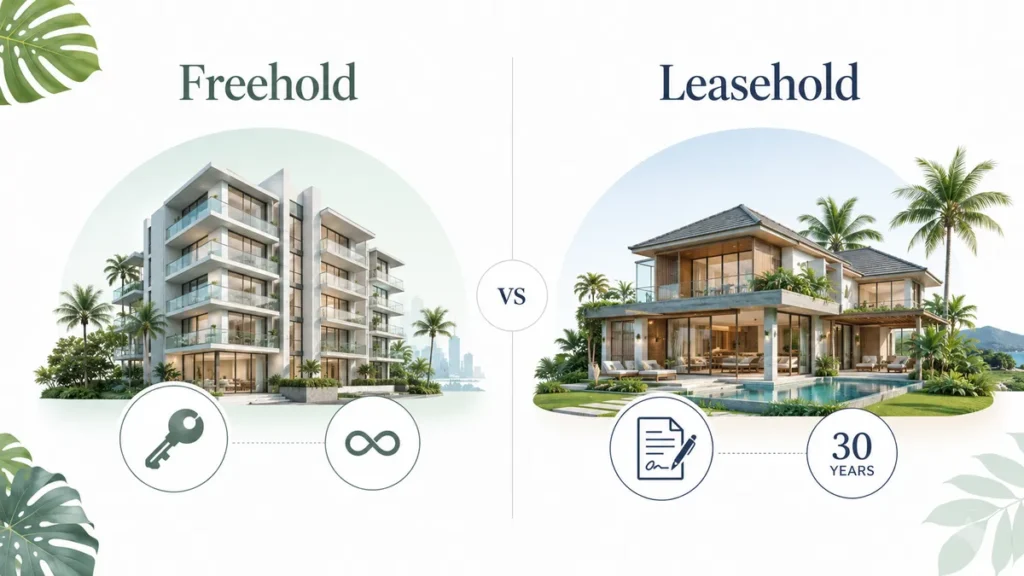
| Format | What the buyer receives | Where is it commonly found? | What to Check First |
|---|---|---|---|
| Freehold | Title registered in the buyer's name | Condominium Units (within quota 49%) | Condominium Status, Remaining Foreign Quota |
| Leasehold | Long-term registered right of use (lease) | Villas, houses, land, and some resort projects | Term of the Agreement, Renewal Terms, and Assignment Rights |
The main point here is this: Freehold is generally easier to understand for condominium units, because foreigners can be full owners within the quota. Leasehold is often used for villas and land-related properties—and in this case, it’s not the marketing term “Leasehold” that matters, but the specific terms of the contract. Neither format is inherently bad. It’s just that each requires its own approach to due diligence.
What Is Freehold?
In the context of Thailand, “freehold” refers to a property title registered in the buyer’s name with the Land Department. For foreign nationals, this most often means owning a unit in a condominium—this is the specific type of real estate that the law explicitly permits foreigners to own.
How Freehold Works for a Condo Unit. When purchasing an apartment in a registered condominium under the foreign quota, ownership is registered in the foreign buyer’s name at the Land Office and confirmed by a separate title deed for the unit—the condominium unit title deed, often referred to as Or Chor 2 / Or. Chor. 2. This document records the unit’s details, floor area, the owner’s name, and the owner’s share of the building’s common property.
It is important not to confuse this document with the Chanote (Nor Sor 4 Jor) land title. The Chanote pertains to the land parcel, whereas Or Chor 2 certifies ownership specifically of an apartment in a condominium. The buyer of an apartment does not become the individual owner of the land beneath the building, but receives a share in the common property of the condominium proportional to their unit.
Freehold title has no expiration date. It can be inherited, sold, and transferred—in accordance with applicable law. The availability of a mortgage or financing for a foreigner depends on the specific bank, the property, and the terms of the transaction. This is a key difference between freehold and leasehold, where everything is determined by the lease agreement.
What is a foreign quota? According to Thailand's Condominium Act, Foreign nationals and foreign legal entities subject to Section 19 may not own more than 49% of the total area of all units in a specific condominium. The remaining portion of the market is commonly referred to as the “Thai quota”—this is not a separate form of ownership, but rather the portion of the condominium’s total area that cannot be registered in a foreign buyer’s name as “foreign freehold” beyond the limit established by law. The quota is calculated based on area, not the number of units—this is an important distinction. A single large unit owned by a foreigner “counts” for more than several small ones.
What happens when the quota is filled. If the foreign quota for a specific condominium has been exhausted, a foreigner will not be able to purchase the selected unit under a foreign freehold title. In practice, there are several options: choose another unit or a project with an available quota, consider a leasehold under the Thai quota, or walk away from the deal. You should not accept the phrase “almost the same,” because the rights under foreign freehold and leasehold differ fundamentally. In the same building, some units may be sold as freehold (under the foreign quota), while others may be sold only under different ownership structures.
A freehold apartment does not mean ownership of the land. This point often causes confusion. A foreign buyer acquires ownership of a specific unit in a registered condominium and a share in the common property. The land and common property are part of the condominium structure, and the apartment owner holds a share in this property proportional to their unit—but does not acquire individual ownership of the land parcel. This is the standard structure for a registered condominium, but it cannot be applied to villas and houses. For villas and single-family homes, the issue of land ownership is fundamental.
What to Check for a Freehold Apartment:
- Does the building have official condominium status under the Condominium Act—has the property been registered in accordance with established procedures;
- Is there any remaining foreign quota for a specific unit?;
- Has a separate title deed been issued for the apartment in the condominium (Or Chor 2), and do the details regarding the unit, square footage, and owner match?;
- Do the documents specify that the quota is allocated specifically for a foreign buyer?
- To register a foreign freehold condo for a foreign buyer, it is generally necessary to confirm that the funds were transferred to Thailand from abroad in foreign currency: either via a FET form or a bank transfer confirmation (credit note), depending on the amount and the requirements of the bank or the Land Office. It is recommended to specify the purchase of real estate and the property details in the payment description;
- What are the monthly common area fees and sinking fund contributions?;
- Are there any restrictions on renting out an apartment on a short-term basis?
What Is a Leasehold?
A leasehold in Thailand is a registered long-term right of use or lease. The buyer does not own the property or the land; instead, they use them for a fixed term under a contract with the actual owner. According to The Civil and Commercial Code of Thailand (Section 538)If a real estate lease is entered into for more than 3 years, it must be drawn up in writing and registered with the competent authority—otherwise, it will be enforceable only for a period of up to 3 years. Registration enhances the tenant’s protection, including in the event of a change in ownership, but the specific consequences depend on the terms of the agreement and the registered rights: without registration, a long-term lease remains an agreement solely between the two parties.
For standard real estate leases, the term is typically registered for up to 30 years; special provisions for specific commercial cases must be verified separately. Upon expiration, the lease may be renewed—provided there is a corresponding clause in the agreement and the owner consents. Renewal does not automatically convert the initial 30-year term into a registered right for 60 or 90 years: the legal validity of such a promise depends on the wording of the agreement, the parties involved, and whether the landowner has changed.
Why is a leasehold common for villas and houses? Since foreigners, according to Thai land laws In most cases, foreigners cannot directly own land; a villa with a land plot is typically offered under a leasehold arrangement: a foreigner leases the land from a Thai owner for 30 years, while ownership of the building (structure) can be registered separately. This is precisely why the term “Leasehold” appears so frequently in villa projects—it is not a restriction imposed by a specific developer, but rather a reflection of the general legal situation in the country.
The 30+30+30 formula and what it means in practice. Many developers advertise villas using phrases such as “30+30+30 years” or “90-year leasehold.” This means that the contract includes provisions for two additional extensions of 30 years each—for a total of up to 90 years. Such a promise may not automatically bind the new landowner, unless it is properly documented and protected—for example, when the property changes hands. The renewal is recorded as an intention, but ensuring its enforcement in practice can be difficult. This does not mean that such arrangements are pointless—they are widespread in the villa and resort real estate market. The Land Office typically registers the initial lease term, while subsequent periods require separate documentation and depend on how legally enforceable the promise of renewal is. You should read the contract very carefully and not treat marketing claims as legal guarantees.
Example of a villa buyer. Imagine a buyer comparing two offers on Koh Samui: Villa A is offered on a 30-year leasehold with a clause allowing for renewal “by mutual agreement,” while Villa B is offered through a Thai company in whose name the land is registered. In the first case, it is important to understand who owns the land, what the renewal terms are, and what happens to the right of use if the land changes hands. In the second case, the structure involving a Thai company requires a separate legal review: it is necessary to understand the shareholder structure, the source of control, the company’s actual business activities, the absence of nominee risks, and compliance with Thai land laws. Both options require a professional legal review, not a decision based on a brochure.
Transfer of Rights, Inheritance, and Resale Under a Leasehold. These are three separate points to check in the contract:
- Assignment of Rights: Can a leasehold be transferred to a third party without the landowner's consent? Not always. In some contracts, this is expressly prohibited or requires the lessor's written consent.
- Inheritance: What happens to the lease after the tenant's death? Under Thai law, the inheritance of a leasehold is not automatically guaranteed unless it is specified in the contract.
- Resale: It is more difficult to sell a property held on a leasehold basis than one held on a freehold basis—the buyer looks at the remaining lease term. If 10 years out of 30 have passed, and the lease has not been renewed or extended, the next buyer will typically base their decision on the remaining 20 years of the lease.
A leasehold is a common and widely used form of land-related property, but it cannot be judged by its name alone. Key parameters include registration, term, renewal conditions, and rights of assignment and inheritance. Since a leasehold can be viewed as a personal contractual right of the lessee, inheritance and assignment must be explicitly verified in the contract. A leasehold should be evaluated based on the contract, not on a promotional presentation.
Foreign Quota and Restrictions on Foreigners
The foreign ownership quota in a condominium isn’t just a rule that everyone knows about. It’s a dynamic factor that varies from building to building and from unit to unit. That’s exactly why “checking the quota” isn’t just a formality—it’s a crucial step before making a reservation.
How is the quota calculated? Under Thai law, foreigners may not own more than 49% of the total floor area of all residential units in a specific condominium. The remaining portion of the market is often referred to as the “Thai quota”—this is not a separate right granted to foreigners, but rather the portion of the area that cannot be registered under a foreign buyer’s name as a foreign freehold title in excess of the 49% limit. If the selected unit is not available under the “foreign quota,” the foreigner may be offered a leasehold structure, a different unit, or another transaction option—but the terms must be verified based on the specific project’s documentation. In such cases, a foreigner does not obtain ownership of the apartment, but only the right to use it for the duration of the lease.
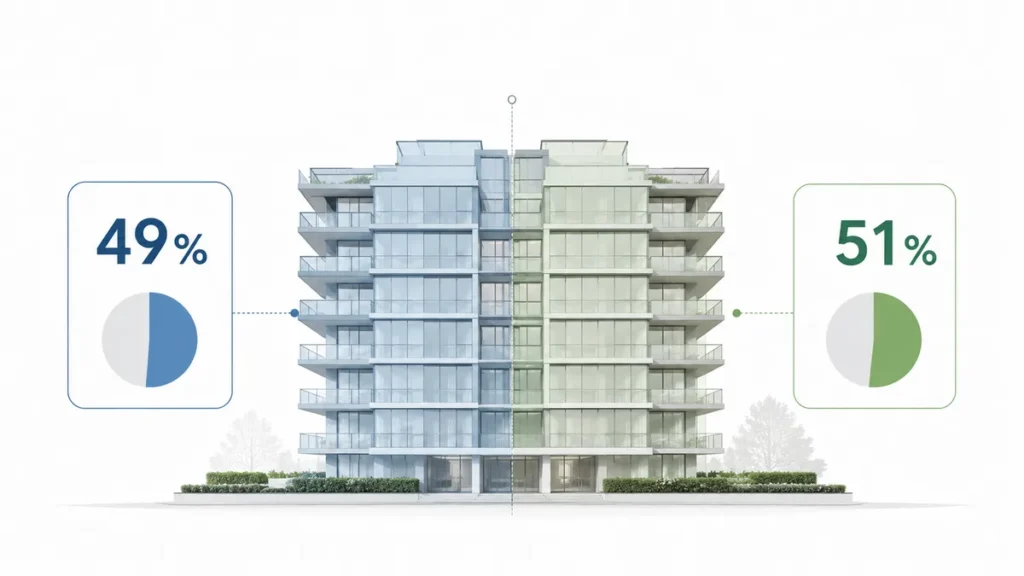
Why is it important to check this for each specific unit? Two adjacent units on the same floor in the same building may fall under different quotas. One is sold as a Freehold (the foreign quota is available), while the other is sold only as a Leasehold (the foreign quota is full). Externally, the units look the same, but their legal status is fundamentally different. If a seller or agent claims that “all apartments in this building are Freehold,” that’s a reason to ask for clarification.
What happens if the foreign quota is exhausted? If the foreign quota has been exhausted, it is not possible to register the selected unit in a foreigner’s name under a foreign freehold. In practice, the seller may offer a leasehold structure, another property with available quota, or an alternative option. Some projects initially offer foreigners a leasehold structure—especially if the building is not registered as a condominium or if the foreign quota is unavailable. It is important not to treat a leasehold as “the same thing”: the rights, term of ownership, and resale scenario will differ fundamentally.
Why foreigners cannot own land directly. Thai Land Code directly restricts The right of foreigners to own land. There are exceptions, but they are rare: for example, Section 96 bis of the Land Code provides for the possibility of owning land for residential purposes if an investment of more than 40 million baht is made in specified assets and with the minister’s approval. In practice, this is not a common route for the average buyer. This means that real estate tied to a land plot—such as a villa, house, or townhouse—requires a separate legal structure. In practice, one may encounter leasehold land, separate registration of rights to the structure, registration of superficies or usufruct, as well as structures involving a Thai company. The latter option must be examined particularly carefully due to nominee risks and restrictions under land legislation.
Ownership of a building and ownership of land are two different things. In some projects, a foreigner may own a property (house, villa) under freehold, while the land beneath it is leased from a Thai owner. This is not a contradiction—it is a legally permissible arrangement. However, when making a purchase, it is important to clearly understand exactly what you have ownership rights to and what you have only the right to use.
How to check your quota before a transaction. Confirming the availability of the foreign quota is not a mere formality that can be put off until later. You can request up-to-date quota information from the developer or seller; however, to verify it yourself, you’ll typically need to contact the Land Office directly or consult a lawyer who can submit an official request. For new-construction projects, the developer is required to track the remaining foreign quota—ask for written confirmation rather than a verbal assurance. In the secondary market, the quota is verified on a unit-by-unit basis: you need to ensure that the unit is registered under the foreign quota, not the Thai quota. It is usually not possible to “reserve” a quota in advance for a specific buyer—it is finalized upon registration of the transaction. Therefore, if the quota is limited, you should not delay the verification and registration process.
Questions to Ask Before Booking:
- Does the building have official condominium status under the Condominium Act? Has the property been registered in accordance with the established procedure?
- What is the current foreign occupancy rate for this building—what percentage is already occupied?
- Is this specific unit for sale as a freehold (foreign quota) or a leasehold (Thai quota)?
- Who owns the land—an individual or a company?
- Is there a registered Chanote for this plot of land?
- What are the terms for renewing a lease if the property is a leasehold?
- Is it possible to assign a lease to a third party?
- What are the rules regarding short-term rentals in this project?
Freehold vs. Leasehold: A Detailed Comparison
Below is a comparison table of key parameters. Its purpose is not to declare one format “the best.” Its purpose is to show exactly what factors you should keep in mind when making your choice.
| Criterion | Freehold | Leasehold | Practical Conclusion |
|---|---|---|---|
| Type of Right | Ownership | Long-term right of use (lease) | Freehold typically grants a more direct right of ownership to the unit; leasehold depends on the contract, registration, and the rights of the landowner |
| A typical object | Condominium Unit (Foreign Quota) | Villas, houses, land, and certain units in a condominium (Thai quota) | The object type largely determines the available format |
| Term | Indefinitely | Usually 30 years, with the possibility of extension | For long-term investments, the time horizon matters |
| Registration | Or Chor 2 (condo unit title deed) in the buyer's name | The lease agreement is registered with the Land Department | Both formats must be registered—please verify that they have been registered |
| Resale | All other things being equal, it is clearer to the next buyer—who receives full title to the property | It's more complicated—the buyer only gets the remaining lease term | Actual liquidity depends on location, price, and demand |
| Inheritance | It may be included in the estate, but a foreign heir must meet the requirements of the Condominium Act | It depends on the terms of the contract; it is not always automatic. | In both cases, it is best to plan your estate in advance with a lawyer |
| The Land Issue | The land on which the condominium stands is not owned by a foreigner | The land remains in the possession of the Thai owner | In most cases, foreigners cannot directly own land |
| Risk Level | Below are the rates for condominium units with the correct quota | It depends on the contract, registration, the landowner, and the terms of the transfer of rights | Leasehold requires a more thorough review of documents |
| A suitable scenario | An Apartment for Living or as an Investment in a Condominium | A villa or house where the land is key | The choice depends on the type of property, the purpose, and your readiness to handle the legal work |
Following this table, it is important to add one practical note: the terms “Freehold” and “Leasehold” used in a project’s advertising are a starting point, not a definitive answer. The actual legal status of a property is determined by documents: the condominium license, title deed, lease agreement, and registration records with the Land Department. That is precisely why any significant step—such as making a reservation, signing a contract, or transferring funds—must be accompanied by a review of the documents, not just a glance at a brochure.
What to Choose Based on Your Goal
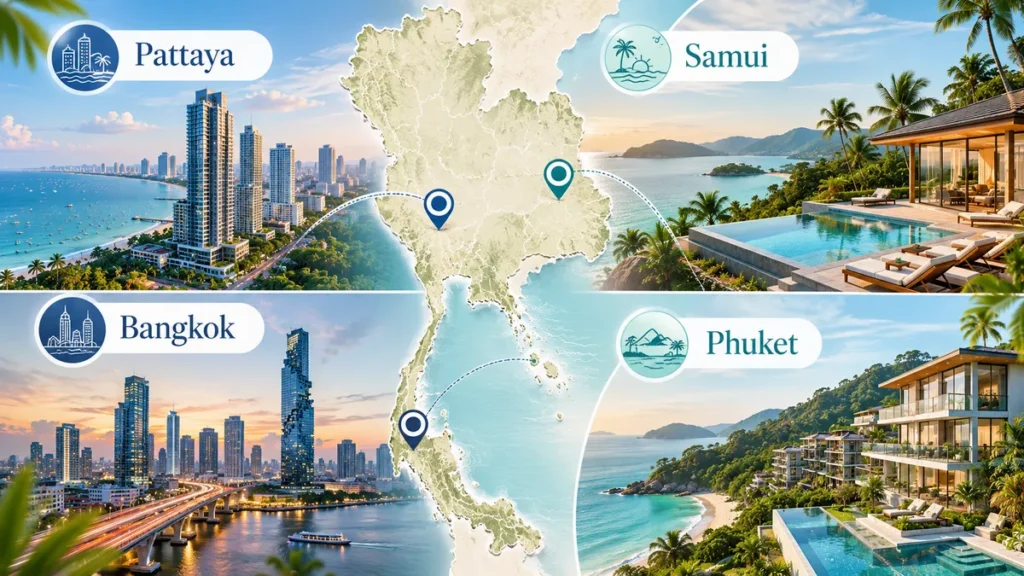
The right approach depends largely on why you are buying real estate in Thailand. Below are four practical scenarios.
For Life
If you are buying an apartment for personal use—whether as a winter home, a permanent residence, or a second home—a freehold unit in a condominium is usually the most straightforward and secure option. Ownership of the unit is not limited by a lease term, and the main terms of the relationship are governed by the Condominium Act, the condominium bylaws, and the property’s documents—regardless of the landlord.
In major condominium markets, including Pattaya and Bangkok, foreign buyers often consider freehold units, but the availability of the foreign quota must be verified on a project-by-project basis. This is a good choice for living: the ownership status is clear, and you have the freedom to use, rent out, or sell the property.
If, on the other hand, you want to live in a villa or house—on Koh Samui or Phuket, for example—then a leasehold becomes a realistic and common option. In this case, the key question isn’t “good or bad,” but “what kind of contract it is.” The term, renewal conditions, and the ability to transfer rights to heirs—all of this needs to be understood before making a purchase.
For investment
For an investor, exit liquidity is of fundamental importance. All other things being equal, a foreign freehold may be more appealing to the next buyer: they receive full ownership rights with no time restrictions, which broadens the pool of potential buyers. However, actual liquidity depends on location, price, the condition of the project, and demand. A leasehold property with a decreasing remaining lease term typically requires a more compelling justification for the price: the buyer will consider the remaining term, the possibility of assignment, and the feasibility of renewal.
That said, when it comes to rental income, the type of ownership is less important—location, the management company, and restrictions on short-term rentals are more significant. Both types of ownership are compatible with renting, but the rules must be verified on a property-by-property and project-by-project basis.
For the villa
Buyers of villas in Phuket or Samui often encounter leasehold arrangements because villas are typically tied to a plot of land that foreigners cannot own directly. This is not a reason to give up on the purchase, but it is a reason to examine the contract very carefully—and to understand exactly which structure is being used: a leasehold on the land, a separate right to the building, superficies, or something else.
For a villa, it is critically important to know: who owns the land, under what terms the lease is renewed, what happens to your rights if the land changes hands, and whether the contract can be transferred to heirs or assigned upon sale. In the real estate markets of Koh Samui and Phuket, the structures of villa transactions vary significantly even between neighboring developments—which is why a legal review is essential here.
For resale
If your strategy is to buy now and sell in 3–7 years, a freehold apartment in a condominium—all other things being equal—typically offers a clearer exit strategy: the next buyer receives full ownership without any remaining lease term. A leasehold property with a decreasing remaining lease term usually requires a more compelling justification for the price: the buyer will consider the remaining term, the possibility of assignment, and the likelihood of renewal. This needs to be factored into your exit strategy as early as the purchase stage.
| The buyer's goal | A more suitable format | Why | What to Check |
|---|---|---|---|
| Life in an Apartment | Freehold | Clear status, no time limit, no dependence on the landlord | Foreign Ownership Quota, Condominium Status |
| Life in a Villa | Leasehold (often the only option) | Land cannot be owned by a foreigner | Lease Agreement, Renewal Terms, Inheritance |
| Investments and Resale | Freehold (priority) | Higher liquidity in the secondary market | Quota, location liquidity, lease restrictions |
| Long-term stay in a villa | Leasehold with a thoroughly reviewed lease agreement | A properly drafted and registered contract can grant clear rights of use for the term of the lease | Term, registration, rights of transfer and inheritance, developer's reputation |
Documents and Transaction Verification
One of the most common situations that complicates the process of buying real estate in Thailand is when a buyer first makes a deposit and then begins to sort through the paperwork. The logic should be the other way around: Documents are verified before the deposit is made, not after.
This is especially important for foreign buyers who do not speak Thai, are unfamiliar with local registries, and are operating within an unfamiliar legal system. Below is a practical checklist of what to verify.

Checklist of documents to prepare before making a deposit:
- Condominium Status — Is the property registered as a condominium under the Condominium Act? Without official condominium status, a foreigner cannot obtain freehold title under the standard model.
- Confirmation of the Foreign Quota — What percentage of the foreign ownership quota is available at the time of the transaction in this particular building?
- Title Deed — For an apartment: Is there an Or Chor 2 (condominium unit title deed) for the specific unit? For land: What type of land title deed is used (Chanote, Nor Sor 4 Jor, or others)? It’s important to understand the difference: Or Chor 2 confirms ownership of the apartment, while Chanote confirms ownership of the land.
- Rights of the Seller or Developer — Who has the right to sell the property? Are there any encumbrances, liens, or legal disputes?
- Payment Route and Banking Documents — To purchase a property in Freehold, a foreigner generally needs to transfer funds into Thailand from abroad and obtain a FET (Foreign Exchange Transaction Form). How exactly is the payment processed?
- Leasehold Agreement — If the property is being sold on a leasehold basis, review the full text of the lease agreement: the term, renewal conditions, consequences of a breach, and transfer rights.
- Landowner Information — Who physically or legally owns the land? Is it an individual or a company? What is the history of this right?
- Wording regarding the extension — How exactly is the lease renewal worded? “By mutual agreement” and “automatically” are fundamentally different phrases.
- Rights of Transfer and Inheritance — Can a lease agreement be assigned? What happens to the right to use the property after the tenant’s death?
- Common fees and sinking fund — How much are the monthly dues? Is the sinking fund sufficient to maintain the building?
- Rental Restrictions — Is short-term rental permitted in the project? Is management through a property management company mandatory?
- Registration Fees and Deadlines — Who pays the transfer fee, stamp duty, and specific business tax? What is the timeline for the transfer of ownership?
Thaicost helps buyers find a property, compare ownership structures, and formulate the right questions for a legal due diligence review—including when communicating with Thai lawyers. This is not a substitute for an independent legal due diligence review, but it is an important part of a sound approach to Selecting Real Estate in Thailand.
Common Mistakes Made by Buyers
Most problems that arise when buying real estate in Thailand are not due to a lack of knowledge about the market, but rather to a few common mistakes made during the process. Here are the most common ones.
Choose based solely on price. A less expensive leasehold unit may seem like an attractive alternative to a freehold apartment in the same building. But price is just one factor among many. The remaining lease term, renewal conditions, transfer rights, and liquidity in the secondary market collectively determine the property’s true value.
Trusting the term “Freehold” without checking the condominium’s status. A developer may refer to a building as a “condominium” and use the term “Freehold” in marketing materials, but if the building is not legally registered as a condominium under the Condominium Act, it is not possible to sell a full freehold unit to a foreigner under the standard model. The marketing term “condo” and the official status of a condominium are not the same thing. A word in a brochure does not equate to legal status.
To assume that “30+30+30” is automatically guaranteed. The "three 30-year periods" formula is often used in villa advertisements. However, in most cases, the second and third periods depend on the terms of the contract and the landlord’s consent—they are not automatically guaranteed by law. Read the contract, not the advertising brochure.
Ignore the exit strategy. Before buying, it’s worth asking yourself: How exactly will I sell this property in 5 or 10 years? Who will I be able to sell it to? How long will the remaining lease term be? How active is the secondary market for this project?
Do not check the rental terms. If a property is being purchased for rental purposes, it is essential to review the project’s internal rules. Short-term rentals may be restricted by condominium rules, licensing requirements, and local regulations. Therefore, you need to review not only the lease agreement but also the rules of the legal entity or management company—this directly affects your actual return on investment.
Pay the deposit before your documents are verified. The most costly mistake. A deposit in Thailand isn't always refundable if the buyer changes their mind after signing. Check the documents before transferring the money.
Comparing Pattaya, Koh Samui, Bangkok, and Phuket using a single template. These are four fundamentally different markets, each with a distinct demand structure, different types of properties, and different legal practices. What works in Pattaya isn’t always applicable to Koh Samui. The local context matters.
Key Findings
- Freehold — the most straightforward structure for condominium units within the foreign quota: ownership is registered in the buyer’s name with no expiration date.
- Leasehold It can work well—especially for villas and properties with land—but the lease agreement is crucial. You shouldn't make a purchase decision without carefully reviewing it.
- In most cases, foreigners cannot directly own land in Thailand. This is the main reason why villas and houses are sold through leasehold arrangements or Thai legal structures.
- Foreign quota (49%) It is determined on a building-by-building and unit-by-unit basis—it is not a one-size-fits-all figure and changes as units are sold within the project.
- Terms and Conditions for Renewal, Transfer of Rights, and Inheritance With a leasehold, it’s not the fine print that matters, but the key terms of the transaction. With a freehold, you also need to plan for inheritance: a foreign heir must meet the requirements of the Condominium Act.
- All other things being equal, a freehold apartment It may be clearer to the next buyer, but actual liquidity depends on location, price, and demand in the secondary market.
- The best choice depends on the purpose, the type of property, the region, and the documentation — not because of the marketing buzzwords in the brochure.
How to Make a Well-Considered Decision
Freehold and Leasehold aren’t just marketing terms or abstract legal categories. They are specific rights that determine what you’ll be able to do with a property in a year, in five years, and in twenty years. The right option depends on exactly what you’re buying, in which region, under what terms, and for what purpose.
A freehold condominium unit within the foreign ownership quota is a straightforward and legally secure option for most buyers. A leasehold villa on Koh Samui or Phuket is a viable option, provided the contract is properly drafted and reviewed. Neither option is inherently bad, but each requires its own approach to due diligence.
Before making a deposit, it’s important to understand three things: what the property’s actual legal status is, what exactly is written in the contract, and who owns the land. Everything else is secondary.
Thaicost helps you compare properties in Pattaya, Koh Samui, Bangkok, and Phuket, understand ownership structures, and ask the right questions for a legal review. Whether you’re just starting to explore the market or have already selected a few properties to compare, request a consultation—we’ll help you sort things out before you make a decision.
This article is for informational purposes only and does not constitute legal advice. Thai real estate laws are subject to change, and the terms of specific transactions may vary significantly depending on the project, region, contract, and developer. Before signing any documents or transferring funds, it is recommended that you conduct an independent legal review with a qualified Thai attorney.
 Real estate in Georgia
 Real estate in Cyprus
 Real estate in UAE
 Real estate in Bali
 Real estate in Montenegro
 Real Estate in Spain
 Real Estate in Saudi Arabia
 Real Estate in Turkey
 Real Estate in Zanzibar
 +66 98 432 7651
 hello@thaicost.com
 Boat Lagoon Marina, 22/1 Moo 2, Thepkasattri Rd, Koh Kaew, Phuket 83000, Thailand



 Get TOP-7 catalog of objects