
 +66 98 432 7651


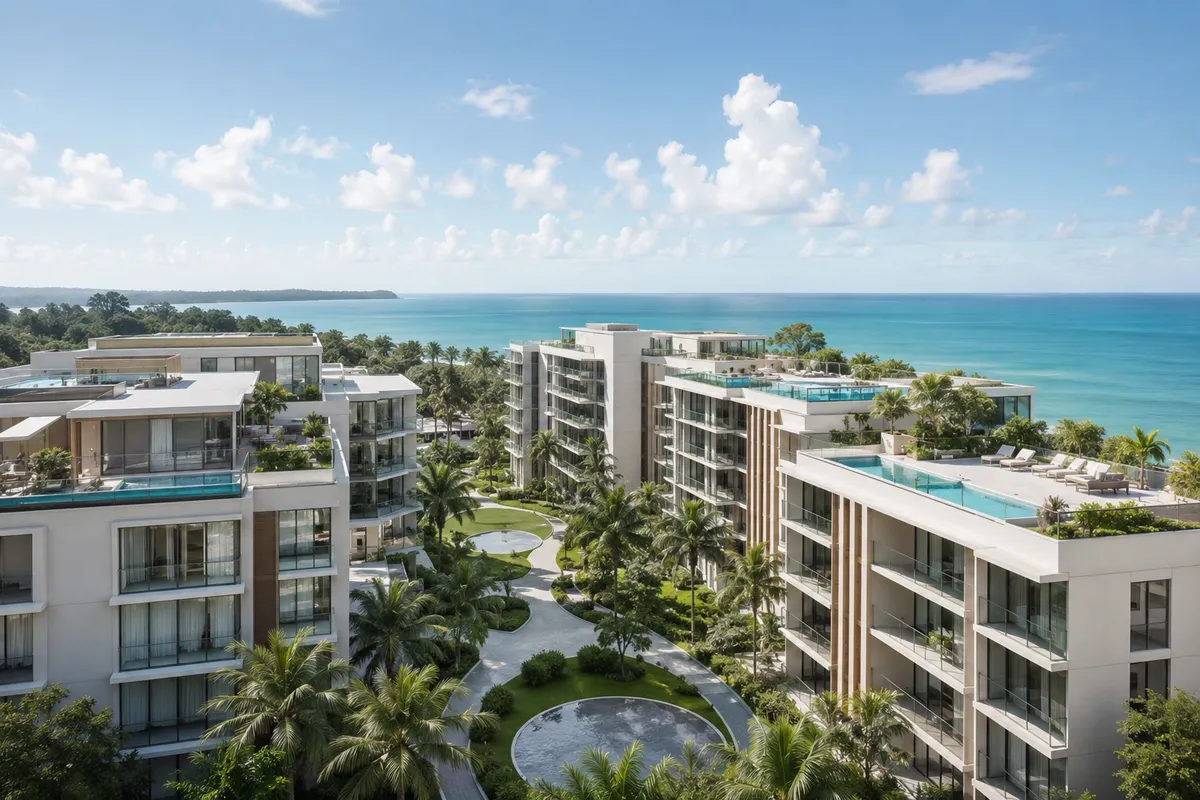
A foreign citizen can buy real estate in Thailand—and do so legally. However, the form of ownership depends on the type of property: buying a freehold apartment and buying a villa with land are fundamentally different transactions involving different legal instruments. It’s important to understand these differences before you make any payment.
This article systematically addresses all the key issues: exactly what foreigners are allowed to buy, the differences between freehold and leasehold, how the foreign ownership quota works, what properties are available in Pattaya, in Phuket and Koh Samui, what makes up the total transaction cost, how the registration process works, what to check before making a reservation, and which risks buyers most often underestimate. Thaicost works with properties in all three regions and, if necessary, can assist with selecting and vetting a specific property.
What Can a Foreigner Buy?
Thai law distinguishes between the right to a property and the right to the land beneath it. A foreign national is entitled to purchase an apartment in a registered condominium as freehold property—this is the most transparent form of ownership for a non-resident. Villas, single-family homes, and land parcels are available under different conditions: through leasehold, a corporate structure, or narrow legal exceptions.
It is important to understand another key point: a “condominium” and an “apartment” are not the same thing. A registered condominium is a building that has been officially registered under the Condominium Act, in which each unit has its own title deed. An “apartment building” is a building that legally belongs to a single owner and is rented out. A foreigner cannot purchase a separate unit in an apartment building as freehold property. This distinction affects the type of transaction, the form of title, and the documents you will receive upon completion.
The legal form of ownership must be determined before making a reservation, not after it.
Freehold apartment
A registered condominium is the only type of property in which a foreign national is entitled to obtain full ownership (freehold) of an individual unit. This right is confirmed by a Condominium Unit Title Deed registered in the owner’s name.
The law sets a limit: Foreigners may own, in freehold, no more than 49% of the total area of all condominium units registered as foreign-owned property. This refers specifically to the total area, not the number of apartments: if a complex has 100 apartments of 30 m² each and one penthouse of 300 m², the quota is calculated based on the total area of all units. The remaining 51% of the condominium’s area must be owned by Thai citizens or legal entities permitted by law. This is called foreign quota — foreign quota.
We’ve covered more details about how the 49% limit works, how to check quota availability, and what to do if the quota is already full in a separate article titled “Foreign Quota in Thailand".
You should check the quota for a specific project: in popular resort complexes, it may already be filled. Before closing the deal, it is recommended that you obtain written confirmation of the availability of the foreign quota from the developer, seller, or the condominium management organization. For more information on the restrictions and conditions governing ownership of units in a condominium, please refer to the official guide. Thailand Board of Investment.
Freehold ownership of an apartment gives the owner the right to participate in the management of the condominium’s common property, to sell the apartment, to bequeath it, and to rent it out—within the limits established by the rules of the specific complex and applicable law. The right of inheritance is preserved; however, to register ownership, a foreign heir must meet the requirements of the law governing foreign ownership of condominiums—otherwise, there may be an obligation to sell the property within a specified period. When purchasing under the foreign quota, you must provide a bank document confirming the transfer of funds from abroad; without it, registration with the Land Office is not possible.
Leasehold Real Estate
A leasehold is a long-term lease of real estate, not a right of ownership. Under Thai law, the maximum term that can be registered with the Land Office is 30 years. However, a lease agreement with a term exceeding three years must be in writing and registered in order to be enforceable beyond the first three years. An unregistered agreement with a longer term protects the tenant only for the first three years.
The "30 + 30 + 30" formula is often seen in the market, and developers present it as a 90-year ownership period. This is a promotional statement, not a legal guarantee. The first 30 years are registered with the Land Office and create a real encumbrance on the property. Subsequent renewals are not automatic: they depend on the terms of the specific contract, the landowner’s intent at the time of renewal, and applicable law. A promise of renewal in an advertisement or preliminary agreement is not equivalent to a right that has already been registered.
When evaluating a leasehold, it is necessary to separately verify the assignment of lease rights to third parties, the possibility of subleasing, the inheritance process, and the remaining lease term. The shorter the remaining term of the registered lease, the more difficult it is to resell the property and the lower its market appeal. The building and the land leasehold may be documented in separate agreements: it is important to understand exactly what you are acquiring in each specific case.
More About Freehold and Leasehold in Thailand
Choosing between freehold and leasehold requires an understanding not only of the legal nuances but also of the investment implications, the property’s liquidity, and inheritance issues. These aspects are discussed in detail in the article “Freehold and Leasehold in Thailand".
Land and a Thai Company
Foreign nationals are not permitted to directly own land in Thailand. The law provides for limited exceptions—for example, for certain investment structures—but these apply only under strict conditions and are not a universal solution for the average buyer.
In practice, foreigners most often use leasehold or corporate structures to own a villa with land, although the law also provides for other special mechanisms—usufruct, superficies, and certain investment schemes. Each of these requires a separate legal assessment. In the case of a corporate structure, such a company must engage in actual business operations and comply with legal requirements. Using a company solely to circumvent land ownership restrictions carries increased legal risks and is not a recommended practice. Nominee shareholders—Thai shareholders who are merely figureheads and have no actual involvement in the business—violate the law and create risks of asset loss, administrative sanctions, and legal disputes.
A corporate structure requires annual financial reporting, tax payments, and administrative expenses. Losing control of the company means losing control of the real estate. Purchasing a villa or a plot of land through any such structure requires an independent legal review—before signing any documents.
Buying real estate in Thailand does not automatically grant the right to a residence permit or citizenship.
Below is a comparison table of the three forms of ownership.
| Format | What the buyer receives | A typical object | Term or Nature of the Right | Key Documents | What to Check | The Main Risk |
|---|---|---|---|---|---|---|
| Freehold | Full ownership of the unit | Apartment in a registered condominium | Indefinitely | Condominium Unit Title Deed | Availability of the foreign quota, confirmation of funds transferred from abroad, requirements for the heir | The quota has been filled; the property is not a registered condominium |
| Leasehold | Registered Leasehold Interest | Apartment, villa, or building on leased land | Up to 30 years (first registered term) | Lease Agreement, Registration with the Land Office | Remaining term, renewal conditions, assignment, inheritance | Renewal is not guaranteed; liquidity decreases as the term expires |
| Corporate Structure | Control through a Thai company—the landowner | Villa, land lot | Indefinitely (provided control over the company is maintained) | Company bylaws, shareholder registry, title deed for the land | Shareholder composition, nominal structures, tax obligations, and the company's actual operations | Nominee shareholders, loss of control, legal violations |
The choice of ownership structure determines not only legal protection but also the possibilities for resale, inheritance, and obtaining financing. Freehold ownership of an apartment in a registered condominium is the most straightforward option for foreign buyers. Leasehold ownership can be a sensible choice provided you have a clear understanding of the remaining term and the terms of the lease agreement. A corporate structure requires comprehensive legal and tax support from day one.
What to Buy and Where to Buy It

The region is chosen based on the intended use: living there permanently, visiting seasonally, renting it out long- or short-term, or reselling it in a few years—these are different strategies with different requirements for the property. The advertised rate of return cannot be the sole selection criterion.
Practical purchase scenarios to consider when selecting a property:
- Permanent residence — transportation accessibility, infrastructure, CAM fee, and property management are important
- Seasonal Housing — Property management while the owner is away, the option to rent out the property, and reliable utilities
- Long-term lease — stable demand, affordability, and a legally transparent rental agreement
- Vacation Rentals Through a Legitimate Management Model — hotel licensing, resort rules, contract with the management company
- Personal Use and Rental — flexibility between lease terms, condominium rules regarding subleasing
- Resale — the area's marketability, form of ownership, and remaining lease term
- Family Villa — legal structure of ownership, inheritance, and property maintenance
- A Condominium with High Market Liquidity — foreign quota, management company, sales history for the project
Pattaya
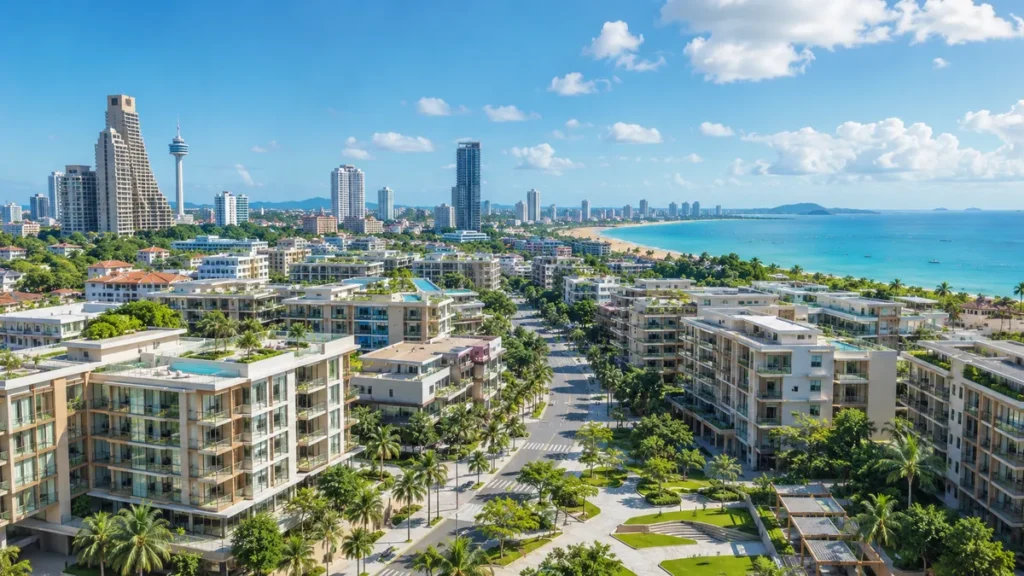
Pattaya is a city with year-round infrastructure, the largest selection of condominiums in the region, and steady rental demand. The city is located about a two-hour drive from Bangkok via the highway, which ensures a steady flow of tenants—both short-term and long-term.
The market varies by area: central locations, Beach Road, Jomtien, Pratamnak, and outlying residential neighborhoods differ significantly in terms of price levels, rental demand, and infrastructure. A wide selection of condominiums at various stages of completion means intense competition among projects—and this creates a risk of oversupply in certain locations, especially in the budget studio segment.
When buying, the property management company is key: the quality of management directly affects the complex’s maintenance, rental occupancy rates, and the building’s condition in 5–10 years. Real estate in Pattaya is characterized by a wide range of entry-level prices and ownership structures—it is easiest to find a property here with an affordable foreign ownership quota compared to other resort destinations.
Phuket

Phuket is a resort market with a higher entry barrier in certain locations and a diverse range of offerings: from compact condominiums set back from the beach to branded residences and premium-class beachfront villas. The key areas—Kamala, Bang Tao, Surin, Nai Harn, and Rawai—vary significantly in terms of the nature of the development, transportation accessibility, and the target tenant demographic.
The market is seasonal: peak demand occurs from November through April, and the off-season significantly reduces occupancy rates. This affects the actual rental yield, which must be calculated taking downtime into account, rather than based solely on data from peak months. The costs of managing a villa—including pool maintenance, landscaping, security, and shuttle service—are significantly higher than those for a condominium.
When buying property in Phuket, it’s worth taking a close look at beach access, the condition of access roads, and the distance to the airport. Guaranteed-return programs, which are often offered by developers, require careful scrutiny: it is important to understand whether the stated return is a fixed commitment or a projection, and under what conditions payments would cease. An exit strategy—whether resale or transfer of the property—should be planned in advance. Real estate in Phuket encompasses a wide range of properties—from studio apartments in condominiums to villas on hilly plots.
Samui
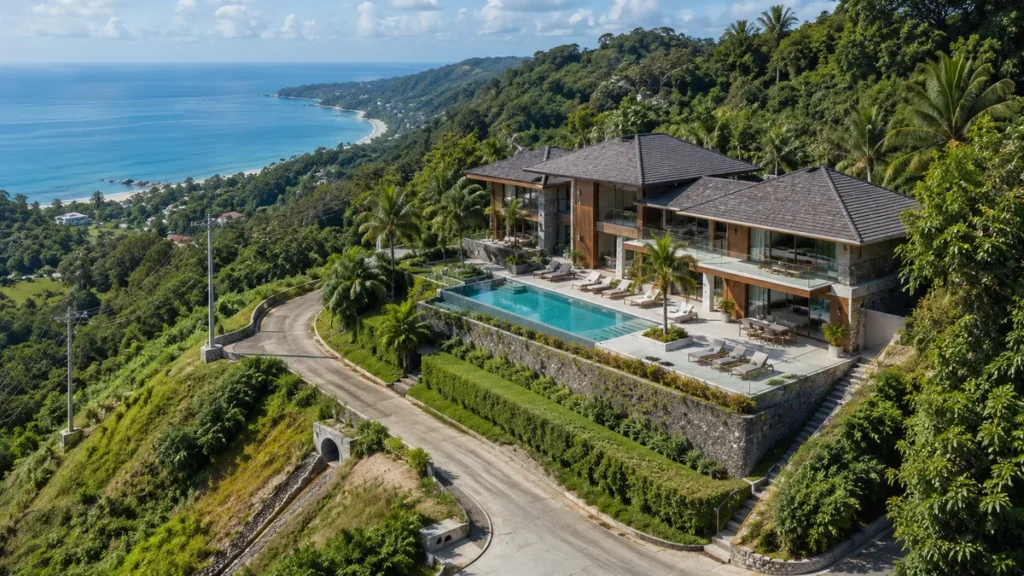
Samui is a market dominated by villas. This market focuses on privacy and lifestyle: there are fewer high-rise condominiums here and significantly more detached properties on sloping lots with views of the sea or mountains.
The island's topography and the scattered nature of its development raise specific engineering challenges that are less critical in other regions. Be sure to check before purchasing: the condition of the access road to the lot and its legal status (easement or private road), the availability and reliability of the water supply, the condition of the power line, the drainage system, and the geology of the slope. The building permit and land title are the key documents that should be requested first.
Maintenance costs for a villa in Samui include regular upkeep of the pool, garden, and roof—these expenses are higher here than in an urban condominium. In certain segments of the Koh Samui market, liquidity may be lower than in Pattaya or Phuket, especially for properties with non-standard locations or difficult access. Real estate on Koh Samui is the choice for those seeking privacy and who are prepared to conduct more thorough due diligence during the property inspection phase.
Below is a comparison of three regions based on key metrics.
| Region | Common Objects | Who is it for? | Nature of the Lease | Legal Spotlight | Complexity of the content | Liquidity | Key Risks |
|---|---|---|---|---|---|---|---|
| Pattaya | Condominiums, Apartments | For investors, those relocating, and the rental business | Long-term, mixed | Foreign quota, management company | Average | High in liquid projects | Oversupply, Quality of Management |
| Phuket | Condominiums, villas, branded residences | For those seeking a resort lifestyle, investors | Short-term, seasonal | Leasehold villas, rental program, EIA | High for villas | Medium to high in prime locations | Seasonality, management expenses, guaranteed return risks |
| Samui | Villas, bungalows, and standalone condominiums | Lifestyle shoppers who value privacy | Primarily short-term | Land title, access, permits | High | It depends on the location and type of facility | Infrastructure, accessibility, and resale challenges in niche segments |
A comparison of regions shows that there is no single “best” option: it all depends on the use case, willingness to incur maintenance costs, and the investment horizon.
Total Purchase Budget
The price listed in the developer’s price list is just a starting point. The actual budget for the purchase includes several categories of expenses, which often total between 5 and 10%—or more—of the property’s value, and in some cases even more.
Expenses Prior to Registration: reservation deposit (booking), scheduled contract payments (for off-plan new construction), advance payments for resale transactions, bank fees for international transfers and currency conversion, and the services of an independent attorney.
Transfer Expenses: transfer fee (registration fee for the transfer of title — standard 2% of the estimated value, as determined by the Land Department; the allocation between the buyer and seller is specified in the contract), lease registration fee — 1% when registering a long-term lease, Stamp Duty upon lease registration—0.1% (total for leasehold—approximately 1.1%), costs for property inspection, furniture, and appliances, water and electricity meters—approximately 10,000–20,000 baht for installation or re-registration, and a sinking fund—a one-time contribution to the condominium’s reserve fund.
Annual maintenance costs: CAM fee (Common Area Maintenance Fee), utility bills, insurance, repairs and maintenance, and lease management.
Rental Expenses: tax on rental income, management company expenses, reserve for downtime between tenants.
Selling Expenses: Specific Business Tax (SBT) — 3.3%, including any local surcharge, if applicable; Stamp Duty — 0.5%, if SBT does not apply (these two fees are not usually charged simultaneously); withholding tax; and an agency commission upon resale.
According to industry reports from 2026, the estimated maintenance costs are as follows:
- Sinking fund — 400–800 baht per m² (one-time fee; the rate is determined by the specific project and is not a government-set rate)
- CAM fee — for large-scale projects, it often ranges from 40–80 baht per m² per month; in premium and branded complexes, the rate may be significantly higher (the rate depends on the infrastructure: the presence of a pool, security, elevators, a shuttle service, and landscaping services increases costs)
- Electricity — about 4–5 baht per kWh; for a one-bedroom apartment with frequent use of air conditioners—approximately 1,500–3,000 baht per month
- Water — about 30–40 baht per m³, approximately 150–300 baht per month
All of the figures listed are approximate. Actual rates depend on the project, the management company, and actual consumption. Before purchasing, it is important to find out who issues the bill—the state-owned utility or the management company—since rates may vary. The CAM fee may be charged in advance; some developers require payment for one or more years in advance.
This is a preliminary estimate, not a commercial offer.
An apartment with an area of 40 m², price — 5,000,000 baht, freehold under the foreign quota; for simplicity’s sake, we’ll assume that the Land Department’s appraised value is also 5,000,000 baht:
- Transfer fee 2% — 100,000 baht (prior to distribution among the parties under the contract)
- Sinking fund at a rate of 400–800 baht/m² — 16,000–32,000 baht
- CAM fee at a rate of 40–80 baht/m²/month — 19,200–38,400 baht per year
Additional costs may include: meter installation fees (10,000–20,000 baht), bank transfer and currency conversion fees, legal services, property acceptance, furniture, and insurance. The actual estimated value may differ from the transaction price. The developer may cover part of these fees—this is subject to negotiation and is specified in the contract. The calculation does not include the seller’s taxes. Before making a reservation, request a customized quote for a specific unit.
Below is a summary table of expenses.
| Consumption | When it happens | One-time / recurring | Landmark | Who is exhibiting? | What to Check |
|---|---|---|---|---|---|
| Reservation Deposit | When booking | One-time | Under the terms of the project | Developer / Seller | Returnable, Recipient, Purpose |
| Transfer fee | When registering | One-time | 2% of the estimated value | Land Office | Who Pays Under the Contract |
| Lease Registration Fee | When registering a leasehold | One-time | 1% of the total rent | Land Office | Applicability to the object type |
| Stamp Duty (Rental) | When registering a leasehold | One-time | 0,1% | Land Office | Applies in conjunction with the lease registration fee |
| Sinking fund | When transferring / purchasing | One-time | 400–800 baht/m² | Management Company | Whether the seller has any outstanding debt |
| CAM fee | Monthly | Regular | 40–80 baht/m²/month for mass-market projects; higher for premium complexes | Management Company | Advance Period, Infrastructure |
| Utility Bills | Monthly | Regular | By consumption | Government Supplier / Management Company | Who issues the invoice? |
| Insurance | Every year | Regular | It depends on the object | Insurance Company | Coverage, Exclusions |
| Lawyer | Before Registration | One-time | Under the contract | Independent attorney | Independence from the developer |
| Resale Expenses | When selling | One-time | SBT 3.3% or Stamp Duty 0.5% | Revenue Department | Applicability to a Specific Transaction |
Once the contract has been signed, it is difficult to change the allocation of expenses between the parties. A written breakdown of costs for a specific unit—provided before the reservation is made, not after—helps avoid unpleasant surprises when the property is handed over.
How the transaction works
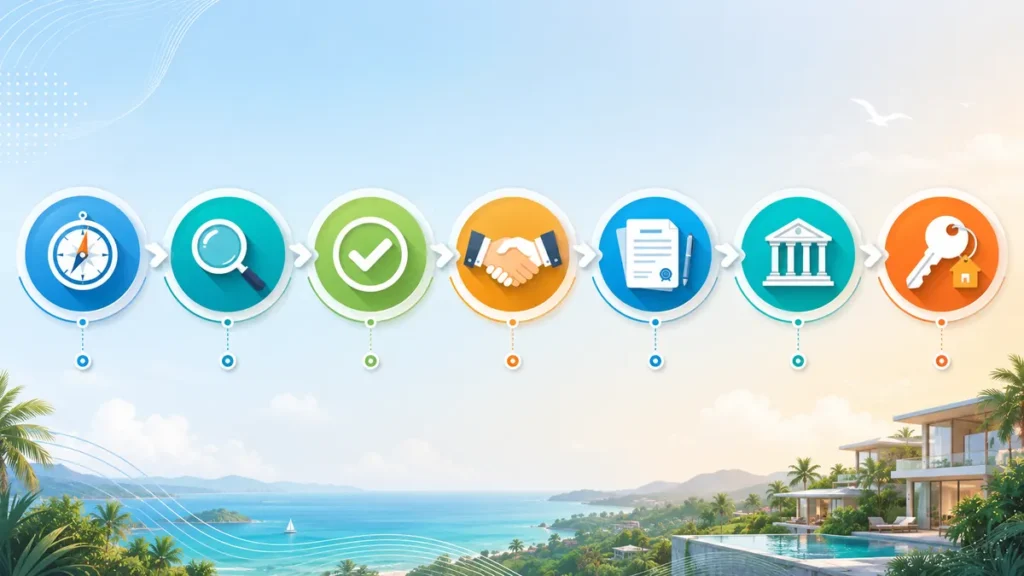
The process of buying real estate in Thailand consists of seven consecutive steps. These steps are generally the same for new construction, completed properties, and the resale market, but they differ in terms of the specific checks and documents required.
Step 1. Defining the goal, budget, and form of ownership
Before viewing properties, you need to answer four questions: why are you buying (to live in, to rent out, as an investment, or to resell); in which region; what is your actual budget, including all associated expenses; and what form of ownership is appropriate for the type of property you’ve chosen.
The type of ownership—freehold or leasehold, condominium or villa held through a corporate structure—must be determined before viewing properties, not after. This affects the list of documents to be reviewed, the process for transferring funds, and the team of professionals needed to handle the transaction. Without answers to these questions, any reservation is a risk.
Step 2. Property Selection and Initial Request for Documents
At this stage, we request floor plans, technical specifications, title documents, information on the availability of foreign ownership quotas, management terms, and the rental program (if applicable). For off-plan properties, we also request the building permit and the condominium’s status.
It is essential to review the documents before making a reservation: this is where discrepancies between the advertising and the property’s actual condition are identified. If the developer or seller does not provide the documents before you make a deposit, that’s already a red flag.
Step 3. Due Diligence Before Making a Reservation
This is the most important step—a detail that buyers often overlook in their rush to secure a property they like. Before making any payment, you must verify the legal entity of the developer or seller, the title to the property, the existence of any liens or encumbrances, the availability of a foreign buyer quota, the terms for refunding the deposit, and whether the contract matches the promotional materials.
For villas, the due diligence process is more extensive: additional documents are required, such as the land title, documents for the access road, and the building permit. The review is conducted by an independent attorney—one who is not affiliated with the developer or seller. For new construction, the legal review focuses on the contract and the developer’s company; for the resale market, it necessarily includes the title deed, encumbrances, and the property’s history.
Step 4. Signing the Reservation Agreement
The Reservation Agreement specifies the particular unit, price, reservation amount, deadline for signing the main contract, and deposit refund terms. The document may be drafted in Thai—a translation is required before signing.
The amount of the deposit and the timeframe leading up to the signing of the Sale and Purchase Agreement (SPA) are determined by the developer or seller: there is no uniform standard, and various terms and conditions exist in the market. A Reservation Agreement may be fully or partially non-refundable if the transaction falls through due to the buyer’s fault—it is essential to read and understand this condition before signing. Each condition is set forth in writing.
Step 5. Due Diligence and Finalization of the Main Agreement
After the reservation is made, an independent attorney conducts a comprehensive legal review of the property and finalizes the main contract—an SPA for a condominium or a lease agreement for a leasehold property.
The SPA must include: the exact unit number, square footage, and finish specifications; the payment schedule; the handover date; compensation for delays; refund terms in the event of termination; force majeure provisions; a warranty against defects; and management terms. For off-plan purchases, the procedure for modifying the design and specifications is also important. If a rental program is offered, its terms must be specified in the main contract, not just in promotional materials. The contract is drafted in Thai; the buyer should sign it only if a clear translation is provided.
Step 6. Transferring Funds and Receiving Bank Documents
The name of the person sending the transfer must match the buyer’s name as specified in the contract. The payment description should clearly indicate the purpose and nature of the payment—an error in the payment description may complicate the registration process.
To register a freehold property under the foreign quota, you will need a bank document confirming the receipt of funds from abroad in foreign currency—the format depends on the specific Thai bank and the amount of the transfer. Correspondent bank fees and currency conversion may reduce the final amount: transfer a little extra, or confirm the net amount to be credited in advance. Paying into the account of a third party who is neither the developer nor the seller and does not have verified authority poses a serious risk, from which even a verbal agreement offers no protection.
Step 7. Acceptance, Registration, and Transfer
The property is accepted prior to the final settlement: all defects are documented in writing, after which the developer or seller is required to correct them. It is not recommended to sign the transfer certificate until the issues have been resolved.
The registration of the property right takes place at the Land Office in the presence of both parties or their representatives acting under a power of attorney. A remote transaction is possible: the buyer prepares a power of attorney in accordance with the requirements of the issuing country and the Thai registration authorities—in some cases, consular legalization is required, while in others, an apostille is sufficient. The registration timeframe depends on the readiness of the documents, the workload at the Land Office, and the form of ownership—it would be incorrect to specify a fixed timeframe. Upon completion of registration, the buyer receives a Condominium Unit Title Deed or the corresponding document based on the form of ownership.
A real-life example.
The buyer selects a 35 m² apartment in a registered condominium in Pattaya, priced at 3,500,000 baht. The buyer requests written confirmation from the developer regarding the availability of the foreign quota, receives a floor plan with the unit number, and the building permit. An independent lawyer verifies the title deed for the building, the condominium’s status, and the terms of the Sales and Purchase Agreement (SPA). The buyer signs a Reservation Agreement specifying the conditions for the refund of the deposit and the deadline for signing the SPA. The buyer transfers the first payment in foreign currency from a Russian bank to the developer’s account and obtains a confirmation document from a Thai bank verifying the receipt of funds from abroad. Upon completion of construction, the buyer conducts a final inspection to document any defects, signs the transfer deed after the defects are rectified, and visits the Land Office together with a representative of the developer to register ownership. Receives a Condominium Unit Title Deed in their own name.
Documents and Site Inspection
Due diligence—the process of verifying the property and the legal soundness of the transaction—is not a mere formality, but an essential part of purchasing property abroad. A foreign buyer is not familiar with the Thai language used in legal documents and, as a rule, engages the services of lawyers to obtain and verify information from government registries. This is precisely why an independent lawyer is not a competitor to a real estate agent, but rather a separate professional role with distinct responsibilities.
The scope of the inspection depends on the type of property. An apartment in a completed condominium complex and a villa under construction on leased land require fundamentally different documents and different levels of expertise. The general principle is the same: Documents are requested before the deposit is made, not afterward.
New construction and off-plan
For a project under construction, the following are verified: the developer’s legal entity—company registration, the authority of the person signing the contract, and the absence of pending lawsuits and outstanding debts. Land title: type of title deed, absence of liens or mortgages in favor of the project’s lending bank—the presence of a lien requires additional legal review, as the lending bank’s rights may affect the project’s completion process in the event of the developer’s financial difficulties. A building permit and, if required based on the project’s scale, an Environmental Impact Assessment (EIA) report. Status of the future condominium: whether an application for registration has been submitted and what stage the review is at.
The SPA agreement must include: the exact unit number and its specifications, a floor plan, a specification of finishes and fixtures, a payment schedule by construction phase, the handover date and compensation for delays, the refund procedure in case of termination, the mechanism for changing specifications, and a warranty against defects. The rental program (guaranteed return program), if offered, must be part of the main contract, not merely included in promotional materials. The terms regarding the CAM fee and sinking fund must be set forth in writing.
There are offers on the market with stated annual returns of 7–10% for terms of 3–5 years. This figure alone does not confirm the investment appeal. We need to determine: whether the income is a fixed obligation under the contract or a projection; from which funds it is paid—from actual rent or from the property’s price; under what conditions the developer may terminate payments; and whether management, repairs, taxes, and downtime are included in the calculation.
Completed Properties and the Secondary Market
When purchasing a completed property or on the secondary market, the seller’s identity and authority are verified, the title to the unit or land, any encumbrances or liens, the availability of the foreign ownership quota at the time of the transaction, a certificate confirming the absence of CAM fee debt (debt-free certificate), outstanding utility bills, the legality of any renovations, the condition of the property and an inventory of furnishings (if sold furnished), current tenants and the terms of their leases, the contract with the property management company, and the possibility of renewing it.
For the villa, the following are additionally verified: the type and status of the title deed for the land, the type of land lease agreement and its remaining term, the title to the building (a separate document), the building permit, the existence of a legally established access road to the property (an easement or a private road with a documented right of way), water supply, electricity, drainage, and the plot boundaries.
Documents to request:
- Condominium Unit Title Deed (title deed for a unit) or title deed for a parcel of land
- Condominium Registration Certificate
- Building Permit
- The developer's corporate documents and the signatory's authority
- Written confirmation of the availability of a foreign quota
- Debt-free certificate (certificate confirming no outstanding CAM fees)
- Certificate of No Outstanding Utility Bills
- A copy of the SPA or lease agreement
- Rental Program — as an addendum to the main contract
- Payee's bank account information, along with proof of authorization
- For the villa: land lease agreement, building permit, access documents
Red flags:
- Pressure to deposit money immediately before the documents have been reviewed
- Refusal to provide the title deed or condominium status prior to booking
- Lack of written confirmation of the availability of a foreign quota
- Payment to a third party not affiliated with the developer or seller
- A promise of a guaranteed 90-year leasehold as a legal right
- Signs of a nominee structure when purchasing a villa through a company
- Discrepancies between advertising materials and the contract text
- Calculation of return on investment, excluding management costs, taxes, downtime, and personal use
- Lack of a legally established right of way to the villa or property
- Waiver of an Independent Legal Review
- The absence of clear, written terms and conditions for the return of the deposit
Payment, Taxes, and Registration
The form of ownership and method of payment must be determined before the first transfer, not during the process. This affects which documents the bank must prepare and what requirements the Land Office will impose during registration.
When transferring funds from abroad, the sender’s name must match the buyer’s name specified in the contract. The payment description should clearly reference the property, the contract, and the nature of the payment—an error in the payment description may complicate the subsequent registration process. A foreign currency transfer to a Thai bank account is recorded by the bank: to register freehold property under the foreign quota, you will need a bank document confirming the receipt of funds from abroad and their conversion. The specific format of such a document depends on the bank and the terms of the particular transaction. You can review the foreign exchange control regulations on the official website: The Bank of Thailand's Foreign Exchange Control Regulations.
Paying into the account of a third party—who is neither the developer nor the seller, whose rights are confirmed by documents—poses a serious risk. Correspondent bank fees may reduce the amount received by the recipient: transfer a little extra, or confirm the final amount with the bank in advance.
The main fees and taxes associated with the transaction:
| Fee / Tax | Rate | Who Pays? | When it happens | Note |
|---|---|---|---|---|
| Transfer fee | 2% based on the Land Department's assessed value | As specified in the contract: the buyer, the seller, or both | When registering a transfer of rights | The appraised value may differ from the transaction price |
| Lease Registration Fee | 1% of the total rent for the period | Under the contract | When registering a leasehold | Applies only to leasehold transactions |
| Stamp Duty (Rental) | 0.1% of total rent | Under the contract | When registering a leasehold | Charged together with the lease registration fee; total ~1.1% |
| Specific Business Tax (SBT) | 3.3%, including the local tax | Salesperson | When recording a sale | Does not apply to all transactions; see the Revenue Department's guidance for details |
| Stamp Duty (Sale) | 0,5% | Salesperson | When recording a sale | Applies only if SBT is not assessed; at the same time, the following are not collected |
| Withholding Tax | It depends on the seller's status | Salesperson | When registering | The calculation is different for individuals and legal entities |
| Land Tax and Property Tax | It depends on the type of use | Owner | Every year | The rate varies depending on whether the property is residential, commercial, or undeveloped |
| Tax on Rental Income | Depends on the taxpayer's status | Landlord | Upon Receipt of Rental Income | The calculation method is determined on a case-by-case basis |
- Transfer fee — The standard fee is 2% of the Land Department’s appraised value; this is a fee charged upon the transfer of title. Who pays it is determined by the contract: it is not uncommon for the parties to split the costs or for one party to bear them entirely.
- Lease Registration Fee — 1% of the total rent for the reported period upon registration of the leasehold
- Stamp Duty on the Registration of a Lease — 0.1% (1 baht for every 1,000 baht of total rent, as specified in Revenue Department's Stamp Duty Regulations); together with the lease registration fee, the total estimated cost for leasehold registration is approximately 1.1%
- Specific Business Tax (SBT) — 3.3%, including the local tax; applies primarily to the seller under certain conditions and does not apply automatically to every transaction; for more details, see Revenue Department's Explanation Regarding the Specific Business Tax
- Stamp Duty on the Sale — 0.5%; applies when SBT is not charged; these two fees are not usually applied at the same time
- Withholding Tax — Withheld from the seller upon registration; the amount depends on the seller’s status (individual or legal entity) and the structure of the transaction
- Land Tax and Property Tax — an annual tax; the rate depends on the type of use of the property
- Tax on Rental Income — arises when property is leased; the calculation method depends on the taxpayer's status
Different fees apply to different parties to the transaction. The law assigns some of the costs to the seller, some to the buyer, and some are allocated as agreed. You should not rely on advertising phrases such as “1% charges” or “all fees included” without a written breakdown. what exactly is included and who exactly pays for each item.
Temporary preferential rates, which are periodically introduced for certain categories of transactions, may change or be discontinued. The standard rates remain in effect in any case.
How to Complete a Transaction Safely
Buying real estate safely in Thailand involves a series of decisions, each of which is made with full awareness and documented in writing. First, you determine the purpose and intended use of the property. Then, you select the region and type of property. Determine the form of ownership—before even looking at price lists. Calculate the total budget, including associated expenses and annual payments. Request documents and conduct due diligence before making any deposit. Transfer funds in compliance with bank requirements and obtain supporting documents. Conduct the acceptance inspection and register the title at the Land Office. Keep the entire set of documents—the unit’s title deed, SPA, bank statements, and acceptance certificates.
Thaicost works with properties in Pattaya, Phuket, and Koh Samui. If you’re in the process of comparing properties or want to understand exactly what’s available under the foreign ownership quota for a specific project, please use selecting real estate in Thailand: You can compare several properties, check the availability of international quotas, get a full breakdown of payments for a specific unit, and request documents before booking.
This material is for informational purposes only and is not a substitute for individual legal, tax, or banking advice in Thailand.
 Real estate in Georgia
 Real estate in Cyprus
 Real estate in UAE
 Real estate in Bali
 Real estate in Montenegro
 Real Estate in Spain
 Real Estate in Saudi Arabia
 Real Estate in Turkey
 Real Estate in Zanzibar
 +66 98 432 7651
 hello@thaicost.com
 Boat Lagoon Marina, 22/1 Moo 2, Thepkasattri Rd, Koh Kaew, Phuket 83000, Thailand



 Get TOP-7 catalog of objects