
 +66 98 432 7651



Renting out a regular apartment in Thailand on a daily or weekly basis without the appropriate legal basis is risky: short-term paid accommodations may fall under the Hotel Act and require the establishment to operate as a hotel. Simply owning an apartment or listing it on Airbnb does not, in and of itself, grant the right to host short-term guests.
For investors, there are several fundamentally different models: a standard residential condominium with monthly rentals, a property in a hotel-licensed project, a rental program through a licensed operator, and the legally mandated framework for small lodging facilities. Below, we’ll explain how to distinguish between them and which documents to review. Before buying an apartment.
Direct answer: For a typical apartment in a residential condominium, renting it out on a daily basis in Thailand without the proper permits and without complying with building regulations creates legal risks.. That said, there are legitimate models—monthly leases and longer-term leases, projects with hotel licenses, and special arrangements for small properties. Which model applies to a specific apartment depends on the type of property, the condominium rules, the presence of a management company, and the structure of the lease agreement.
This article covers all levels: from the Hotel Act to the rules governing a specific building, from TM.30 to the practical realities of the rental market. After reading it, the reader should not only know that “there are restrictions,” but also understand exactly what to check before making a purchase or entering into a lease.
Is it possible to rent out an apartment by the day?
Here, we need to distinguish between several fundamentally different scenarios. A “yes” or “no” answer always applies to a specific location, not to Thailand as a whole.
A Brief Overview of the Main Scenarios
| Script | Short-term rentals (by the day / week) | What to Check First |
|---|---|---|
| A standard apartment in a residential condominium | Operating Without Permits — High Legal Risk | Hotel Act, Rules Governing Legal Entities, House Rules |
| Apartment in a development with a hotel license | Depends on the structure: operator, contract, specific facility | Who holds the license, and does it apply to this apartment? |
| Monthly rental / Rentals for a month or longer | As a rule, outside the hotel system, provided that the conditions are met | Contract terms, building rules, taxes, TM.30 for foreign residents |
| Villa / Single-Family Home | Separate Legal Analysis | Property Status, Permits, Type of Development |
| A property applying for small-scale lodging status | Requires verification for a specific object | Compliance with criteria, notification procedure, building regulations |
It is important to understand that this table is not a legal opinion, but rather a checklist of questions. The answers may vary for each specific property.
Daily Rentals in Thailand: Key Figures
| Question | What You Need to Know |
|---|---|
| Standard daily/weekly rental | It may fall under the Hotel Act and require the appropriate legal framework |
| Rentals for a month or longer | Hotel Act excludes from the definition of a "hotel" accommodations provided only on a monthly payment basis or for longer periods |
| "The 30-Day Rule" | A practical guideline; the law itself uses the criterion of “monthly paid accommodation” |
| Small Accommodation Facility | No more than 8 rooms and no more than 30 guests, provided that the established conditions and procedures are followed |
| TM.30 | Notification of a Foreign National’s Residence — Within 24 Hours of Arrival |
| Operating a hotel business without a license | Section 59 provides for up to 1 year of imprisonment and/or a fine of up to 20,000 THB, plus an additional fine of up to 10,000 THB for each day the violation continues |
| Rental income | For an individual, this is considered income under Section 40(5) of the Revenue Code; the tax is calculated based on the taxpayer's status and applicable deductions |
The penalty is specified in Section 59 of the Hotel Act: up to 20,000 THB and/or up to one year of imprisonment, plus up to 10,000 THB for each day the violation continues. TM.30—the official Immigration Bureau—confirms this within 24 hours.
Ownership of an apartment and the right to operate a hotel business there are not the same thing. Thai law distinguishes between these concepts, and it is precisely this distinction that forms the basis of the entire topic.
The situation is further complicated by the fact that, in practice, a single building may have multiple owners who rent out apartments on a daily basis through various platforms. The fact that neighbors are doing this does not mean that such activities comply with the law or the building’s rules. The mere presence of listings on these platforms does not confirm the legality of the activity. Official enforcement actions—including inspections conducted by Thai authorities—show that violations can indeed be prosecuted.
Why Is There a 30-Day Rule?
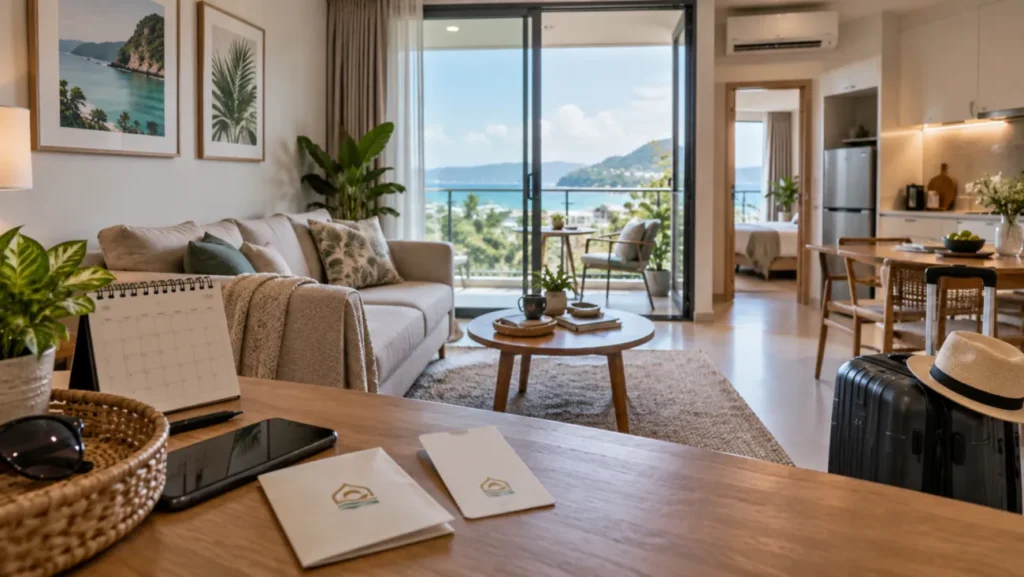
The key document on this topic is— Hotel Act B.E. 2547 (2004), the Thai Hotel Business Act. It regulates any activity that involves providing paid temporary lodging—regardless of what it is called or through which platform it is booked.
The logic behind the law is this: if a facility systematically accommodates guests for a short period of time in exchange for payment, this essentially constitutes a hotel business. Therefore, it requires an appropriate license (hotel license), which is issued to a specific operator for a specific facility.
Hotel Act does not establish a separate “29 days versus 30 days” rule. Section 4 excludes from the definition of a hotel any lodging provided only on a monthly payment basis or for a longer term. Therefore, in practice, residential condominiums tend to follow monthly rent — a lease of approximately one month or longer — is treated as a model that does not fall under hotel regulations. The “30-day” figure is a convenient practical market guideline, not a literal interpretation of the law. It’s best to review the specific contract template on a case-by-case basis rather than treating this number as a universal legal test. And in any case, a “monthly rental” does not exempt you from other obligations: building regulations, notification of foreign residents, and tax issues.
Airbnb is not a license
This is where investors most often confuse two concepts. Airbnb, Booking, and similar services are sales channels, platforms for finding housing. They are not regulatory agencies and do not issue any permits for hotel operations.
The ability to list a property on Airbnb does not confirm that a specific property is authorized to operate as a short-term rental.
The fact that the platform has accepted the listing does not mean that the property complies with Thai law, the rules of a specific condominium, or the terms of the management agreement. Verifying compliance is the owner’s responsibility, not the platform’s.
The Thai government has repeatedly identified the practice of renting out apartments on a short-term basis without the necessary permits as a violation. According to the Thai Department of Public Relations, the relevant inspections were conducted, and the Hotel Act (Sections 15 and 59) provides for penalties against individuals who operate a hotel without a license. This does not mean that every owner is inspected—but it does mean that the issue is not purely theoretical.
What penalties apply for operating without a hotel license?
The Hotel Act is not limited to the requirement to obtain a license. According to Section 59, a violation of the licensing requirement for a hotel business set forth in Section 15 may result in imprisonment for up to one year, a fine of up to 20,000 THB, or both penalties simultaneously. In addition, the law provides for an additional fine of up to 10,000 THB for each day the violation continues.
It is important to distinguish between the maximum penalty prescribed by law and the penalty imposed in a specific case. The mere fact that a notice was posted does not automatically result in the imposition of the maximum fine: the circumstances of the violation and the application of liability are considered by the competent authorities on a case-by-case basis.
For the buyer, the main takeaway is practical: the strategy of “I’ll start renting it out first, and if any issues arise, I’ll deal with them later” creates not only the risk of a conflict with a legal entity, but also the risk of violating the Hotel Act.
Are daily rentals actually inspected?
The ban should not be viewed as a purely formal regulation that exists only on paper. Thai authorities conduct inspections of short-term lodging facilities, and the Hotel Act provides the legal basis for holding operators liable for running a hotel business without the required license.
However, one should not jump to the conclusion that every report automatically leads to an investigation or a fine. The intensity of enforcement may vary by province and over time. For investors, however, another point is more important: an investment model should not be based on the assumption that violations are “usually overlooked.”
Don't want to review dozens of projects on your own? Please specify your budget, region, and preferred rental model—we'll find properties where you can check these details before making a purchase.
Get a selection of properties
Hotel License and Exemption for Small Establishments

Not every project in Thailand operates like a typical residential condominium. Some properties were originally designed as hotels or mixed-use developments— hotel-licensed residence or branded residence with hotel management. The difference is fundamental.
In such a project, a hotel license is issued hotel business operator to operate the hotel specified in the license. Depending on the business structure, the license holder may be an individual, a partnership, or a legal entity; in large hotel residences, it is most often a specialized management or hotel company. Therefore, when reviewing a specific apartment, it is important to determine exactly which property the license covers and whether that apartment is part of the relevant operating model. The owner of an apartment in such a project typically transfers management of the unit to the operator and receives a share of the revenue through a rental pool or a rental management agreement.
It's important not to oversimplify: The fact that a project has a hotel license does not mean that every individual owner has the right to personally accommodate guests under any conditions. There are several issues that need to be clarified:
- To whom exactly was the license issued—to a developer, a management company, a specific legal entity, or an individual?
- Does the license apply to a specific apartment or only to certain sections of the building?
- Who is the current operator?
- Is the owner required to rent out the apartment only through a property management company?
- What are the terms of the contract: commission, restrictions on personal occupancy, and term?
This means that when buying an apartment in a “hotel-style” development, you should read the management agreement carefully rather than relying solely on the developer’s presentation.
Exception for Small Accommodation Facilities
In 2023, the following was published in Thailand: Ministerial Regulation on Types and Criteria for the Hotel Industry (No. 2), B.E. 2566, which provides for a special mechanism for small lodging facilities.
Starting in 2023, the facility with a total no more than 8 rooms and a capacity of No more than 30 guests can be derived from the definition of “hotel” provided that the specified conditions are met. But this not an automatic exclusion: The operator must notify the registrar, after which the facility is subject to inspection by an authorized official; based on the results of the compliance inspection, the registrar issues written confirmation. Thus, the mere fact that a property has 8 or fewer rooms does not in itself grant the right to begin offering short-term accommodations—you must complete the necessary procedures before starting operations.
This exception cannot be automatically applied to every apartment in the condominium. It applies to the property as a whole, rather than to an individual unit in a residential building. Whether it applies to a specific form of ownership is a separate issue that requires a case-by-case review, including consideration of the rules governing condominium legal entities.
| Model | Accommodation Type | What Needs to Be Checked | Does a standard condo unit automatically qualify? | Main Limitations |
|---|---|---|---|---|
| Hotel License | Short-term, hotel | To whom it was issued, for which facility, and who the operator is | No | Contract with the operator, rental program |
| Small Accommodation Exemption | Short-term, simplified regime | Compliance with criteria, property type | Requires verification for a specific object | Up to 8 rooms / 30 guests; notification + property inspection + written confirmation from the registrar |
| Monthly rental (30+ days) | Long-term lease | Building Regulations, TM.30, Taxes | As a rule, it is more applicable | Specific Rules for Legal Entities, Contracts |
How to Inspect a Specific Apartment in 5 Steps
- Is this a typical residential condominium? Do not assume that ownership automatically permits hotel use.
- Is there a valid hotel license? If there is one, find out who holds the license and which specific hotel property it covers.
- Is this specific apartment part of the hotel/rental program? The mere presence of a hotel component somewhere within the complex is not enough on its own.
- What do the condominium regulations and house rules say? Check the restrictions on commercial use and short-term guests.
- Who actually welcomes the guest? If it’s a licensed operator, review the rental management agreement. If the owner plans to rent out the property on their own, check separately to ensure that this specific arrangement is legal.
If the seller, agent, or operator cannot provide a documented answer to at least one of the first four questions, do not include the estimated income from daily rentals in your investment calculations until the verification process is complete.
Take a look at professionally managed projects in Thailand


 Pattaya, Wongamat
 starting at 40.5 m²


 Phuket, Bang Taostarting at 108 m²


What Decisions Does the Condominium's Legal Entity Make?

Even if state law permits a certain type of lease, a specific condominium may have its own rules that restrict or completely prohibit it.
Condominium as a Legal Entity — is a registered legal entity established under the Condominium Act to manage and maintain the common property of a condominium. It operates through an appointed manager and in accordance with the Condominium Act, the registered condominium regulations, and the decisions of the owners. According to Sections 32–33 of the Condominium Act, the regulations govern the use of both private and common property within the condominium.
Section 17/1 of the Condominium Act must be considered separately. The Act sets forth specific requirements for parts of a condominium designated for commercial activities, including the establishment of a separate system of entrances and exits, to ensure that such activities do not disrupt the normal living conditions of the owners. Common English translations of Section 17/1 also explicitly state that commercial activities are permitted in parts of the condominium specifically designated for that purpose. Therefore, the possibility of operating a separate residential unit as a hotel cannot be determined solely based on the “juristic person” classification—it is necessary to verify the legal status of the specific part of the building and the applicable project documents.
In practice, this means the following: in some condominiums, short-term rentals are expressly prohibited by the rules. In others, they are not formally prohibited, but there are restrictions on guest access, check-in, and the use of the pool and elevators. In others, short-term rentals are permitted provided that the owner works through an accredited operator.
Registered regulations and legally adopted house rules are binding documents, not mere recommendations. Violations may result in measures provided for in the specific condominium’s rules, or in a legal entity or other owners filing a complaint with the competent authorities. The possibility of monetary penalties or restrictions on certain additional services should be verified by referring to the specific building’s documents and applicable law.
What to Ask Before Buying an Investment Apartment:
- Registered condominium regulations—an official document submitted upon registration of the building
- Building rules (house rules) — may be updated by decisions of the legal entity
- Guest Access Policies: Check-in, Overnight Guests, Short-Term Stays
- Is there a direct restriction or ban on short-term rentals?
- Information regarding whether the project holds a hotel license and the name of the license holder
- A management agreement or rental management agreement, if applicable
- Fees Charged by the Management Company
- Restrictions on the Owner's Personal Occupancy When Participating in a Rental Program
Don't just take the agent's or developer's word for it. The rules for a specific building are documents that you can—and should—read.
How the Legal Rental Model Works
Rentals for a month or longer
For a typical residential condominium, a monthly rental arrangement allows one to avoid the Hotel Act’s hotel-style regulations—provided its conditions are met—though the requirements of the lease agreement, the building’s specific rules, TM.30, and tax obligations still apply.
The Hotel Act excludes from the definition of a hotel those facilities established to provide accommodations solely on a monthly payment basis or for a longer period. Therefore, monthly rental is typically used as a model that does not require a hotel license under the Hotel Act. This, however, does not override the rules of the specific condominium, tax obligations, or the requirements of TM.30.
The following are important for this model: a properly drafted lease agreement, compliance with building regulations, notification of foreign residents (TM.30, see below for details), and accurate reporting of income.
Hotel-Licensed Residence
In this model, the guest is not legally hosted by the owner, but by licensed operator. The apartment owner entrusts the property to a management company; the operator accommodates guests, handles payments, and arranges for cleaning and other services. The owner receives a share of the revenue according to an agreed-upon arrangement.
This model makes it possible to accommodate short-term guests because an operator with the appropriate license assumes operational responsibility. But it comes at a cost: the operator’s commissions, restrictions on personal use of the apartment, and a lack of direct control over revenue.
For an owner who lives outside Thailand, this can be convenient—provided that the contract with the operator is clear and protects the owner's interests.
Rental pool
A rental pool is a system in which several apartments are combined into a single inventory managed by an operator. Reservations are accepted centrally. Rental income from the entire pool is divided among the participants—either proportionally or according to another agreed-upon formula.
Project presentations involving a rental pool may specify a fixed rate of return, a projected rate of return, or guaranteed payments for a specific term. These concepts should not be confused: before comparing projects, it is necessary to determine whether a figure is a forecast, a share of actual revenue, or a contractual obligation of a specific payer. It is important to distinguish between several concepts here:
- Fixed Income — The developer or operator guarantees a specific amount regardless of the actual occupancy rate. The guaranteed return is typically offered for a contractually limited period. When evaluating such an offer, it is necessary to compare the property’s price with comparable apartments that do not have a rental guarantee, verify who exactly guarantees the payments, from what source they are funded, and what happens after the guarantee period ends.
- Revenue Share — The owner receives a share of the pool's actual income. The amount depends on the season, occupancy, and management.
In both cases, the operator's commissions, operating expenses, maintenance costs, and other items are deducted from gross revenue. The advertised rate of return and the owner's net income are different figures.
What matters to an investor is not the maximum nightly rate, but the net income after accounting for downtime, management, cleaning, operating costs, and tax obligations.
Three Rental Models: What's Different for the Landlord
| Parameter | Standard condo + monthly rent | Hotel Residence | Rental pool |
|---|---|---|---|
| Short-term guests | Usually not the main model | Available within a licensed framework | Possible with the appropriate structure |
| Who is looking for tenants/guests | Owner or agent | Operator | Operator |
| Management | On your own or through an agent | Professional Cameraman | Centralized |
| Income | Renting a Specific Apartment | Under a management agreement | According to the pool distribution formula |
| Owner's Stay | This is usually specified in the lease agreement | May be limited to | It is often limited by the contract |
| Main Document | Lease and Condo Rules | Hotel/Operator + Management Agreement | Rental Pool Agreement |
| The Main Risk for the Buyer | To make a mistake regarding the building regulations | Failure to verify the scope of the license and the agreement | Measure advertising yield instead of actual net income |
Real estate for investment in Phuket
 Phuket, Bang Taostarting at 108 m²

 Phuket, Thalangfrom 150.15m²
 Phuket, Cherngthalaifrom 39.25m²
Airbnb, Booking, and other platforms
Let's break down the chain of participants, which investors often confuse.
Booking Portal (Airbnb, Booking, Agoda, and others) are technology intermediaries. They connect hosts with potential guests and may provide the infrastructure for bookings, payments, and reviews. Listing a property on such a platform does not in itself constitute a government verification of its legal status and does not replace any permits that may be required under Thai law.
Owner — a person who holds title to the property. Ownership does not automatically confer the right to operate a hotel.
Operator (hotel business operator) — a person who has been issued a license to operate a hotel business. Depending on the business structure, this may be an individual, a partnership, or a corporation. The operator is responsible for compliance with the Hotel Act and for holding the license. The obligations regarding the registration of foreign guests are regulated separately—through TM.30, which is the responsibility of the host under the Immigration Act.
Permitted Use of the Building — is specified in the condominium’s documents and determines the purposes for which the property may be used.
That is why changing the venue does not resolve the legal issue:
If the property's operating model requires permits, switching from Airbnb to direct bookings does not eliminate that requirement.
Whether a business owner posts an ad directly on their website or does so via Telegram or WhatsApp doesn't fundamentally change the situation. The issue lies in the nature of the business, not the sales channel.
A professional management company can handle reservations, payments, and guest services through multiple platforms simultaneously. However, its legal role depends on the structure of the specific project: it is necessary to verify separately whether it is the holder of the hotel license, the hotel manager, the owner’s agent, or performs another function under the contract.
TM.30 and the Settlement of Foreign Nationals
TM.30 is a notification filed with immigration authorities when a foreign national resides in private housing. The legal basis is Section 38 of Thailand’s Immigration Act.
The concept is simple: if a foreign national is staying at a hotel, the hotel manager is responsible for filing the required notification in accordance with established immigration procedures. In private accommodations, the obligation under Section 38 of the Immigration Act rests with homeowner, head of household, landlord/property owner, or any other person who legally acts as the host. According to Thailand's official website, the notice must be filed within 24 hours from the moment the foreign national arrives.
Who exactly is responsible is the key question. Section 38 lists the homeowner, head of household, landlord/possessor, or hotel manager—depending on who is actually and legally providing the lodging. In practice, in projects managed by a professional operator, the management company assumes this responsibility—but this must be clarified in advance, rather than assumed.
Airbnb and Booking do not file TM.30 reports on behalf of the property owner. This is the responsibility of either the owner or the authorized operator.
The application can be submitted online through the Immigration Department's portal or in person at an immigration office.
Things to clarify with the property management company before the first guest arrives:
- Who submits Form TM.30—the management company or the owner?
- Is the automatic notification system set up?
- What information do you need from a guest for check-in?
- What should you do if a guest arrives late at night or on a day off?
- Does the company have experience working with international guests?
For a property owner who manages the rental independently from another country, TM.30 is a significant operational issue. A forgotten or late notification creates the risk of a breach of the host party’s obligations and may cause practical difficulties during the guest’s immigration procedures.
Taxes and Owner Expenses
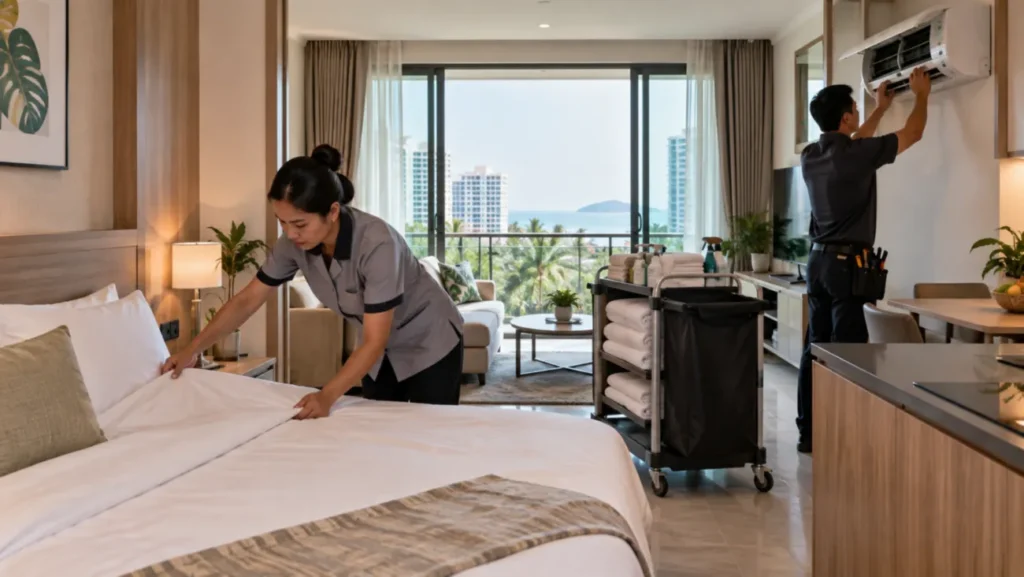
One of the most underrated aspects of investment leasing is the difference between gross and net income. Investment presentations often indicate gross rental yield — return on investment before expenses. Therefore, before comparing properties, it is important to clarify whether the figure refers to gross or net return.
The real economy looks different.
From revenue to net income:
| Article | When it happens | Who usually pays for it? | What to Ask the Operator |
|---|---|---|---|
| Booking Platform Commission | Every reservation | Deducted from revenue | What percentage does each platform take? |
| Management Company Commission | Every month / every reservation | Owner | A fixed amount or % of income? |
| Housekeeping and Linen Change | Each guest's departure | As a rule, the owner | Is it included in the fee or charged separately? |
| Consumables | Regularly | Owner | Who is responsible for purchasing and record-keeping? |
| Utility bills (electricity, water) | Monthly | It depends on the contract | Pay-per-guest or a flat rate? |
| Internet | Monthly | Owner | Is it included in the common area fee or charged separately? |
| Common area fee (building maintenance fee) | Monthly | Owner | What is the rate per square meter, and how is it adjusted? |
| Minor repairs and appliance replacement | In fact | Owner | Who organizes it, and who pays for it? |
| Off-season (periods without guests) | Seasonal | Loss of income | What is the actual average load? |
| Insurance | Every year | Owner | Does the policy cover short-term rentals? |
| Tax on Rental Income | Every year | Owner | I need advice from a tax specialist |
| Additional Operator Expenses | Under the contract | Under the contract | What is included in “other expenses”? |
An individual's income from renting out real estate in Thailand is classified as "income from property rentals" under the assessable income category according to Section 40(5) of the Revenue Code. A non-resident for tax purposes in Thailand may also have tax obligations in Thailand on income derived from sources within the country. The specific amount of tax, deductible expenses, withholding tax, and filing procedures depend on the taxpayer’s status and the structure of the transaction—all of which should be verified with a Thai tax specialist rather than based on general descriptions found online.
Example: Why 8% in the presentation isn't yet 8% for the owner
Let's assume, purely for the sake of example:
| Indicator | Hypothetical Example |
|---|---|
| Price of the apartment | 5,000,000 THB |
| Gross rental income for the year | 400,000 THB |
| Gross yield | 8% |
| Management | −60,000 THB |
| Cleaning, Supplies, Minor Repairs | −30,000 THB |
| Common area fee and other owner expenses | −25,000 THB |
| Ordinary and Unforeseen Expenses | −20,000 THB |
| Income after the specified expenses, before individual taxation | 265,000 THB |
| Implied return after these expenses | 5,3% |
The figures in the example do not represent the market’s average return or a forecast for a specific project. They merely illustrate the calculation process. For a real-world project, you must substitute its price, the operator’s contract, historical utilization rates, and actual expenses.
How Taxes Affect the Calculation of Returns
For an individual, income from real estate rentals falls under Section 40(5) of the Revenue Code. For the rental of a house, building, or other relevant structure, the Revenue Department provides a choice between a standard deduction of 30% from income and taking into account actual allowable expenses, provided that supporting documents are available.
This is does not mean that the tax amounts to 30% of the rent. In this case, 30% refers to a potential deduction of expenses prior to the further calculation of taxable income. The final tax burden depends on the owner’s tax status, total income, the structure of rent receipts, and other circumstances.
Separate rules apply to non-residents, including withholding tax in cases specified by the Revenue Code; therefore, before calculating the net yield, a foreign owner should review their structure with a Thai tax specialist.
Additional expenses related to apartment maintenance are discussed in detail in the article “How Much Does It Cost to Maintain a Property in Thailand?".
An important practical conclusion: A project with higher daily rates does not necessarily generate higher net income. Occupancy rates, operator fees, seasonality, and expense structure can make a “more expensive” property less profitable. You should compare net figures after all deductions, not advertising metrics.
Phuket, Pattaya, Koh Samui, and Bangkok
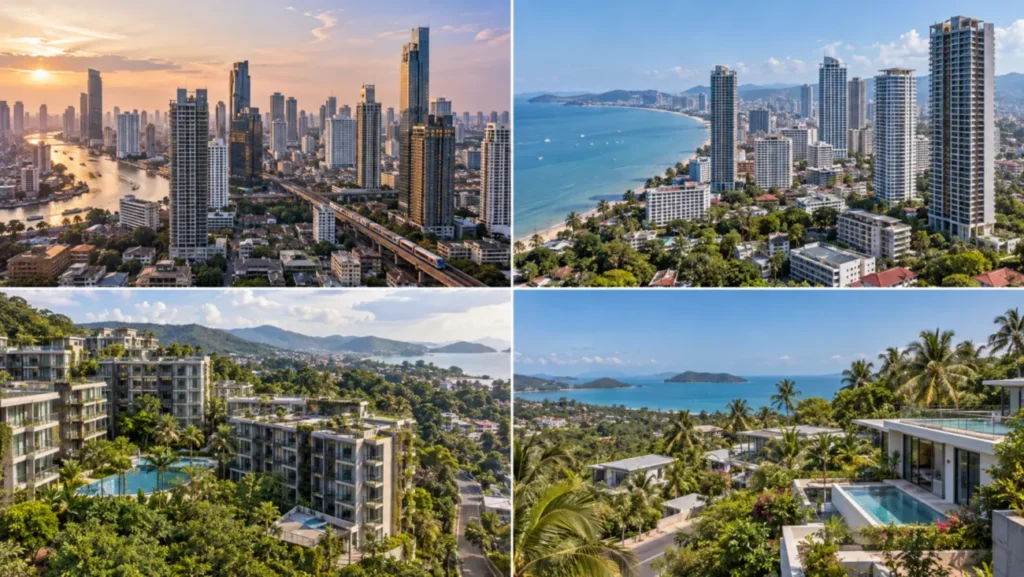
Thailand’s four major markets operate under the same laws but are structured differently in terms of their business models. It is important for investors to understand not only “where returns are higher,” but also how demand is structured and which leasing model is realistic for a specific market.
| Market | Nature of Demand | What Investors Should Check in Particular |
|---|---|---|
| Phuket | Tourism, seasonal (peak season: November–April), international visitors | Whether the project has a hotel license, the operator's name, the terms of the rental pool, and the payment schedule during the off-season |
| Pattaya | Vacation rentals and longer-term leases | Project type (residential or hotel), legal entity regulations, permissible lease term |
| Samui | Tourist island market; villas and condos are common | Type of property (condo vs. villa), property status, transportation access, and who the operator is |
| Bangkok | The city's housing market, featuring short-, medium-, and long-term housing options | Condominium rules; calculate the monthly/long-term rental scenario separately |
Phuket — a major tourism market where hotel-managed properties are widely available. When purchasing a property with a hotel license or rental pool, it is particularly important to verify the operator, the terms of the contract, and the actual occupancy rates of the specific project by season—high season (November–April) and low season (May–October) can yield significantly different results.
Pattaya — a market that offers both short-term tourist rentals and longer-term lease options. For a specific property, it is important to verify the actual demand patterns in its location, the building’s regulations, and the permitted operating model. In Pattaya, residential and hotel formats coexist, making it particularly important to verify a project’s status.
Samui — an island with pronounced seasonality and a significant proportion of villas. For properties on Koh Samui, an additional question often arises regarding legal status—the distinction between freehold and leasehold, and the type of development. This issue is discussed in more detail in the article “Freehold and Leasehold in Thailand". The island's transportation accessibility also affects operational logic.
Bangkok is, first and foremost, a real estate market. Alongside tourist accommodations, the market for medium- and long-term rentals is well-developed here. Therefore, when evaluating a residential condominium, it makes sense to calculate the monthly and long-term rental scenarios separately and compare them with the short-term model for a specific property. The rules for legal entities in central developments are often stricter than in tourist areas.
If the purpose of the purchase is specifically for daily rentals
Don't choose an apartment first and then decide how to rent it out. For this kind of investment strategy, it's better to reverse the order:
acceptable lease model → project documents → operator → management agreement → expenses → actual financials → specific apartment.
If the profitability of a transaction depends on short-term guests, the feasibility of such an operation must be assessed before making a deposit or signing a contract, rather than after the property is registered.
Are you looking for an apartment in Thailand specifically to rent out? We'll find options that take into account your desired lease term, budget, region, management model, and the specific complex's restrictions.
Take the quiz and get a curated selection
What to Check Before Buying an Apartment
This is a practical guide for those who are just considering purchasing an investment apartment. If you haven't made a decision yet, you have the opportunity to ask all the right questions before signing the contract.
What documents should you request if you're promised income from short-term rentals?
| What the seller claims | What to Ask to See |
|---|---|
| "The project has a hotel license." | A copy of the current license and the licensee's information |
| "You can rent out your apartment by the day." | Project documents + confirmation that a specific unit is included in the corresponding operating model |
| "The management company takes care of everything" | Rental Management Agreement and Information on the Operator's Legal Role |
| "Daily rentals are permitted by the complex" | Condominium Regulations and Current House Rules |
| "Income Guaranteed" | A contract specifying the amount/formula, warranty period, payer, termination conditions, and exclusions |
| "Yield on 8%" | Calculation of gross/net yield, commissions, expenses, historical performance, and calculation methodology |
| "TM.30 Takes the Lead" | The relevant provision of the contract or written confirmation from the operator |
A screenshot of an Airbnb listing, a verbal promise from an agent, or the fact that neighboring apartments have been rented out do not serve as substitutes for official documents.
Step-by-Step Buyer's Checklist:
- Legal Classification of the Object — Is it a residential condominium, a hotel-licensed residence, an apart-hotel, or something else? That defines the scope of the entire analysis.
- Ownership — Freehold or leasehold? Foreign ownership quota or a Thai legal entity?
- Registered Condominium Rules — What do they say about the commercial use of apartments? Ask to see the original document, not the agent’s summary.
- Does the project allow for the proposed operating model? — If you're planning a short-term rental, it must be permitted specifically in this building.
- Possession of a hotel license — Does the project have one? Who was it issued to? For how long? Has it expired?
- Who is the current operator? — This is important if the license is held by one legal entity but managed by another.
- Does the license or rental program apply to a specific apartment? — In large-scale projects, there may be situations where some of the apartments are part of the hotel section, while others are not.
- Management Agreement (rental management agreement) — Read the entire document, not just the summary. Key points: term, commission, payment terms, owner stay, and early termination conditions.
- Owner's Stay — Can you live in the apartment yourself, and under what conditions? Are there any restrictions on the number of days per year?
- Rules for Withdrawing from the Rental Program — How do you leave the program if you want to sell your apartment or switch to a different model?
- Responsibilities Regarding Guests and Reporting — Who submits Form TM.30, and who keeps track of tenants?
- A Realistic Cost Estimate — Ask for a full breakdown: all fees, operating costs, and simple and complex load scenarios.
- Contingency Plan in the Event of a Model Change — If a short-term rental isn't possible or isn't cost-effective, will you be able to switch to a monthly rental? What would that require?
We also recommend reviewing the article “Property Inspection When Buying Real Estate in Thailand"— it involves a more comprehensive legal review of the property."
Are you looking for a property in Thailand to rent out? When it comes to an investment property, it’s not just the stated rate of return that matters, but also the operating model, the complex’s rules, and the owner’s expenses. Find suitable options.
If the apartment has already been purchased
If you already own an apartment and the question of renting it out came up after you bought it—the situation can be resolved, but it requires a systematic approach. Don’t start by posting an ad.
Steps for the current owner:
- Get the condominium rules — Request the condominium regulations and house rules from the building’s legal entity. If you already have them, review them, paying close attention to the section on commercial use and the rules for guests.
- Check the status of the facility — Is it a residential condo or a project with a hotel component? That determines what types of units are even possible.
- Check the hotel's license or the operator — Is there a property management company in the building with the appropriate status? Under what conditions can one sign up with it?
- Determine the maximum lease term — Is short-term rental only available through a licensed operator, or is it not available at all? Is a monthly rental a safer option?
- Determine who will welcome the guests — Is it you personally or a management company? This affects TM.30 and taxes.
- Get to grips with TM.30 — If you plan to host international guests, set up the notification process before their first check-in.
- Check Your Tax Liabilities — Consult a tax professional regarding how to report rental income.
- Calculate the net economic benefit — not advertising revenue, but the actual figure after accounting for all expenses. Compare the scenarios: short-term vs. monthly rental.
- Only then should you choose a booking site — The sales channel is determined last, after everything else has been decided.
Red flags—reasons to stop and double-check:
- “Everyone here does it that way” is not an argument, but an observation about a practice that does not necessarily comply with the law
- "Airbnb has approved the listing" — the platform does not issue approvals
- “If there are 8 or fewer rooms, you definitely don’t need a license”—this is an oversimplification; the exception requires compliance with additional conditions and does not automatically apply to every apartment
- “The neighbors have guests, so it’s okay”—inconsistent enforcement of the law does not mean it is lawful
- "The developer promised an annual return of X%" without a contract or a detailed breakdown of expenses
- It is not possible to provide a valid hotel license—neither the document nor the name of the license holder
- It is unclear who is legally considered the operator of the short-term rental.
What Property Owners Need to Keep in Mind
Ownership rights and the right to operate a hotel business in one’s apartment are not the same thing. This is the fundamental principle from which everything else follows.
Airbnb, Booking, and other platforms are sales channels, not regulatory authorities. Posting a listing on the platform does not confirm that the property complies with the requirements of the Hotel Act or the rules of a specific condominium.
A standard residential condominium and a hotel-licensed project are fundamentally different models. In the first case, short-term rentals are generally not allowed. In the second case, they are possible, but only through an operator and under the terms of a contract.
Monthly rent is a practical model, but it is not a one-size-fits-all solution. The Hotel Act excludes accommodations provided on a monthly or longer-term basis from the definition of a hotel; however, this does not exempt such establishments from building codes, TM.30, or tax obligations. The “30-day rule” is a market benchmark, not a literal legal requirement.
The exception for small venues (up to 8 rooms / up to 30 guests) is not automatic. In addition to meeting the numerical criteria, you must notify the registrar, have the property inspected by an authorized person, and obtain written confirmation. This does not automatically apply to every apartment in a condominium—you must verify its applicability to a specific property on a case-by-case basis.
TM.30 and taxes cannot be ignored. For a property owner who hosts foreign guests or tenants, these are real obligations with specific deadlines and responsibilities.
An investment opportunity should be chosen based on a viable operating model, not just on the promised return. The advertised rental yield is a gross figure. The owner’s actual income is determined after deducting all expenses and should be calculated for a specific property, rather than taken from advertising materials.
It is recommended that you consult a legal or tax professional familiar with Thai law regarding any decisions related to leasing, taxes, or the legal status of a specific property. This article provides general guidance but is not a substitute for individual consultation.
The best time to ask all the right questions is— before signing the purchase and sale agreement, rather than after the first guest checks in.
 Real estate in Georgia
 Real estate in Cyprus
 Real estate in UAE
 Real estate in Bali
 Real estate in Montenegro
 Real Estate in Spain
 Real Estate in Saudi Arabia
 Real Estate in Turkey
 Real Estate in Zanzibar
 +66 98 432 7651
 hello@thaicost.com
 Boat Lagoon Marina, 22/1 Moo 2, Thepkasattri Rd, Koh Kaew, Phuket 83000, Thailand




 Get TOP-7 catalog of objects