
 +66 98 432 7651



The price listed in the property advertisement is not the same as the total cost of the transaction. When registering a transfer of property ownership in Thailand, several separate payments are required: a registration fee payable to the government, a tax paid by the seller depending on the duration and nature of ownership, and a possible stamp duty. Each of these is calculated based on its own formula and rate, and simply adding them together to arrive at a single “purchase tax rate” will yield an incorrect result.
Current as of August 2026. The rates and rules governing temporary government benefits are subject to change. Before registering a transaction, you must verify the current terms of the transaction against official data. Department of Lands, Thailand и Revenue Department of Thailand as of the date of registration.
It is important to understand one more fundamental difference: by law, some payments are the responsibility of the seller, while others are the responsibility of the buyer; the actual allocation of costs between the parties is determined by the terms of the specific contract. Market practice and legal norms diverge on this point—and this must be verified by reviewing the text of the agreement, rather than guessing.
The form of ownership warrants special attention. Registration costs Freehold (full ownership) and Leasehold (long-term leases) are calculated according to different rules. They cannot be compared, just as you cannot use the expense table for a condominium when calculating a transaction involving a villa or a plot of land.
Below is a structured breakdown of each payment: the rate, the tax base, the conditions of application, who pays the government, and how this may be redistributed under the contract. It also includes three practical budget calculation scenarios and a checklist of questions to ask before making a deposit.
The most important thing to understand right away is: There is no single, universal “purchase tax” in Thailand. The total cost is made up of several payments with different tax bases, different payers, and different conditions for application. You can’t simply take the advertised price of a property and multiply it by a single percentage.
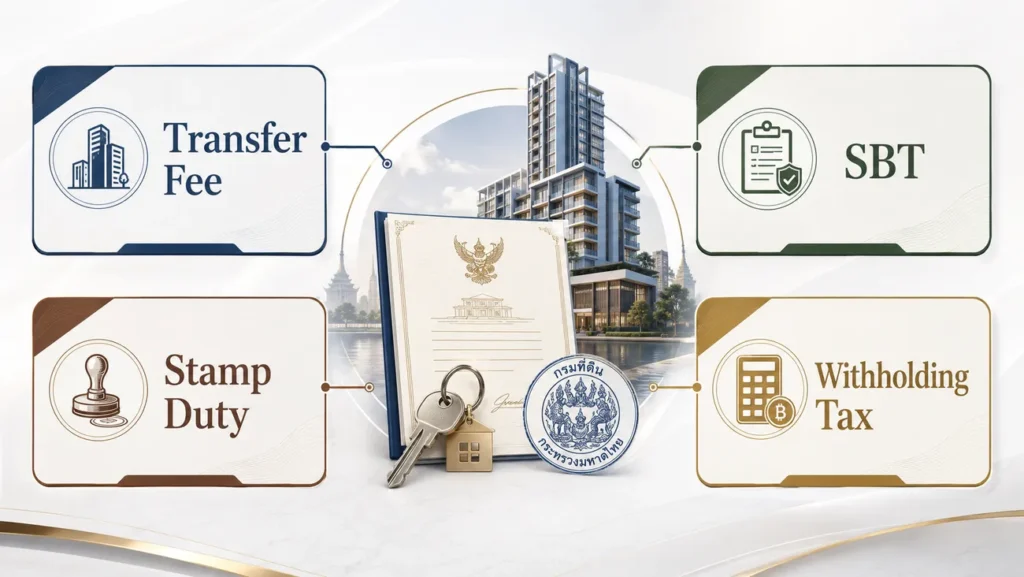
The short answer. When registering a real estate transaction in Thailand, the following main fees apply:
- Transfer Fee — registration fee; standard rate 2% of the official appraised value of the property, as determined by the Department of Lands;
- Specific Business Tax (SBT) — tax on the sale of commercial or income-generating real estate; the effective rate, including local tax, is 3,3% from the tax base; this does not always apply;
- Stamp Duty — stamp duty on the relevant document (instrument); for a document related to the transfer or creation of a real property right — 0,5% from the established base; for a lease agreement— ~0,1% of the total rent and key money for the entire term. Key money is an additional one-time payment to the landlord, as specified in the lease agreement, for granting the right to lease, in addition to the regular rent. If the lease agreement does not provide for such a payment, it is not included in the calculation.
- Withholding Tax — withholding tax on the seller's side; the rate and calculation method depend on whether the seller is an individual or a company.
These figures cannot be added together to yield a single number: they apply under different conditions and are calculated based on different factors. The final amount depends on the specific property, the type of title, the seller’s status, and the length of ownership.
Taxes and Fees When Buying Real Estate in Thailand in 2026
| Payment | Rate | Database | Usually refers to |
|---|---|---|---|
| Transfer Fee | 2% | Land Office Appraised Value | Determined by contract |
| SBT | 3,3% | Higher than the transaction price and the appraised value | To the Salesperson |
| Stamp Duty on the Sale | 0,5% | Higher than the transaction price and the appraised value | To the seller, if SBT does not apply |
| WHT, corporate seller | 1% | Established Tax Base | To the Salesperson |
| WHT, individual seller | According to a special formula | Estimated Value + Length of Ownership | To the Salesperson |
| Lease Registration Fee | 1% | Total rent + applicable key money | To the Tenant |
| Stamp Duty on Leaseholds | ≈0.1% | Total rent + applicable key money | To the Landlord |
Important: The buyer does not add 2% + 3.3% + 0.5% + WHT. These payments arise under different conditions and relate to different parties to the transaction.
Why does it say "tenant" when buying real estate here?
In Thailand, foreigners can purchase real estate not only under a freehold title but also under a leasehold title. In the case of a leasehold, the buyer effectively receives registered long-term leasehold right, rather than ownership of the property or the land. Therefore, legally, the parties to the contract are referred to as the lessee and the lessor, even if the project’s advertising refers to such a transaction as a “leasehold purchase.” This is precisely why, instead of a Transfer Fee, there is a separate fee for registering the lease and Stamp Duty on the lease agreement.
How Much the Buyer Pays: A Quick Overview
| The Situation | What typically happens to a buyer |
|---|---|
| Freehold Apartment | Transfer Fee — typically 2% of the official appraised value; the portion actually borne by the buyer is determined by the terms of the transaction |
| New Construction, Freehold | A transfer fee is charged when a completed property is registered; refer to the contract with the developer for details on how the fee is allocated. |
| Freehold Secondary Market | Transfer fee plus any applicable contractual expenses; SBT, stamp duty, and WHT are primarily the seller’s responsibility, but the contract may alter the economic allocation. |
| Leasehold | Registration fee — 1% of the total rent for the registered term; Stamp Duty on the lease agreement — approximately 0.1% |
| Additionally | Sinking Fund, Common Area Fee, bank fees, legal review, and other transaction costs |
There is no one-size-fits-all rule for buyers to “add 5–7%.” First, you need to determine the form of the right, the official appraised value, and which expenses the contract specifically assigns to the buyer.
What taxes are due when making a purchase?
Before breaking down each payment, it’s helpful to see the big picture all in one place. The table below is a starting point, not a final calculation: each row has its own terms and nuances, which are described in the following sections.
| Payment | Rate Guide | Basis for Calculation | When to Use | Who is responsible for paying | Who is actually responsible for payment under the contract? |
|---|---|---|---|---|---|
| Transfer Fee | 2% (standard) | Official Assessed Value (Department of Lands) | For any registration of a transfer of freehold title | Payable upon registration; allocation between the parties is as specified in the contract | Determined by the terms of the transaction; expenses may be shared or borne entirely by one of the parties |
| Specific Business Tax (SBT) | 3,3% (3% + 10% local tax) | The official appraised value or the contract price—whichever is higher | Sale for commercial or investment purposes; depends on the circumstances of the transaction | Salesperson | May be accepted by the buyer in accordance with the terms of the contract |
| Stamp Duty (document related to the transfer of title) | 0,5% | The higher of the two: the contract price or the appraised value | When selling real estate, as a rule, SBT is not levied | Salesperson | May be allocated under the terms of the agreement |
| Stamp Duty (Lease Agreement / Leasehold) | ~0,1% (1 baht / 1,000 baht) | Total rent for the entire term and key money (if applicable) | When registering a long-term lease | Landlord by law | Actual allocation of expenses—as specified in the contract |
| Withholding Tax | It depends on the seller's status (individual / company) | For individuals—under a special mechanism with a fixed deduction; for companies—1% of the tax base (withheld upon registration) | In the case of any transfer of rights for consideration | Seller; withheld upon registration with the Land Office | Sometimes accepted by the buyer under the contract |
| Leasehold registration fee | 1% | Total rent for the entire registered term and key money (if applicable and included in the base amount at the time of registration) | When registering a long-term lease (Leasehold) | Tenant (purchaser of the leasehold interest) | - |
Would you like to include the property and the registration costs in your calculation right away?
We'll find options in Phuket, Pattaya, Bangkok, or Koh Samui that fit your budget and preferred type of ownership.
Find a Property
Who Pays: The Buyer or the Seller
| Payment | With whom is it inherently connected? | What a buyer should check |
|---|---|---|
| Transfer Fee | Registration of a Transfer of Ownership | How is the fee divided between the parties to the contract? |
| Specific Business Tax | Salesperson | Does the contract place part of the cost on the buyer? |
| Stamp Duty on the Sale | Salesperson | Is Stamp Duty applied instead of SBT? |
| Withholding Tax | Salesperson | Is the buyer required to compensate the seller? |
| Leasehold registration fee | Registration of a Leasehold Interest | The complete calculation basis, including rent and any key money |
| Stamp Duty on Rentals | Landlord — legal taxpayer | Who is actually responsible for this expense under the contract? |
Therefore, the question “Who pays taxes when buying real estate in Thailand?” cannot be properly answered by saying “it’s split 50/50.”
Three important distinctions to keep in mind.
First: a tax and a fee are different categories. A “Transfer Fee” is a registration fee paid to the government for an administrative action. SBT and Stamp Duty are taxes on specific transactions. Withholding Tax is a tax withheld at source on the seller’s income.
Second: the person who is legally obligated to pay the tax and the person who actually bears the expense are not always the same. The seller is required to pay withholding tax to the government. However, the contract may stipulate that the buyer reimburses the seller for part of these expenses or assumes them.
Third: The contractual allocation of expenses is the result of negotiations, not a legal requirement. The transfer fee is charged upon registration of the transfer of title. The contract must specify which party actually bears this expense and in what proportion it is divided.
The party obligated to pay tax to the government and the party that actually bears the costs under the contract are not always the same. Read the contract, not general market assumptions.
Transfer Fee
A transfer fee is a registration fee paid to the Land Office (Thailand’s Department of Land) at the time of the official registration of the transfer of ownership. Without this payment, registration will not be processed, which means that ownership is not legally transferred to the buyer.
The standard rate is 2% of the property's official appraised value, as established Department of Lands. It is important to understand that this assessed value is an administrative figure that the government revises periodically. It may differ significantly from the market price and from the amount specified in the purchase and sale agreement. The Transfer Fee cannot automatically be calculated as 2% of the property’s advertised value—the calculation is based on the assessed value set by the Land Office.
For example, if the official appraised value of an apartment is 3,000,000 baht and its market price is 4,500,000 baht, the transfer fee is calculated based on 3,000,000 baht and will amount to 60,000 baht. This example is for illustrative purposes only: actual appraised values must be obtained directly from the land administration office for a specific property.
The standard mechanism for calculating the transfer fee does not establish a separate base rate based on the buyer's nationality. However, citizenship may affect eligibility for temporary government benefits—so it is important to verify the current rate as of the date of registration.
In Thailand, temporary programs to reduce registration fees for certain categories of transactions are periodically implemented. Their validity periods, price limits, and requirements for the property and the buyer must be verified immediately prior to registration by referring to current announcements from the Department of Lands and relevant regulations. A preferential rate intended for Thai citizens cannot be automatically applied to a foreign buyer — The eligibility requirements for such programs generally apply only to certain categories of people.
Transfer Fee for Foreigners in 2026
The standard transfer fee is 2% of the property's official appraised value.
In market reports, you may come across a rate 0,01%. It is part of a government incentive program for certain categories of residential real estate and buyers who meet the established criteria. For foreign buyers, this benefit cannot be factored into the standard transaction calculation: the basic guidelines remain 2%.
If a developer or seller offers a foreign national a reduced registration fee, you must request the legal basis for this before signing the contract and confirm that the discount applies with the Land Office as of the registration date.
In the primary market Developers often cover the transfer fee in full or state, “We will pay all registration fees.” Such a statement must be interpreted literally in the contract text: it is important to understand exactly which payments are included and which are not. Sometimes, “registration expenses” mentioned in advertising materials do not include the seller’s withholding tax, which technically does not apply to the buyer but can affect the overall outcome of the negotiations.
On the secondary market Terms are determined on a case-by-case basis. The buyer should clarify the allocation of expenses before signing any preliminary agreement.
SBT and Stamp Duty
These are two interrelated but fundamentally different payments. They are often confused, combined, or described as a single entity—and this is one of the most common mistakes in materials about property taxes in Thailand.
The easiest way to remember the logic is as follows: SBT and Stamp Duty on the sale of a freehold property are generally considered alternative payments, rather than two taxes that should automatically be added together. First, determine whether SBT applies. If it does, the corresponding stamp duty is generally not levied on the transfer of real estate; if SBT does not apply, you must check for stamp duty.
Specific Business Tax
The Specific Business Tax (SBT) is a type of indirect tax introduced in 1992. It applies to certain types of activities that are exempt from Value-Added Tax (VAT). Among the activities subject to the SBT is the sale of real estate for commercial or income-generating purposes, regardless of how it was acquired, in accordance with the rules, procedures, and conditions established by royal decree.
It's easier for a customer to understand it this way: SBT is a tax that must be verified on the seller’s end, especially if the seller is a company or if the property was owned by an individual for a relatively short period of time.
This is a fundamentally important distinction. The SBT on the sale of real estate is not an automatic tax levied on every residential property transaction. It applies only when the government classifies the sale as a commercial or income-generating transaction. The specific terms for applying SBT to a particular transaction must be determined in accordance with the rules in effect as of the date of registration. — They depend on the seller's category (individual or company), the nature of ownership, the type of property, and other circumstances.
The SBT tax base for real estate transactions is gross revenue. The rate is 3%. In addition to the SBT, a local (municipal) tax is levied at a rate of 10% on the SBT amount. Total The effective rate, including local tax, is 3.3% from the tax base.
The tax base is the higher of the following two amounts: the official appraised value or the amount specified in the contract. If the market price of the transaction is lower than the appraised value, the tax is still calculated based on the appraised value.
How SBT Is Calculated: Examples
| Price in the contract | Estimated value | Basis for calculation | SBT 3% | Local Tax 10% from SBT | Total 3.3% |
|---|---|---|---|---|---|
| 3,000,000 ฿ | 2,500,000 ฿ | 3,000,000 ฿ | 90,000 ฿ | 9,000 ฿ | 99,000 ฿ |
| 4,000,000 ฿ | 4,500,000 ฿ | 4,500,000 ฿ | 135,000 ฿ | 13,500 ฿ | 148,500 ฿ |
| 8,000,000 ฿ | 6,500,000 ฿ | 8,000,000 ฿ | 240,000 ฿ | 24,000 ฿ | 264,000 ฿ |
How to read the table: The higher of the two values—the transaction price or the official appraised value—is used for the calculation. For example, if an apartment is sold for 4 million baht but its official appraised value is 4.5 million baht, the basis will be 4.5 million baht. With an effective rate of 3.3%, the SBT amount will be 148,500 baht.
In this context, SBT typically refers to obligations salesperson, rather than being a standard tax imposed on the buyer. However, the contract may provide for a different economic allocation of costs, so the buyer should still review this clause before signing the contract.
The buyer does not need to automatically add 3.3% to the property price. The table shows how SBT is calculated when it applies to a specific sale. Legally, this tax is the responsibility of the seller, although the contract may shift part of the cost to the buyer.
SBT — an obligation of the seller. It is paid upon registration of the transfer of title at the Land Office. The contract may provide that the buyer will reimburse the seller for this expense—but this is a contractual provision, not a legal requirement.
If SBT does not apply, you must check Stamp Duty separately. When selling real estate, stamp duty typically applies specifically in situations where the transaction is exempt from SBT.
The application of the SBT cannot be reduced solely to the “less than five years of ownership” rule—that would be an oversimplification of the actual regulations. For individuals, there are circumstances under which the SBT is not levied. In particular, the length of ownership and the use of the property as the seller’s residence—provided the seller’s name appears on the house registration for a specified period—may be relevant. There are also specific exemptions for inheritance and certain other types of transfers. The applicability of a specific exemption must be determined based on the circumstances of the transaction, rather than applying it automatically.
When It's Especially Important to Check the SBT
| The Seller's Situation | Practical Conclusion |
|---|---|
| Company | SBT is usually one of the key payments involved in a sale |
| Individual, short period of ownership | We need to check whether the sale qualifies as subject to SBT |
| Individual, long-term ownership | It is possible that there is no SBT and that Stamp Duty applies |
| The property was used as the seller's residence | We need to verify the conditions for the applicable exception, including registration with the house registration office. |
| Inheritance or Other Special Transfer | There may be some exceptions |
The holding period is an important factor, but not the only one. For a specific transaction, you need to verify the basis for applying or exempting it from the SBT.
Stamp Duty
Stamp duty is levied on legal documents, not on transactions or individuals. Documents subject to stamp duty include those related to the transfer of rights to land parcels and lease agreements.
The following apply to real estate transactions: Two different rates depending on the type of document:
- A document (receipt) related to the transfer or creation of a real property right: Stamp duty is 1 baht for every 200 baht or fraction thereof—that is, approximately 0,5% the higher of the two: the contract price or the appraised value.
- Lease Agreement (lease of land, a building, or other property): 1 baht for every 1,000 baht or fraction thereof of the total rent and key money (if applicable) for the entire registered term—that is, approximately ~0,1%. According to the Stamp Duty Schedule, the party responsible for paying stamp duty on a lease agreement is the landlord. If the agreement provides that the tenant will effectively bear this cost, this should be specifically stated in the terms of the transaction.
These two rates should not be confused: 0.5% applies to a document transferring ownership, while ~0.1% applies to a lease agreement (Leasehold).
When selling a property and registering the transfer of ownership, SBT and the corresponding stamp duty are generally not levied at the same time: If the sale is subject to SBT, Stamp Duty on the relevant document is generally not applicable. Stamp Duty on a lease agreement is a separate matter and is calculated according to its own rules. This distinction is crucial for calculating expenses.
| The Situation | SBT | Stamp Duty | What to Check |
|---|---|---|---|
| The seller is an individual; the sale is classified as a commercial transaction | Applies to (3,3%) | Not typically used | Term and conditions of ownership; address registration |
| The seller is an individual; the sale is not considered a commercial transaction | Not applicable | Applied (0.5% relative to the base) | Grounds for Exemption from the SBT |
| Seller — Company | Applied in most cases (3.3%) | It is generally not used when SBT is present. | Company Registration Status |
| Leasehold (Lease Registration) | Does not apply to rentals | Applies to (~0.1% of rent and key money); the payer is the landlord | Lease term, key money requirement, and cost-sharing terms |
Withholding Tax
Withholding Tax — a tax withheld at source on the seller’s income from the sale of real estate. Formally, it applies to the seller, not the buyer. However, it is important for the buyer to understand how this tax works before signing the contract for two reasons. First, the contract sometimes stipulates that the buyer assumes responsibility for the withholding tax or reimburses the seller for it. Second, a seller facing a significant tax burden may factor it into the property’s price or renegotiate the terms of the deal.
For the buyer: This isn't your typical purchase tax, but it can affect the price and the allocation of costs in the contract.
Withholding tax is withheld upon registration at the Land Office: the official handling the transfer of title calculates and collects the payment.
If the seller is an individual
Calculating withholding tax for an individual is one of the most complex mechanisms in Thailand’s real estate taxation system. It cannot be described by a single rate or by simply multiplying the transaction price by a percentage.
For individual sellers, a special mechanism applies that uses the official appraised value of the real estate and a statutory deduction for expenses. The amount of this deduction depends on the method of acquisition and length of ownership. However, the deduction does not increase in proportion to the length of ownership—on the contrary, the amount of the allowable deduction decreases as the ownership period lengthens: for example, a higher deduction rate applies after 1 year of ownership than after 3 or 5 years.
After applying the prescribed deduction, the calculated amount is allocated over the number of years of ownership; the income tax scale specified for this calculation is applied to the resulting annual amount; and the calculated amount is then multiplied by the number of years of ownership. Withholding tax cannot be determined simply by multiplying the price of the item by a single rate — The total amount depends on the appraised value, the term, and the method of purchase.
Standard deduction for calculating WHT
| Term of Ownership | Standard Deduction |
|---|---|
| 1 year | 92% |
| 2 years | 84% |
| 3 years | 77% |
| 4 years | 71% |
| 5 years | 65% |
| 6 years | 60% |
| 7 years | 55% |
| 8 years and older | 50% |
This is not the WHT rate. The percentage indicates the standard deduction applied at one of the stages of the calculation for the relevant cases. After the deduction, the remaining amount is allocated across the years of ownership, the appropriate tax bracket is applied to the annual income, and the result is multiplied by the number of years of ownership taken into account.
Example of a WHT calculation for an individual
Estimated value: 3,000,000 THB
Period of ownership: 3 years
Standard deduction: 77%
- Deduction: 3,000,000 × 77% = 2,310,000 THB.
- Estimated amount after deduction: 3,000,000 − 2,310,000 = 690,000 THB.
- Estimated value for one year: 690,000 ÷ 3 = 230,000 THB.
- The applicable WHT/PIT scale is applied to this amount.
- The tax calculated for the year is multiplied by three years of ownership.
The actual calculation must be confirmed with the Land Office for the specific property and seller prior to registration.
If the seller is a company
For legal entities, the procedure is fundamentally different. If the seller is a company or a legal partnership, tax is withheld at a rate of 1% of the established tax base (whichever is higher: the appraised value or the contract price). The mechanism is a withholding system: the payer of the income withholds the corresponding amount from the payment to the seller and remits it upon registration. For the selling company, the withheld amount is treated as a tax credit when calculating its final corporate tax liability.
Just because the seller is formally responsible for paying withholding tax doesn't mean the buyer is indifferent to it. When determining the price and terms of a contract, both parties generally take the seller’s tax burden into account. A savvy buyer asks the seller for a calculation of this tax before signing any binding documents.
Freehold and Leasehold
The form of ownership is not a technical legal term, but a practical variable that directly affects what payments arise from a transaction and how they are calculated. Using the expense table for Freehold when calculating Leasehold will result in a fundamentally incorrect budget.
For more information on the nature and legal differences between the two forms, see the article “Freehold and Leasehold in Thailand".
| Consumption | Freehold | Leasehold | Comment |
|---|---|---|---|
| Transfer Fee | 2% of the estimated value | Not applicable | With a leasehold, ownership does not transfer |
| Leasehold registration fee | Not applicable | 1% of the total rent for the entire term and key money (if applicable) | To be paid by the tenant upon registration |
| Stamp Duty on a Lease Agreement | Not applicable | ~0.1% of the total rent and key money (if applicable) | Legal payer—landlord; actual allocation—as specified in the contract |
| SBT (at the seller's) | Can be used | Does not apply to the registration of leases | SBT is a tax on sales, not on rent |
| Withholding Tax (at the seller's end) | Used | It depends on the circumstances | You need to check for each structure |

Freehold in a condominium — the most straightforward option for a foreigner. It is registered with the Land Office, involves a transfer fee, and, provided the foreign ownership quota requirements are met, the foreigner receives a condominium unit title deed in their name. For more details on the requirements for foreigners, see the article “Foreign Quota in Thailand".
Leasehold refers to the registration of a long-term lease, typically for 30 years. The Land Office registers the lease agreement, not the ownership right. The registration fee (1%) is paid by the tenant and is calculated based on the total rent for the entire term and any key money, if provided for in the agreement. If the total rent amounts to, for example, 3,000,000 baht without key money, the registration fee will be 30,000 baht. In addition, Stamp Duty of approximately 0.1% is assessed on the same base — 3,000 baht, for which the landlord is the legal payer; the actual allocation of this expense is determined by the lease agreement.
When purchasing a villa or a property with land, the issue of ownership becomes significantly more complicated. The options for direct land ownership by foreigners in Thailand are considerably limited and are permitted only in specific cases provided for by law. One alternative to consider is a registered long-term land lease. Ownership through a Thai company requires a separate legal basis and a genuine, legitimate corporate structure; The use of Thai nominee shareholders solely to circumvent restrictions on foreign land ownership is not permitted. For villas, the land rights and the rights to the structure located on the land must be analyzed separately.
Never use the cost calculation for one type of ownership to compare it with another. These are different legal mechanisms with different fees, different documents, and different legal consequences.
Freehold Condominiums in Phuket





 Phuket, Bang Tao
 starting at 45 m²


New Construction and the Resale Market
The purchase scenario has a significant impact on what payments are involved, how they are allocated, and what to check in the contract.

Buying from a developer
When purchasing an apartment or condominium from a developer, the transfer fee is paid upon the actual registration of the transfer of title to the completed condominium unit with the land registry. The specific requirements for registration depend on the project’s legal readiness and the documents required for the transfer of the specific property.
Many developers advertise a “free transfer fee” or claim that “we’ll cover the transfer fee.” You need to check the contract carefully to see whether the offer includes only the transfer fee or also the seller’s SBT and withholding tax. An advertising claim that “all costs are included” does not mean that there are no other payment obligations.
In addition to state taxes, when purchasing a unit in a new building, there are condominium fees. These are not government taxes and do not go to the budget—they are administrative fees paid to the developer or management company:
- Sinking Fund — a one-time contribution to the building’s reserve fund; payable once upon purchase or upon first move-in;
- Common Area Fee — a regular fee for the maintenance of common areas, security, the pool, elevators, etc.
The amounts of these payments vary depending on the project and must be specified in the contract or in a separate addendum. Their Do not confuse this with the transfer fee or government taxes.
Purchase on the secondary market
In a secondary market transaction, the key variables are — seller's period of ownership and his status (an individual or a company). These two factors determine whether SBT or Stamp Duty will apply, and the amount of Withholding Tax.
If the seller is an individual who has owned the property for a relatively short period and the sale qualifies as a commercial sale, SBT will most likely apply. If the seller has owned the property for a long time and the sale does not qualify as a commercial transaction, the SBT may not apply, and Stamp Duty may apply instead.
Before making a deposit, you must obtain the following from the seller:
- information about the form of title and the type of document for the property;
- length of ownership and date of purchase;
- seller status (individual / company);
- the existence of encumbrances (mortgages, third-party rights);
- The proposed contractual allocation of all registration costs.
| Consumption | New building | Secondary Market | What to Clarify Before the Transaction |
|---|---|---|---|
| Transfer Fee | The developer often takes it or splits it | As specified in the contract | Read the terms of the contract |
| SBT | The developer pays if there are grounds to do so | It depends on the length of ownership and the seller's status | Length of ownership, type of seller |
| Stamp Duty | As a rule, it is not used when SBT is present | Used when SBT is not available | Determine whether SBT applies |
| Withholding Tax | 1% from the database—withheld upon registration (corporate seller) | It depends on the seller's status and length of ownership | Request a quote from the seller |
| Sinking Fund | Usually, when buying from a developer | It may have already been paid by the previous owner | Check the status with the management company |
| Common Area Fee | Begins on the date of transfer | Will be transferred to the buyer as of the date of registration | Check Your Balance |
What Makes Up a Buyer's Budget?
| Category | Is that a tax? | When it happens |
|---|---|---|
| Transfer Fee | No, registration fee | When registering a freehold |
| Leasehold registration fee | No, registration fee | When registering a long-term lease |
| SBT / Stamp Duty | Yes | Depending on the sales structure |
| Seller's Withholding Tax | Yes | When recording a sale |
| Sinking Fund | No | Usually, when an apartment is transferred for the first time |
| Common Area Fee | No | On a regular basis after the transfer of the property |
| Legal Review | No | Before making a substantial deposit |
| Bank Transfer and Currency Conversion | No | When transferring funds |
| Technical Acceptance | No | Before handing over the completed project |
New Construction in Thailand


 Phuket, Nai Yangfrom 187m²

How much should be allocated in the budget?
Instead of a generic "add X% to the price," here are three specific scenarios with source data. All amounts are in Thai baht. Illustrative examples: The actual Transfer Fee amounts depend on the official assessed value of the specific property, as determined by the Land Office.
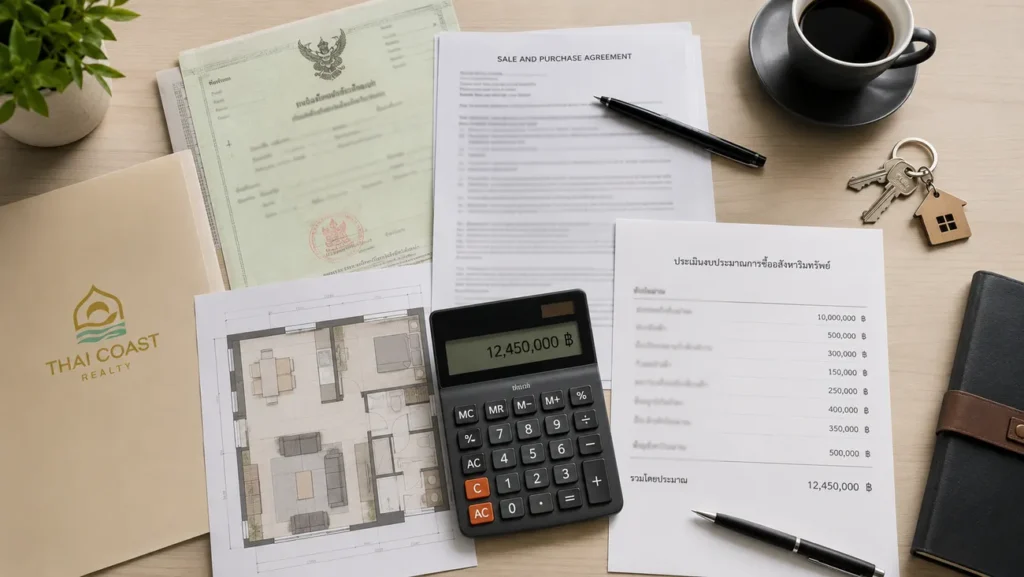
Scenario 1. Freehold Apartment in a New Construction Building
- Transaction price: 3,500,000 baht
- Official estimated value (for illustrative purposes only): 2,800,000 baht
- Seller: real estate developer
- Contractual allocation: Transfer Fee — 50/50; SBT and Withholding Tax — to be paid by the developer
- Type of Title: Freehold Condominium
| Payment | Database | Rate | Amount | Who Pays? |
|---|---|---|---|---|
| Transfer Fee | 2,800,000 ₿ (estimated) | 2% | 56,000 ₿ (buyer's share under contract 50% = 28,000 ₿) | Under the terms of the contract—50/50 |
| SBT + local tax | 3,500,000 ₿ (price > appraised value) | 3,3% | 115 500 ₿ | Developer |
| WHT (withheld at the time of registration) | 3 500 000 ₿ | 1% (company) | 35 000 ₿ | Developer |
| Sinking Fund | It depends on the project | - | To be specified in the contract | Buyer |
The buyer's expenses under the terms of this contract: Transfer Fee — 28,000 baht, plus the Sinking Fund at the project rate.
Scenario 2. Freehold Apartment on the Resale Market
- Transaction price: 4,000,000 baht
- Official estimated value (for illustrative purposes): 3,200,000 baht
- Seller: an individual
- Holding period: 2 years; the sale is classified as a commercial sale
- Contractual allocation: Transfer Fee — 50/50; SBT and Withholding Tax — paid by the seller
- Type of Title: Freehold Condominium
| Payment | Database | Rate | Amount | Who Pays? |
|---|---|---|---|---|
| Transfer Fee | 3,200,000 ₿ (estimated) | 2% | 64,000 ₿ (buyer's share 50% = 32,000 ₿) | Under the terms of the contract—50/50 |
| SBT + local tax | 4,000,000 ₿ (price > appraised value) | 3,3% | 132 000 ₿ | Salesperson |
| Withholding Tax | Calculation Using a Special Mechanism | It depends on the term and deductions | A calculation based on specific data is required | Salesperson |
Buyer's expenses: A transfer fee of 32,000 baht, as specified in this contract. The amount will vary depending on the terms of the contract.
Scenario 3. Leasehold
- Total rent for the entire term: 3,000,000 baht (30 years); no key money required
- Type: Long-term lease, registered with the Land Office
| Payment | Database | Rate | Amount | Legal taxpayer |
|---|---|---|---|---|
| Leasehold registration fee | 3,000,000 ₿ (rent; no key money required) | 1% | 30 000 ₿ | Tenant |
| Stamp Duty on a Lease Agreement | 3,000,000 ₿ (rent; no key money required) | ~0.1% (1 baht / 1,000 baht) | 3 000 ₿ | Landlord by law |
| Transfer Fee | Not applicable | - | - | - |
| SBT | Does not apply to rentals | - | - | - |
The total amount of these two registration fees, based on the specified hypothetical base, will be approximately 33,000 baht: 30,000 baht registration fee and 3,000 baht stamp duty. It is important to verify separately which party is legally responsible for each payment and how the expenses are allocated under the contract. If the contract provides for key money, it is included in the base amount for both payments and increases the total amount.
Summary Comparison Table of Scenarios:
| Script | Price / Base | Buyer's Expenses (Registration Fees) | Seller's Expenses | What Depends on the Contract |
|---|---|---|---|---|
| New Construction, Freehold | 3 500 000 ₿ | ~28,000 ₿ (50% Transfer Fee) + Sinking Fund | SBT, Withholding Tax | Distribution of the Transfer Fee |
| Freehold Secondary Market | 4 000 000 ₿ | ~32,000 ₿ (50% Transfer Fee) | SBT, Withholding Tax | Breakdown of All Fees |
| Leasehold | 3,000,000 ₿ (rent without key money) | Registration fee: 30,000 ₿; Stamp Duty: ~3,000 ₿ — the tenant's actual expenses depend on the allocation specified in the contract | - | Allocation of stamp duty for leases; existence of key money |
All examples use illustrative figures. Actual amounts depend on the specific property, the Land Office’s appraised value, whether key money is involved, and the terms of the contract.
Don't want to break down each expense item yourself? Find real estate in Thailand that fits your budget and needs — When calculating, you can take into account the form of ownership, registration fees, and additional transaction costs in advance.
Additional Expenses
Taxes and registration fees are not the only expenses involved in purchasing real estate in Thailand. It is important to clearly distinguish between government fees and other types of expenses.
The following are not government taxes but are included in the actual transaction budget:
- Legal Due Diligence — Verification of the property’s legal status, encumbrances, building permits, and the developer’s status. For foreign buyers, an independent legal review is especially recommended before making a substantial deposit or signing a binding contract. For more information: “Real Estate Due Diligence When Buying Property in Thailand".
- Registration and Administrative Expenses — Small fees for processing documents, transfers, and notary services.
- Bank Transfer — When making a payment from abroad, the sending bank charges a fee for the SWIFT transfer. The fee depends on the bank and the amount.
- Currency Conversion — When transferring funds in baht, the bank uses an exchange rate that may differ from the market rate. For large amounts, the difference is significant.
- Bank confirmation of the source of funds for a foreign buyer of a condominium. When registering foreign property within the foreign ownership quota, you must provide the proof of the relevant receipt or use of funds as required by the Condominium Act. Depending on the method of payment, this may be foreign exchange transaction documentation or other acceptable bank confirmation. The specific set of documents should be agreed upon in advance with the bank and the land registry.
- Sinking Fund — a one-time contribution to the building's reserve fund; calculated per square meter; the amount is specified in the contract or the condominium's articles of association.
- Common Area Fee (maintenance fee) — A regular fee for the maintenance of common areas; this fee may be collected in advance for several months upon the transfer of the property.
- Acceptance Costs — A technical inspection of the property before signing the acceptance and transfer certificate. An independent inspector helps identify construction defects and nonconformities. The procedure and responsibility for rectifying them depend on the nature of the defect, the terms of the contract, the developer’s warranties, and applicable regulations.
- Insurance — It is not required under Thai law for individuals, but it is advisable when renting out a property.
What to ask the seller or developer before making a deposit:
- A written calculation of the transfer fee, including the estimated value;
- Information on whether SBT or Stamp Duty applies, and who pays;
- Calculation or estimate of the seller's withholding tax;
- Contractual allocation of all registration costs;
- The amount of the Sinking Fund per square meter;
- The Common Area Fee rate and the period for which it is collected in advance;
- Common Area Fee balance (for purchases on the resale market);
- Confirmation that there is no mortgage or encumbrance on the property.
What about taxes after the purchase?
The expenses don't end on the day of registration. In Thailand, there is Land and Building Tax — a tax on land and buildings, the amount of which depends on the property category, its use, its appraised value, and any applicable exemptions.
This payment should not be confused with the Common Area Fee or the Sinking Fund: the latter are condominium expenses, not state taxes.
In this article, it is sufficient to explain the principle. Detailed rates, payment terms, and calculation examples are best covered in a separate article. "How Much Does It Cost to Maintain a Property in Thailand?".
What to Check Before a Transaction

Many risks can be mitigated by reviewing tax, registration, and contractual terms before making a deposit. Below is a practical checklist of what you need to clarify before transferring significant funds.
- Determine the form of ownership. Freehold or Leasehold—the costs, documentation, and legal implications are fundamentally different. Don't assume the type of ownership based on an advertising description.
- Request an official appraisal. The transfer fee is calculated based on the Land Office's assessed value, not the market price. This figure must be obtained or confirmed before the budget is calculated.
- Determine the seller's status. Whether the entity is an individual or a company determines how withholding tax works and how SBT is applied.
- Check how long the seller has owned the item. It determines whether SBT or stamp duty applies, as well as the amount of withholding tax for an individual.
- Obtain a written breakdown of all taxes and fees. Not just verbal promises, but a document listing specific amounts for each item. Ask the seller, the developer, or the specialist handling the transaction to prepare Preliminary settlement/closing statement: the property price, the appraised value, each government fee, the amount owed by each party, condominium fees, and other expenses. Compare this document with the contract before transferring the principal amount.
- Verify the contractual allocation of expenses. Check the contract text to determine who is responsible for paying each item: Transfer Fee, SBT, Withholding Tax, and—in the case of a leasehold—Stamp Duty on the lease and whether key money is listed in the database.
- Read the contract carefully. In particular, the provisions regarding the allocation of registration costs, the terms of the property transfer, and liability for outstanding debts.
- Make sure that the Sinking Fund and Common Area Fee are not mistaken for state taxes. These are payments of different types, and mixing them distorts the budget picture.
- Check which government benefits are in effect as of the date of registration. Temporary exemptions from the transfer fee are periodically introduced and rescinded. You should check the current announcements from the Department of Lands for the terms and conditions—rates intended for Thai citizens cannot be automatically applied to foreign buyers.
- Get the final calculation before visiting the Land Office. All figures must be agreed upon in writing by the registration date.
The total transaction budget should be calculated not based on a single interest rate, but on the specific property, the form of title, the seller's status, the appraised value, and the terms of the contract.
First, the property—then a precise calculation of the transaction.
Select the appropriate criteria, and in the list of results, you can compare properties not only by price but also by type of ownership and terms of transfer.
Take the placement quiz
What to Consider When Budgeting for a Transaction
The price listed for a property is a starting point, not the final budget. A real estate transaction in Thailand involves several payments, each with different calculation bases, different payers, and different terms and conditions.
Key takeaways for practical planning:
- The transfer fee is calculated based on the Land Office’s official appraised value, not the market price—the difference can be significant;
- The standard transfer fee rate is 2%; temporary discounts are available, but they are time-limited, subject to specific terms and conditions, and may not apply to international buyers—be sure to check before registering;
- When selling real estate, SBT and Stamp Duty related to the transfer of title are generally not assessed simultaneously; Stamp Duty on a lease agreement is a separate payment with its own rate of ~0.1% and its own legal payer—the landlord;
- Withholding Tax — a tax paid by the seller, but its amount affects negotiations regarding price and the allocation of expenses;
- Freehold and leasehold require fundamentally different calculations — Do not use the table for one form when applying it to another; for Leasehold, the database includes not only the rent but also key money, if provided for in the contract;
- Legally, part of the taxes is the responsibility of the seller or landlord, but the contract specifies who actually bears the cost—this should be verified in the text of the agreement;
- Sinking Fund, Common Area Fee, and bank fees—these are actual budget items that are not government taxes;
- A written breakdown of all expenses from the seller or developer is a prerequisite before making a significant financial commitment.
The budget calculation for a specific transaction should be verified against the current regulations of the Land Office and the Revenue Department as of the registration date, using data specific to that property. For properties with non-standard title structures—particularly villas and land parcels—it is recommended to seek separate consultation with a Thai real estate attorney or tax advisor.
Official sources for independent verification:
 Real estate in Georgia
 Real estate in Cyprus
 Real estate in UAE
 Real estate in Bali
 Real estate in Montenegro
 Real Estate in Spain
 Real Estate in Saudi Arabia
 Real Estate in Turkey
 Real Estate in Zanzibar
 +66 98 432 7651
 hello@thaicost.com
 Boat Lagoon Marina, 22/1 Moo 2, Thepkasattri Rd, Koh Kaew, Phuket 83000, Thailand




 Get TOP-7 catalog of objects