
 +66 98 432 7651


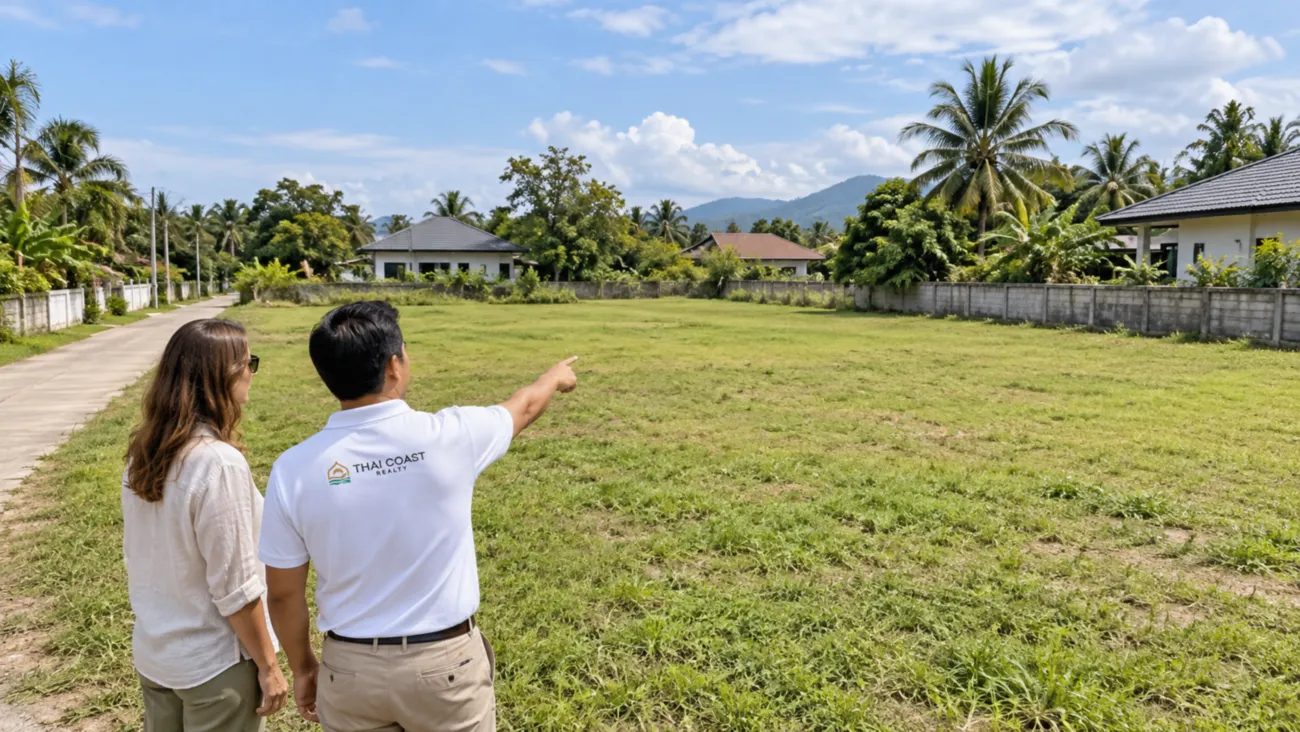
The seller’s statement that “all the documents are in order” says nothing about your rights to the land. Thai law distinguishes between several categories of land documents, and each one confirms a different scope of rights: some grant ownership, others merely confirm the right to use the plot, and still others are issued under special regimes and are not intended for free market circulation.
Basic distinction: Chanote (Chanot Thi Din; modern form—Nor Sor 4 Jor)—a land title. Nor Sor 3 Gor и Nor Sor 3 — evidence of established land use related to the right to possess a plot of land; such evidence is not equivalent to a title deed. Documents subject to restricted and special regulations include Nor Sor 2, Sor Kor 1, Sor Por Kor 4-01 и By Bor Tor 5: None of them constitutes a full-fledged land title or serves as a substitute for one.
This classification is important both when buying a villa and when signing a long-term land leases under a leasehold arrangement: It is the type of land document that determines which rights can be registered with the Land Office and what legal risks must be taken into account.
Main Types of Land Documents
Land documents in Thailand are divided into three categories, which differ fundamentally in the scope of the rights they confer.
First Group — Title deed. This is the Chanote (Nor Sor 4 Jor): it confirms the right to own, use, and dispose of a specific parcel of land, and records of transfers of title and encumbrances are noted on the back of the document and in the Land Office registry.
Second group — Certificates of Established Land Use (Nor Sor 3 Gor and Nor Sor 3). These are associated with the right to possess a plot of land based on the state’s recognition that the land has been developed and used, but they do not constitute a Chanote title. Sales, leases, and other transactions involving such plots are possible; however, the registration procedure depends on the specific type of document and the status of the plot.
Third group — notifications, permits, and special-regime documents. Sor Kor 1 — a notice of ownership; Nor Sor 2 (Bai Jong) — a temporary permit for land development with significant restrictions on transfer; Sor Por Kor 4-01 is issued as part of agrarian reform and entails a special regime; Por Bor Tor 5 pertains to the declaration of land information for tax purposes. None of these constitute a land title and none are equivalent to a Chanote.
Land Documents in Thailand: A Comparison of Forms
| Document | This confirms | What's Important for the Transaction | The main question of the audit |
|---|---|---|---|
| Chanote (Nor Sor 4 Jor) | Land Title | Registration of transfers, mortgages, leases, and other rights | Registration records on the reverse side and current status at the Land Office |
| Nor Sor 3 Gor | Confirmed land use with ownership rights; more clearly defined boundaries | Actions can be logged based on the status of the site | Ability to record the desired action, accuracy of boundaries |
| Nor Sor 3 | Confirmed land use with ownership rights; less clearly defined boundaries | A number of transactions are possible; a public notice procedure applies to sales | Accuracy of the area, composition of adjacent parcels, applicable procedure |
| Nor Sor 2 (Bai Jong) | Temporary Permit for Land Use and Development | Ordinary sales and transfers are prohibited; the exception is inheritance. | What specific actions does the document authorize; the possibility of issuing another document |
| Sor Kor 1 | Notice of Ownership, Not a Full Title | Does not establish ownership | Eligibility and Process for Obtaining a Land Title; Required Procedures |
| Sor Por Kor 4-01 | Right of Use Under Agrarian Reform | ALRO Special Mode: Significant Transmission Restrictions | Permissibility of Use and Transfer of Rights Under ALRO Rules |
| By Bor Tor 5 | Reporting Land Information for Tax Purposes | In and of itself, it does not establish a right to the land | What type of land document exists in parallel? |
How to Determine the Type of Document in Advance
| Document | Label in Thai | Visual Landmark |
|---|---|---|
| Chanote, the modern form of Nor Sor 4 Jor | No. 4, Section J. | The Red Garuda Coat of Arms |
| Nor Sor 3 Gor | No. 3, Group K. | The Green Garuda Coat of Arms |
| Nor Sor 3 | No. 3 | The Black Garuda Coat of Arms |
| Nor Sor 3 Khor | No. 3, Section C. | Black Garuda coat of arms; distinguished by a letter index |
The color of the seal helps you preliminarily identify the form, but does not confirm the document’s authenticity, the seller’s rights, or the absence of restrictions. A final verification is conducted based on the Thai designation, the details listed, and current information from the Land Office. Do not rely on the color when reviewing a black-and-white copy.
Chanote, Nor Sor 3 Gor, and Nor Sor 3
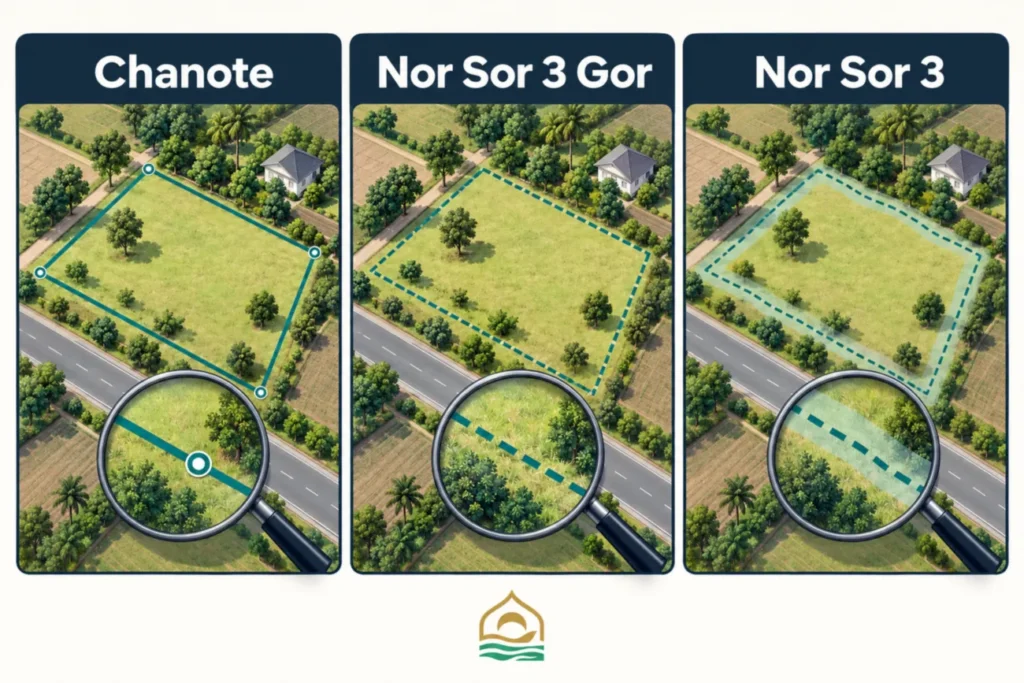
The three forms differ not only in name but also in the scope of rights, the level of detail in the plot description, and the range of permissible legal actions. It is important to understand these differences before you begin researching a specific property.
Chanote: Title to Property
Chanote (Chanot Thi Din) — a land title; the current form is Nor Sor 4 Jor (น.ส.4 จ.). The legal category of land titles also includes some older forms of documents, so the final status of a specific document must be verified at the Land Office. A Chanote certifies that a specific plot of land belongs to the registered owner and allows the owner to conduct any legally permissible transactions at the Land Office—such as sale and purchase, gifting, mortgaging, registration of long-term leases, and other rights.
A plot of land with a Chanote title has a cadastral description: its boundaries were determined during an official survey and are recorded in the state registry. The front page of the document includes the form, number, plot details, and a map. The reverse side of the Chanote contains registration records, including those regarding transfers of rights and encumbrances. These must be cross-checked against current Land Office records, with separate verification of any prohibitions on registration actions and public restrictions on land use. When conducting a verification, you should first consult the Land Office’s records and submit a request there, rather than relying solely on a photograph of the front side of the document.
However, the accuracy of the cadastral description does not automatically mean that no one disputes the actual boundaries, that the parcel has been legally exempted from protected area restrictions, or that the history of its formation is flawless. Each of these issues requires a separate review. For more details on the document’s content and its practical significance, see the article on “Chanot in Thailand".
The term “Chanote” refers to a type of land title document, not to the form of rights held by a foreign buyer. A foreigner who obtains a leasehold on a plot of land with a Chanote does not become the owner of the land—he registers a leasehold interest, and these are fundamentally different things.
An important distinction that is often overlooked: the existence of a Chanote for a plot of land does not mean that a foreigner can acquire ownership of that plot. The issue of how a foreigner’s rights are formalized is a separate matter, and it is not determined by the type of land title document.
Nor Sor 3 Gor: Confirmed Use
Nor Sor 3 Gor (น.ส.3 ก.) — a certificate of confirmed land use associated with the right to possess a plot of land. Unlike the Chanote, this document is not a title deed: it records the state-recognized fact that a specific individual has developed and used the plot. Nor Sor 3 Gor and Nor Sor 3 are not lease agreements—they constitute a separate legal category.
In terms of the clarity of its boundaries, a Nor Sor 3 Gor is closer to a Chanote than a standard Nor Sor 3: when it was issued, the boundaries were defined in greater detail, taking neighboring parcels into account. This reduces, but does not eliminate, boundary disputes. Transactions involving such plots—including sales and the registration of long-term leases—are registered with the Land Office; however, the specific procedure and feasibility of a given action depend on the status and location of the plot.
The holder of a "Nor Sor 3 Gor" title is entitled to apply for a Chanote provided that certain conditions are met: lawful ownership, compliance of the property with the requirements of the Department of Lands, completion of a cadastral survey, and resolution of any objections or disputes in accordance with established procedures. Being able to apply and being guaranteed to receive a Chanote are not the same thing. The Land Office makes the decision after reviewing all relevant factors.
Nor Sor 3: More Questions About Borders
Nor Sor 3 (น.ส.3) — also a certificate confirming land use with the right of possession, but with less certainty regarding boundaries compared to Nor Sor 3 Gor. When this document was issued, the cadastral survey was less detailed or was based on landmarks that may change or be disputed over time.
This does not mean that all transactions involving Nor Sor 3 are prohibited. Sales, leases, and a number of other transactions can be registered with the Land Office. However, When selling a plot of land with a standard Nor Sor 3 designation, a 30-day public notice procedure applies — This refers to the deadline for filing the notice, not the overall deadline for completing the transaction. The procedures, exceptions, and required documents should be clarified with the relevant Land Office. One of the risks is a discrepancy between the description of the parcel in the document and its actual boundaries and use. Before any transaction, it is important to carefully verify the actual boundaries, compare the documented area with the cadastral map, and ensure there are no disputes with neighboring plots.
In addition to the two forms described above, there is Nor Sor 3 Khor (น.ส.3 ข.)—a distinct variety that was issued in certain regions. The Latin transliterations "Gor" and "Kor" (or "Khor") may be the same or intermixed in different sources, but the Thai indices ก. and ข. refer to different documents with different issuance histories. When reviewing a specific document, refer to the Thai text rather than the Latin transcription provided in the seller’s or agency’s description.
Documents with Restricted Access
Four types of documents—Nor Sor 2, Sor Kor 1, Sor Por Kor 4-01, and Por Bor Tor 5—regularly appear in listings for the sale of land or villas, but none of them constitutes a full-fledged land title and none is equivalent to a Chanote.
Nor Sor 2 (Bai Jong) — a temporary permit to use and develop land. Land covered by such a document may not be sold or transferred to another person—the only exception is transfer by inheritance. This fundamentally distinguishes Nor Sor 2 from a Chanote and certificates of land use. The possibility of issuing a different land title document and any restrictions that would remain in effect afterward must be verified separately at the Land Office for the specific parcel. You should not assume that the conversion to a stronger title will occur automatically or based on a verbal agreement with the seller.
Sor Kor 1 — a notice of possession, not a full title to the property. The document records the fact of land use, but does not in itself confirm ownership or grant the same scope of rights as a Chanote. Sellers offering a plot with a Sor Kor 1 often mention the possibility of converting it. Here, there is an important practical detail: For the individual registration of a Chanote or a certificate of land use based on Sor Kor 1, following an application filed after February 8, 2010, a court ruling is required to confirm lawful ownership and use of the land prior to the Land Code’s entry into force. This is not a universal requirement for all methods of issuing land titles, but it significantly affects the feasibility of the seller’s promises. You should verify the applicable procedure for a specific plot of land with the Land Office, in consultation with an independent Thai attorney.
Sor Por Kor 4-01 It is issued by the Agricultural Land Reform Office (ALRO) under a special regime established by the Agricultural Land Reform Act. This document grants the right to use agricultural land in accordance with the terms of the reform; however, it imposes significant restrictions on the transfer of rights: The law establishes a special procedure and specifies the group of persons to whom such land may be transferred. Sor Por Kor 4-01 should not be considered as a basis for a standard purchase of land for a commercial villa. Simply obtaining an agricultural document does not, in and of itself, convert a plot of land into freely transferable land with a standard Chanote, nor does it permit commercial development. The ALRO verifies whether a specific use is permitted and whether the rights can be transferred.
Por Bor Tor 5 (P.B.T.5) — a form for reporting land information for the purposes of the former local land tax. By itself, it does not prove payment of the tax, ownership, or lawful possession of the land parcel. If, instead of a land title document, the seller provides this form as the primary document for the property, the legal status of the plot remains unconfirmed.
If, instead of a land title document, you are shown only the Por Bor Tor 5 tax form, that is grounds to stop and conduct a further review—and not to pay.
Signs of a deal that indicate you should put payment on hold
- Instead of a land title document, the seller provides only the Por Bor Tor 5 tax form
- The land title document is Sor Kor 1 or Sor Por Kor 4-01, and they promise to issue the Chanote after full payment has been made
- The offer is for a plot in Nor Sor 2, but the seller refers to it as “land with full title documents”
- The seller does not provide the reverse side of the land title document or refuses to do so
- An assurance that the document conversion will take “several weeks,” without any official confirmation that the application has been submitted
- Please pay in full, as the legal processing is taking place “simultaneously with payment.”
- The lot is being offered as “land for a villa,” but the document was issued under the agrarian reform program
What does this mean for a foreigner?
The issue of the type of land document and the issue of the form of registration of a foreign national’s rights are two separate matters that cannot be used interchangeably.
Legal Status of Land This is determined by the type of land document: a Chanote confirms ownership, while Nor Sor 3 Gor and Nor Sor 3 confirm use and possession; special-regime documents grant an even more limited set of rights. The type of document determines what can be registered at the Land Office with respect to that particular plot.
Form for Registering a Foreign National's Rights — a separate legal issue. As a general rule, Foreign nationals cannot purchase land in Thailand for personal ownership. The law provides for special conditions and exceptions that apply in specific cases—they are not a one-size-fits-all framework and require review with a lawyer in light of the specific situation. One option for securing land rights is a long-term lease registered with the Land Office. Registering a lease or other right does not make a foreigner the owner of the land, even if the plot has a Chanote.
Rights to the Building — This is another separate issue that is often confused with land title. A land title document and the right of ownership to a building located on a plot of land are different legal entities and different documents. A foreign national may own a building on a leased plot of land, but not the plot itself: both issues must be verified independently.
When purchasing an apartment in a registered condominium, you are asked to provide a document for a specific unit— Condominium Unit Title Deed, Form Or Chor 2 (อ.ช.2). The project's Chanote title deed does not replace it. During the verification process, the apartment number, registered area, owner, and records of encumbrances are cross-checked.
If an apartment is purchased while still under construction and the individual title has not yet been issued, this does not in itself constitute a violation. Before payment is made, the project’s land documents, permits, contract, and the procedure for subsequently registering ownership of the unit should be verified. A promise to register the apartment as property must be distinguished from an already registered title.
You should verify the land title document even in the case of a leasehold, not just when purchasing: the landlord must indeed be the registered owner, the property must not have any encumbrances that would prevent the registration of a long-term lease, and the document itself must permit the required type of registration. The distinction between freehold and leasehold is discussed in more detail in a separate article.
Check out villas and homes in Phuket


 Phuket, Rawai
 starting at 38.3 m²

 Phuket, Bang Taofrom 272m²
 Phuket, Thalangfrom 388m²

How to Inspect a Lot Before Paying
Verifying a land title document is not a mere formality, but a prerequisite for making a decision. The sequence of steps is important here: each previous step determines the purpose of the next one.
Steps for Inspecting a Lot Before Payment
- Request legible copies of both sides of the document — the front side (with details, the cadastral map, and information about the parcel) and the back side (with registration records). A refusal to show the back side is a signal to stop.
- Determine the exact form of the document and the appropriate Land Office — based on the Thai details, not on the seller’s or agent’s description. The type of document determines which agency to contact and which procedure to follow.
- Verify the registered rights holder and the seller's authority — whether the seller is the same person, and whether the power of attorney has been executed in accordance with the requirements of the competent Land Office (for land-related transactions, Form Tor Dor 21 is used, among others). If the power of attorney was executed abroad, separately verify the requirements for its certification and legalization. For a legal entity, verify the registration details, signing authority, and necessary corporate resolutions. The current rights holder is determined through the Land Office.
- Check Registered Encumbrances — mortgages, long-term leases, easements, liens, other restrictions, and prohibitions on registration actions. This is done by submitting a request to the Land Office, not by providing a photocopy.
- Compare the area, the cadastral map, and the actual boundaries — The actual boundaries may not match the description in the document. This is particularly critical for Nor Sor 3.
- Check whether there is legal access to the road — Having a private driveway or a registered easement. A plot of land without legal access from a road cannot be used properly, even if it has a Chanote.
- Check Permitted Land Use and Construction — zoning, protected areas, shoreline restrictions, permitted land uses, and maximum number of stories. These issues are not determined by the type of land document.
- Hire an independent Thai attorney for a legal assessment and, if necessary, a licensed surveyor to verify the physical boundaries on site.
- Include the terms of the inspection in the contract before payment is made — the timeframe, the list of items to be inspected, and the procedure for addressing any issues identified. The return of the deposit is not an automatic right and depends on the specific terms of the contract and applicable regulations.
A self-conducted preliminary review of the document, a title search at the Land Office, and a comprehensive due diligence process are procedures that differ in scope. A preliminary review provides a general understanding of the type and details of the document. A title search identifies the current titleholder and any registered encumbrances. Due diligence includes a legal opinion on the entire set of verified factors and recommendations regarding the structure of the transaction. For more details on this difference, see the article on A Comprehensive Property Inspection When Buying Real Estate in Thailand.
Site Inspection: What, Where, and Why One Copy Isn't Enough
| What We Check | Where to Find Confirmation | Why One Copy Isn't Enough |
|---|---|---|
| Copyright Holder | Request to the Land Office regarding the information in this document | The copy may have been modified or is out of date; the Land Office shows the current record |
| Mortgages and Registered Rights | Land Office Registry, Request to Check Encumbrances and Case Files | Encumbrances and restrictions on registration are verified at the Land Office; they are not visible on a copy of the front page |
| Borders and Area | Cadastral map from the Land Office; a surveyor, if necessary | The actual boundaries may differ from the description in the document |
| Access | Review of related documents, easements, and contract terms | Access from the road may pass through someone else's land without being legally established |
| Land Use and Construction | Local authorities, zonal plan, relevant agencies | The type of document does not specify what construction is permitted or how the lot may be used |
How to Find the Lot Area in a Document
In Thai land documents, area may be specified in rai, ngan, and square wah. To compare it with the listing, it must be converted to square meters.
| Unit | Area |
|---|---|
| 1 rai — paradise | 1,600 m² |
| 1 ngan — ngan | 400 m² |
| 1 square wah — square wah | 4 m² |
Formula: Area in m² = rai × 1,600 + ngan × 400 + square wah × 4.
For example, the entry 0–1–50 In the order "rai–ngan–square wah," it means 600 m²: 400 + 50 × 4.
Compare the lot area with the land area listed in the ad. The area of the house, terraces, pool, and total interior area are other factors to consider. Converting units does not replace verifying the property boundaries and current registration information.
There are online services available for getting a preliminary idea of a plot's location, including the official LandsMaps map. However, According to data from Thailand's Government Open Data Portal, The map display of the parcel is intended solely for familiarization with the area and does not constitute legal evidence. The online map does not show the complete, current legal status or all registered rights; therefore, it does not replace a request to the Land Office.
"Chanote" does not automatically imply the absence of building restrictions, the legality of the land's origin, or the right to use it for any purpose. Each of these issues is reviewed separately—by different agencies and according to different procedures.

Is it possible to obtain a Chanote?
Converting a document of a lower legal status into a Chanote is a feasible process, but it is neither automatic nor guaranteed. A seller’s promise to obtain a Chanote after payment is not equivalent to a decision by the Land Office, and it is crucial to distinguish between these two things.
The possibility of obtaining a Chanote depends on several factors simultaneously: the original form of the document, the legality of ownership and the history of land development, the location of the property (not all properties are eligible for a Chanote), the results of the cadastral survey, the review of any objections or disputes in accordance with established procedures, and the decision of the competent Land Office. Official Documents from the Department of Lands They point out that, for the issuance of land documents, both the legality of use and the status of the territory itself are important.
There is no universal “ladder” by which any Nor Sor 3 Gor or Nor Sor 3 will necessarily be converted into a Chanote: it all depends on the specific plot of land, its history, and its location. In some cases, the conversion is impossible due to zoning restrictions; in others, the process takes significantly longer and requires more approvals than the seller promises. An unresolved dispute with neighbors or third parties can delay or prevent the issuance of the document.
What to Ask a Seller Who Promises to Upgrade a Document's Status
- A copy of the submitted application with a receipt stamp from the Land Office
- The Land Office's official response to the application (if it has already been received)
- Information on the progress of the cadastral survey and its results
- Information regarding the existence or absence of any stated objections or disputes
- Information about restrictions that may prevent the issuance of a Chanote: protected area, shoreline, land status
- Contract Terms in the Event of Denial of Status Upgrade: Refunds, Price Changes, and Termination Procedures
If the seller does not provide supporting documents, the buyer cannot consider the application and the possibility of obtaining a Chanote to be verified. A verbal promise is no substitute for official confirmation.
Real-Life Scenarios for Buyers
Four training scenarios are discussed below. These are hypothetical examples designed to help you relate the described rules to real-world situations when selecting an object—they are not descriptions of actual transactions.
Training Scenarios: What to Check Before Making a Decision
| The Situation | What Not to Do Right Away | Next step |
|---|---|---|
| Villa in Phuket: It has a Chanote title, but access to the property is through a neighbor's land | Sign the contract, assuming that the Chanote resolves the issue of physical access | Check for an easement in the Land Office registry; if none exists, determine the basis for the use of the access road and whether it can be legally established |
| Lot on Koh Samui: Nor Sor 3 Gor; the seller promises to obtain the Chanote quickly | Pay before receiving the Chanote, or rely solely on a verbal promise | Request a copy of the submitted application from the Land Office; specify in the contract the procedures and conditions in the event of a rejection or delay |
| House in Pattaya: The seller shows only the front page of the land title document | To consider the inspection complete without seeing the reverse side | Insist on receiving a copy of the title records; independently request the current status from the Land Office |
| Apartment in Bangkok: The buyer accepts a Chanote for the project's land in exchange for the apartment deed | Sign a contract based on a land title document as proof of ownership of the apartment | Requesting a document for a specific unit within a registered condominium is a separate type of document for a different legal object |
Find a property that fits your needs
An apartment in a condominium and a villa with land require different sets of documents. Specify your budget, location, and purpose of the purchase—Thaicost Realty will suggest properties for you to compare. A legal review of the selected property is conducted separately prior to the transaction.
Starter Kit: What to Request to Begin the Review
- Legible copies of both sides of the land document
- Thai name of the document and its details: form, number, district, province
- Name of the registered rights holder as stated in the document
- Cadastral map of the lot indicating its area
- Documents confirming the seller's authority to act on behalf of the copyright holder
What to Check Before Making a Decision
The exact title of the document is just the beginning of the analysis. To decide whether to buy or lease, you need to know the legal status of the land, the registered owner, the existence of encumbrances and restrictions, the actual boundaries and area, legal access to the plot, permitted uses and authorized construction, as well as whether the selected type of document allows for the form of title registration you are planning.
A practical next step: Ask the seller for both copies of the land title document and have the documents reviewed by an independent legal professional before making any payment.
The legal information was verified in October 2026. This material is provided for general informational purposes only and is not a substitute for a professional legal assessment of a specific matter.
 Real estate in Georgia
 Real estate in Cyprus
 Real estate in UAE
 Real estate in Bali
 Real estate in Montenegro
 Real Estate in Spain
 Real Estate in Saudi Arabia
 Real Estate in Turkey
 Real Estate in Zanzibar
 +66 98 432 7651
 hello@thaicost.com
 Boat Lagoon Marina, 22/1 Moo 2, Thepkasattri Rd, Koh Kaew, Phuket 83000, Thailand




 Get TOP-7 catalog of objects