
 +66 98 432 7651



It is technically possible to transfer a large sum of money to Thailand to purchase an apartment or villa—an international bank transfer remains one of the most common and straightforward methods in terms of documentation. However, for a foreign buyer, simply transferring the money to the seller is not enough. The payment must be processed in such a way that the source of the funds, the transfer route, the sender's name, the payment description, and the bank confirmations correspond to the specific transaction. — especially when it comes to registering ownership.
In the case of a standard purchase of a condominium by a foreign buyer under a freehold title based on the transfer of funds, Thai law requires that the funds be transferred from abroad in foreign currency and be properly verified by the receiving Thai bank. That is precisely why the question of “how to pay” is not simply a choice between a bank transfer and another service—it begins with understanding the nature of the transaction and ends with retaining the bank documents after the funds have been credited.
When purchasing real estate, it is important not simply to transfer money to Thailand, but to ensure in advance that the bank can verify the foreign origin of the funds and the purpose of the payment in a format suitable for registering the transaction.
Banking routes, fees, and correspondent bank requirements are subject to change, so you should always confirm the specific channel and account details immediately before sending money—any instructions received even a few months ago may no longer be current.
How to Transfer Money to Buy Real Estate in Thailand: A Quick Guide
When a foreigner purchases a freehold condominium, the standard process is as follows:
- Obtain the contract, invoice, and official bank details from the seller or developer.
- Check with the receiving Thai bank to find out what document it will use to verify the foreign funds received for registration purposes.
- Send money from abroad in accordance with the bank's instructions and fill out the payment details correctly.
- After the funds have been credited, obtain confirmation from the receiving bank.
- Retain the contract, invoice, shipping confirmation, and proof of receipt from abroad both before and after the registration of ownership.
For leaseholds, villas, purchases made through a legal entity, and other arrangements, the payment procedures and documentation may vary.
The Land Department has separate regulations governing the documents that verify the source of funds when a foreigner purchases a condominium, so the emphasis on verifying the documents before payment is justified.
What to Check Before a Transfer
The money transfer process doesn’t start in a banking app, but with the transaction documents. Before sending even a small deposit, the buyer should clearly understand: who exactly is the recipient, which account the money is going to, whether the account details match those in the contract or official invoice, and who will prepare the documents for registration.
Check out this selection of condominiums in Thailand





 Pattaya
 from 24m²
The type of transaction determines the payment route. In a standard purchase of a condominium by a foreign buyer on a freehold basis using foreign financing, the bank confirmation of the foreign funds’ receipt is directly linked to the subsequent registration with the Land Department. For leasehold purchases or purchases made through a Thai legal entity, the requirements may differ. In the primary market, funds are typically transferred directly to the developer according to an approved payment schedule; in the secondary market, they are transferred to the seller—who may be an individual or a company—and the payment terms are agreed upon separately.
Before initiating a transfer, consider the following questions:
- Who is listed as the seller in the contract, and does this match the name of the payee on the bank details?;
- which account the funds will actually be deposited into—the developer’s account, the private seller’s account, or an escrow account;
- In what currency is the invoice issued, and is there a fixed amount in THB?;
- What is the payment schedule: deposit, interim payments, final payment;
- Is the deposit refundable, and under what conditions?;
- Who is notified of the enrollment, and who provides the supporting document;
- freehold or leasehold—and which of these requires proof of the foreign origin of the funds.
What to do before sending money:
- a signed contract or reservation agreement, depending on the stage of the transaction;
- an official invoice or payment order specifying the exact amount, currency, and payment details;
- The recipient's full bank details: name, bank name, account number, SWIFT/BIC;
- a written agreement on the purpose of the payment;
- the contact information for the party that will confirm receipt of the funds and, if necessary, arrange for a bank confirmation of the international transfer;
- the approved payment schedule, if the purchase is being paid in installments.
Any discrepancy between the name on the contract and the recipient’s name as listed in the payment details is a reason to pause and determine the cause before making the transfer, not after. For more details on how the purchase process works: “How to Buy Real Estate in Thailand".
Three things to confirm before sending money
| Who should I ask for clarification? | What to Ask |
|---|---|
| Sending Bank | Can I send the required amount using these account details? In what currency? What documents will be required? What fees might apply? What reference number will be assigned to the payment? |
| Thai recipient bank | Will he accept the transfer via the selected route; how will the transfer be classified; what document regarding the foreign transfer will he be able to issue? |
| Developer or seller | What amount should actually be received; what payment description should be used; who pays the fees; to which account should the money be sent |
It is best to send a large transfer only after the instructions from the sending bank, the receiving bank, and the parties to the transaction have been mutually agreed upon.
Ways to Transfer Money
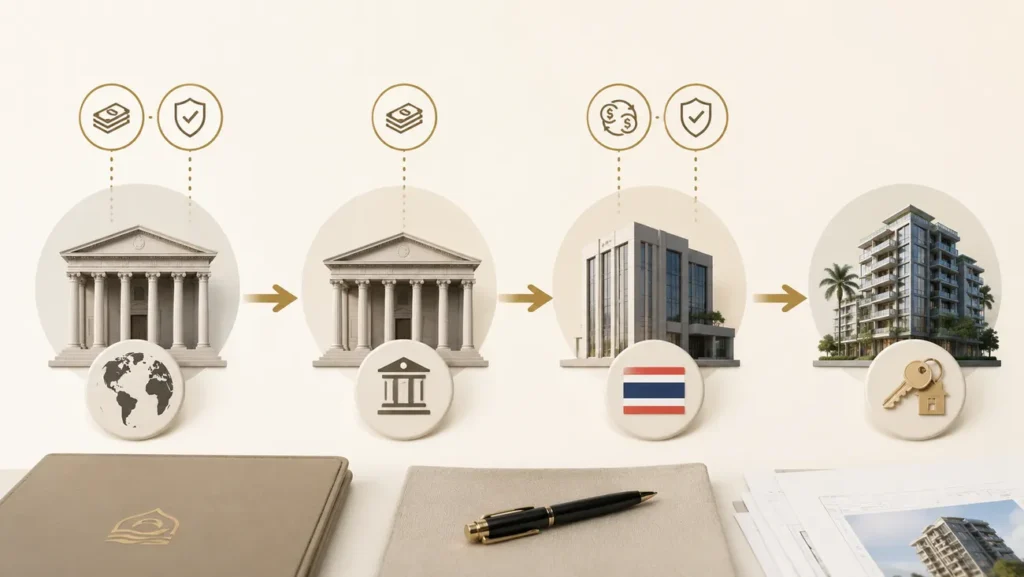
There are several ways to transfer money when purchasing real estate in Thailand, but they differ significantly in terms of the required documentation. Technically, “transferring” money and “providing documentary evidence of a foreign payment for a transaction” are not the same thing.
International Bank Transfer
Do I need to open an account at a Thai bank?
You don't need your own account in Thailand for every transaction.
In the primary market, funds can be transferred directly to the developer’s official account. When purchasing a completed property, having your own Thai bank account can be convenient for initially receiving an international wire transfer and subsequently settling the payment with the seller.
The main issue is not whether a Thai bank account exists, but whether the bank can provide documentation confirming the initial receipt of funds from abroad in a form suitable for registering a specific property.
Bangkok Bank specifically notes that when purchasing a condominium, funds from abroad can be transferred to your own Thai account, or—if you do not have one—to the developer’s account or that of another agreed-upon recipient. In any case, before making the transfer, you should clarify what document the bank will be able to provide for the subsequent registration of ownership.
A bank transfer via the SWIFT system or another international interbank route is one of the most common and transparent methods of paying for real estate in Thailand. The funds are debited from the sender’s account, pass through one or more correspondent banks, and are credited to the recipient’s account—either directly to the developer or seller, or to the buyer’s own account at a Thai bank.
Correspondent Banks — These are intermediary banks through which an international payment passes. Each of them may charge its own fee, which reduces the final amount credited. Before making a large payment, it’s a good idea to check with the sending bank about the expected route and any fees charged by intermediary banks—to the extent that the bank has this information available.
When setting up a transfer, the bank usually offers a choice of fee allocation schemes: SHA (each party pays for its own banks), OUR (the sender is responsible for standard bank fees) or BEN (All fees are deducted from the recipient’s amount.) When this option is available, “OUR” generally reduces the likelihood that fees will be deducted from the recipient’s amount; however, you should still confirm the exact amount credited with the banks, as fee processing depends on the routing. If the invoice is for a fixed amount, this issue is particularly important.
After sending the payment, save the bank’s confirmation of the international transfer and its reference number. The format of the document depends on the bank and the payment infrastructure used: while the ISO 20022 standard is used in modern interbank data transmission, the bank provides the customer with its own transaction confirmation—the name and format of which depend on the specific bank. Both documents—from the sending bank and the receiving Thai bank—must be kept, as they may be required when registering a transaction or if the bank has any questions.
Before making a large payment, some buyers test the process with a small trial transfer. This is permissible only if the terms of the contract allow for such a payment and neither bank has any restrictions. You should not split payments as a way to circumvent bank compliance—this creates additional risks rather than resolving them.
How much can a Thai bank charge for an incoming transfer?
The fee depends on the bank, the route, the account type, and the currency. Below are examples of published fee schedules from select Thai banks.
| Thai Bank | Published commission for incoming international transfers |
|---|---|
| Bangkok Bank | 0.25% of the amount, minimum 200 THB, maximum 500 THB per transaction |
| Krungsri | 0.25% of the amount, minimum 200 THB, maximum 500 THB per transaction |
These amounts refer only to the receiving bank's fee. Additional charges may include the sending bank's fee, deductions by intermediary banks, and currency conversion losses.
Bangkok Bank sets a target price of 0.25%, with a low of 200 THB and a high of 500 THB, as well as a benchmark of 1–2 business days for a standard SWIFT transfer with a correctly completed payment instruction. Krungsri publishes the same fee range.
Rates were verified in August 2026. Before making a payment, you should check the current terms and conditions directly with the bank.
Transfer from an account in a third country
For customers who send funds from Russian banks or first transfer funds to another jurisdiction, the banking routes require a separate verification process.
For some buyers, the funds are not held in their country of citizenship but in a foreign account—in the UAE, Georgia, Kazakhstan, Hong Kong, or another jurisdiction. Technically, such a transfer works similarly to a standard international transfer; however, the receiving Thai bank will evaluate it in terms of the origin of the funds and the relationship between the sender and the buyer.
Key questions for this scenario:
- Does the sender's name match the buyer's name on the contract?;
- If the payment is made by another person or company, how will the relationship with the buyer be verified?;
- Is the Thai bank willing to accept a transfer from this jurisdiction and in this currency?;
- What document will be issued as proof of foreign enrollment?
The receiving bank may request additional documents: a statement from the sender’s account, an explanation of the source of funds, or a contract. These requirements should be clarified in advance, before initiating the transfer.
Alternative Methods
In addition to traditional bank transfers, there are other payment methods—each with its own limitations when it comes to real estate transactions.
Payment Services may use local payout routes, so the transfer is not always automatically recorded by the receiving Thai bank as an international incoming payment from abroad. If confirmation of the funds’ foreign origin is required to register the transaction, you must check with the payment service and the Thai bank in advance—before sending the money—to see if it’s possible to obtain a Confirmation Letter or another acceptable document under this arrangement. For large amounts, you should also check the limits set by the specific service.
Cash. Bringing in foreign currency in cash does not, in and of itself, preclude the possibility of using those funds to purchase a condominium; however, this approach requires separate documentation. When bringing in an amount subject to customs declaration, you must file a Thai Customs declaration and retain the supporting document. For example, Bangkok Bank states that foreign currency imported for the purchase of a condominium and properly declared to customs can be presented to the bank along with the customs document when exchanging it for baht. For large transactions, a bank transfer typically leaves a simpler paper trail; therefore, the use of cash and the required set of documents must be agreed upon in advance with the receiving bank and the party handling the registration.
Bank Cards They can be used for individual small payments—if the recipient allows it—but not for the main payment for a transaction.
Digital assets (cryptocurrency). The use of digital assets should not be viewed as a direct substitute for standard bank transfers for real estate transactions. In Thailand, there are regulatory restrictions on the use of digital assets as a means of payment for goods and services through regulated digital asset operators. Converting cryptocurrency to fiat currency also does not waive the bank’s KYC/AML requirements, the need to verify the source of funds, or the requirement to document foreign remittances. If such an arrangement is being considered for a real estate transaction, it must be reviewed in advance with a Thai attorney, a licensed provider, and the receiving bank.
Payment through an intermediary — When the funds are formally transferred by a third party, prior approval from the receiving bank and a lawyer is required: if the sender’s name does not match the buyer’s name, this could create serious difficulties during registration.
Table 1. Comparison of Real Estate Payment Methods in Thailand
| Method | Documentary Evidence | Suitable for a major transaction | What to Check in Advance | Main Risk |
|---|---|---|---|---|
| International Bank Transfer | High: Confirmation from the sending bank, confirmation from the Thai bank | Yes, with the right preparation | Route, correspondents, payment purpose, document format from the receiving bank | Withholding of route commissions, delays in passage |
| Transfer from your foreign account | High, if the name matches the contract | Yes, if the sender and the buyer are the same person | Does a Thai bank accept transfers from this country? What is the confirmation format? | Request for Additional Documentation Regarding the Source of Funds |
| Payment Service | Depends on the payout route | Requires preliminary review | Is the transfer marked as international? Is it possible to receive a confirmation letter? | A local payout provider may not generate the required document for registration |
| Foreign currency cash | Possible provided that customs and banking procedures are completed correctly | Requires preliminary review | Customs declarations, bank documents, and land administration requirements | If the necessary documents are missing, it may not be possible to verify the origin and import of the funds for registration purposes |
| Bank Card | Low for large amounts | No | Does the payee accept card payments? What are the limits? | Amount Limits, Conversion Losses |
| Digital Assets / Settlement Through an Intermediary | It depends on the conversion scheme | Requires prior approval from a lawyer and the bank | Legal structure, the bank's position, documentation | Failure to Meet Freehold Registration Requirements |
Which payment method should I choose?
| The Situation | The route typically considered | The main condition |
|---|---|---|
| Buying an Apartment Directly from a Developer | International wire transfer directly to the developer | Obtain a valid document regarding admission from abroad |
| Resale Purchase | Transfer to your own Thai bank account, followed by settlement, or another method specified in the contract | Retain proof of the original foreign receipt |
| The funds are held in a proprietary account in a third country | Transfer from this foreign account | Be prepared to verify the source of the funds |
| Leasehold | As set forth in the contract | Do not automatically transfer foreign-freehold claims |
| A villa or a property with a complex ownership structure | Only after the legal structure has been determined | First, determine ownership; then, trace the money's path |
We'll find you a property with a payment plan that works for you
Are you still looking for a property? We’ll find options in Thailand that fit your budget, purchase goals, type of ownership, and a payment schedule that works for you.
This selection will include current apartments and developments in Phuket, Pattaya, Bangkok, and other popular destinations. Get a selection of properties
FET and Transfer Confirmation
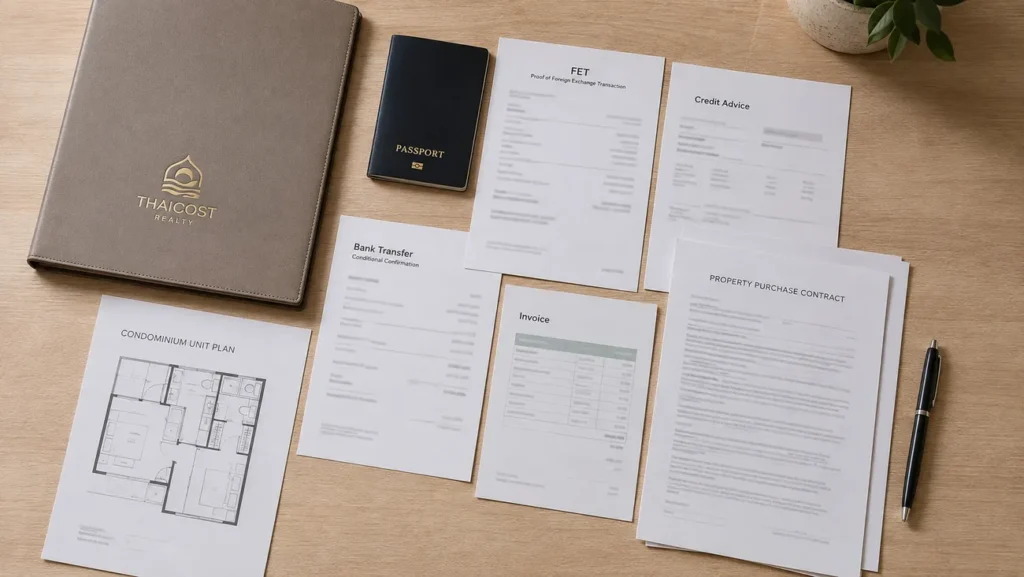
When people talk about FET (Foreign Exchange Transaction) When purchasing real estate in Thailand, this term usually refers to a bank document confirming that funds were transferred to Thailand from abroad in foreign currency. This document—or its equivalent under a different name—may be required when registering a foreigner’s title to property, particularly in the case of a standard purchase of a freehold condominium by a foreign buyer.
Terms vary by bank. Proof of Foreign Exchange Transaction — wording that highlights the key point: proof that a foreign exchange transaction was conducted from abroad. Credit Advice — a notification that a Thai bank sends to the recipient when funds are credited. Confirmation Letter for an International Fund Transfer — a term used by a number of Thai banks. These are not exact synonyms: for registration with the Land Department, a document is acceptable as long as the specific land office accepts it as proof of a foreign remittance—its name and format depend on the bank and the transfer route.
If the funds have been credited to a Thai bank but the payment is listed as a domestic transfer rather than an international transfer, you should clarify the situation in advance. Some systems allow for additional confirmation through the receiving bank; however, the procedure and required documents depend on the specific bank.
Why is this important? Government Portal Thailand.go.th It explicitly states that, in a standard condominium purchase by a foreign buyer, the funds must be transferred from abroad in foreign currency; the transfer description must specify that the funds are for the purchase of a condominium, including the project name, the unit number, and the buyer’s name—and it is precisely this bank confirmation of the funds’ receipt that is used for registration.
To register, the buyer must obtain a bank document confirming the receipt of funds from abroad in accordance with the requirements of the specific transaction and the relevant land administration office. The bank records the details of the foreign exchange transaction and provides confirmation in accordance with applicable foreign exchange regulations and its own procedures. The name, format, and process for obtaining such confirmation vary by bank and transfer route, so you should verify these details before sending the money.
It is often claimed online that an FET is only required for amounts of $50,000 or more. This figure is taken from earlier banking regulations. The previous standardized FETF form pertained to a different system; the current Bank of Thailand regulations specify different thresholds in other contexts. You shouldn't treat the historical threshold of $50,000 as the current rule for 2026 — You should check with the receiving Thai bank regarding the specific form of confirmation and the conditions for obtaining it before making the transfer.
Why do different threshold voltages for FETs appear in the sources?
Articles and bank guidelines may mention various amounts related to the verification of foreign exchange transactions. These should not be interpreted as a single, universal threshold for real estate registration.
| Amount | Where did it come from? |
|---|---|
| $20 000 | A historic milestone: Under the Bank of Thailand’s previous rules, a Foreign Exchange Transaction Form was required for currency transactions equivalent to USD 20,000 or more |
| $50 000 | In 2010, the Bank of Thailand raised the previous FET threshold from USD 20,000 to USD 50,000; therefore, this amount is still cited in bank guidelines and materials regarding the purchase of condominiums. |
| $200 000 | In the Bank of Thailand’s current guidelines, this is the threshold above which authorized banks must request supporting documents for foreign exchange transactions, subject to the exceptions provided for in the rules. |
Important: These amounts relate to changes in foreign exchange control regulations and banking documentation and do not imply that a foreign buyer of a condominium is not required to provide proof of the foreign origin of funds below a certain threshold. To complete the registration, you must check with the receiving bank in advance to determine what document it will issue for the specific transaction.
Practical conclusion: The buyer should not determine whether a document is necessary based solely on the payment amount. Before sending the money, the buyer should ask the receiving bank what specific document it can issue to record that particular transaction.
The Bank of Thailand confirms that foreign exchange transactions must be conducted through licensed market participants, and that foreign currency may generally be brought into Thailand without restrictions on the incoming transfer itself (Bank of Thailand — Exchange Control Regulations).
What information should you check in advance in the supporting document:
- name of the buyer/recipient;
- sender information;
- amount and currency;
- transaction date;
- payment description and property details, if required;
- information that confirms the foreign origin of the translation.
The exact details and format of the document should be confirmed with the bank and the party handling the registration. This must be coordinated to before sending the money, not after.
Learn how the foreign ownership quota works in a condominium and why it's important for registration: “Foreign Quota in Thailand".
How to Fill Out the Payment Details
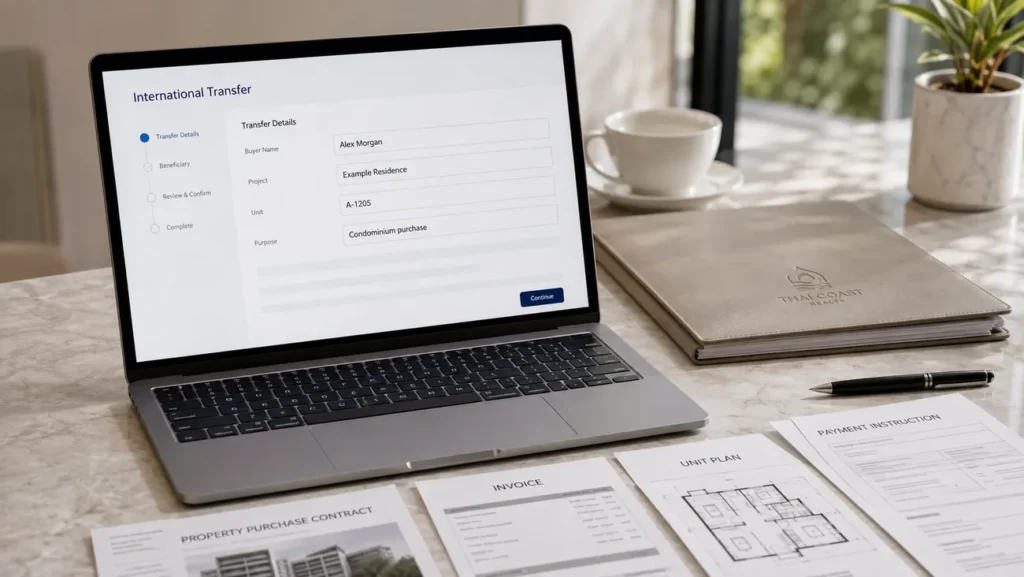
The “purpose of payment” (purpose of payment / payment details / remittance information) field is one of the most underrated aspects when sending large sums of money. It is through this field that a Thai bank understands the purpose for which the funds were received, and it is based on this information that the bank generates the foreign transfer confirmation for the transaction.
Vague descriptions such as “personal transfer” or “family support” in the purpose field create ambiguity: the receiving bank may issue a confirmation without linking it to a specific transaction, which will complicate the registration process. The payment description must reflect the actual purpose of the payment and comply with the instructions provided by the developer, the seller, and the party preparing the registration documents. The Thailand.go.th government portal explicitly states that the payment description must include the name of the condominium, the unit number, and the buyer’s name.
A standard assignment form for the purchase of a condominium looks something like this:
For the purchase of a condominium unit [Unit Number] in the [Project Name] development by [Buyer's Full Name]
This is an example, not a standard banking clause. The specific wording must be agreed upon with the developer or seller, the receiving Thai bank, and the attorney, if one is involved in the transaction. Requirements may vary depending on the project, the bank, and the payment stage.
It’s best to obtain the payment instructions in writing before sending the money: correcting a bank document after a large international transfer is much more difficult than verifying the instructions in advance.
Practical guidelines for prescribing:
- Use the Latin alphabet if specified in the bank's instructions; check with the sending bank for the exact acceptable character format;
- Enter the buyer's name exactly as it appears on their passport;
- Project name — exactly as it appears in the official designation;
- Include the unit number if it has already been specified during the payment process;
- For scheduled interim payments, check with the developer to see if you need to include the invoice number or the payment phase.
If the transfer is made in installments according to a schedule, the purpose of each payment should be agreed upon separately—the requirements for the description may vary at different stages.
Primary and Secondary Markets

The payment schedule depends largely on whether the property is being purchased from a developer or a private seller.
New building
In the primary market, the buyer typically makes an initial payment reservation fee — A small deposit to reserve the unit. After that, a Sales and Purchase Agreement is signed, and the parties agree on a payment schedule: an initial down payment, interim payments as construction progresses, and a final payment upon handover of the property.
The funds are transferred directly to the developer’s account using the official account details specified in the invoice or payment instructions. Each payment must be accompanied by a confirmation, which the developer accepts as fulfillment of the buyer’s obligations.
What to Look for When Buying a New Home:
- receive an invoice for each payment installment before it is made;
- keep a record of each payment received;
- Check with the developer to find out what documents will be required for the final handover of the property and its registration;
- With a long-term payment schedule that may span several years, bank details may change—you should double-check them before each transfer.
New Construction Projects in Phuket, with Payment in Installments

 Phuket, Bang Taostarting at 45 m²


 Phuket, Bang Taostarting at 108 m²

Secondary property
When purchasing a completed property from a private seller or a company, the process is generally more time-sensitive and less structured than in the primary market. It is often necessary to agree on the sequence of “payment—documents—registration” in advance: exactly when payment is made, when the deed of transfer is signed, and when the transfer of title is registered with the land registry.
If the buyer has opened an account at a Thai bank, they can first transfer the money to their own account and then pay the seller. In this case, it is important to ensure in advance that the bank can document the initial foreign remittance in a format suitable for registering the specific transaction. In some cases, when making a payment, the following is used for registration: cashier's check — a bank check certified by the bank. The applicability of this instrument depends on the agreement between the parties and the specific bank’s policies; check with a lawyer and the bank in advance to determine which procedure applies in your situation.
Table 2. Payments in the Primary and Secondary Markets
| Stage | New building | Secondary Market |
|---|---|---|
| First payment | Payment for the reservation in accordance with the developer's instructions | Deposit under the contract with the seller |
| Major Payments | According to the schedule in the contract, based on the invoice | Under the terms of the contract, this is usually a large payment |
| Recipient | Developer (company) | Private seller or company seller |
| Bank Documents | Invoice + confirmation of each payment | Contract + Proof of Payment |
| Final Calculation | When transferring an asset or acquiring a right | When registering a transfer of title with the land department |
| Special Audit | The Relevance of Payment Details for Each Transaction | "Payment—Registration" Sequence |
Freehold and Leasehold: How the Type of Ownership Affects Payments
The choice between freehold and leasehold is not only a legal issue but also a practical one, directly related to the type of paper trail a payment should generate.
Under the most common scheme for a foreigner to purchase a freehold condominium—where the right to purchase is substantiated by the transfer of funds from abroad—documentary evidence of the foreign currency’s entry into Thailand is required for registration. The Condominium Act also provides for other legally prescribed grounds and methods of verifying funds; therefore, the requirements should be reviewed in light of the buyer’s status and the specific transaction. This is precisely why a bank transfer with the correct payment description and confirmation from a Thai bank is not merely a recommended practice but a prerequisite for registration. For more details, see: “Freehold and Leasehold in Thailand".
For leasehold properties (long-term lease, typically for 30 years with the option to extend) the requirements for verifying the foreign origin of funds may vary. A leasehold is registered with the land department; however, the legal nature of the transaction is different, and the documentation requirements should be clarified with a lawyer as they apply to the specific property and contract.
Villas and Land Lots — That’s a separate issue. Foreigners, except in specific cases provided for by law, cannot directly own Thai land. Separate restrictions apply to villas and land parcels: a leasehold and a legally operating Thai company have different legal statuses; The use of nominal Thai shareholders solely to circumvent foreign ownership restrictions is not permitted. The structure of the transaction must be reviewed separately with a Thai lawyer. For more details: “How a Foreigner Can Buy a Villa in Thailand".
Do not apply the payment and documentation requirements for a freehold condominium to other forms of ownership—such as a villa, leasehold, or a Thai company—as these require separate consultation with a lawyer.
Key practical conclusion: Before you begin arranging the transfer, determine the form of ownership and check with a lawyer or the developer to find out what document regarding the receipt of foreign funds will be required when registering the specific property.
Table 3. What to Clarify with the Sending Bank and the Thai Receiving Bank
| Sending Bank | Thai recipient bank |
|---|---|
| Does the transfer route support Thailand? | Does it accept incoming transfers from this country? |
| Currencies Available for International Transfers | Procedure for converting to THB, if necessary |
| Fees and Transfer Limits | Admission Fee and the Procedure for Its Collection |
| Documents Required to Justify the Payment | Documents to Verify the Receipt of Funds |
| The ability to obtain a bank confirmation with a reference number | Ability to issue a Proof of FX Transaction, Confirmation Letter, or Credit Advice |
| Proposed Chain of Correspondent Banks | Will it accept a payment from a specific correspondent bank? |
Fees and Exchange Rates: The True Cost of a Translation
The amount the buyer sends and the amount the seller actually receives may differ significantly. It is important to take this into account before signing the contract, not after the money has been sent.
The total cost of the translation consists of:
- the sending bank's fees for the international transfer;
- fees charged by correspondent banks along the route;
- fees charged by the receiving Thai bank for an incoming transfer;
- the currency spread on conversion (the difference between the market rate and the bank's rate);
- possible re-conversion, if the funds were converted in several stages.
A marketing term like “fee 0%” or “best exchange rate” doesn’t necessarily mean a cheap conversion: the bank may offset the lack of a direct fee by applying a less favorable exchange rate. Compare the total amount the seller will receive, not just the stated commission.
Hypothetical example: If an invoice is issued for a fixed amount of 5,000,000 THB, the buyer must calculate how much foreign currency to send so that, after all conversions and deductions, the seller receives exactly that amount. An underpayment due to correspondent bank fees constitutes a formal breach of contract.
Example: You need to pay for an apartment that costs 5,000,000 THB
Let's say that, according to the invoice, the seller is supposed to receive exactly 5,000,000 THB.
Buyers should consider not just one fee, but several possible factors:
| Consumption | How does this affect the translation? |
|---|---|
| Invoice Total | 5,000,000 THB must be deposited into the seller's account |
| Sending Bank Fee | It depends on the bank's fee schedule |
| Commissions Charged by Intermediary Banks | May be withheld during the payment process |
| Thai Bank Commission | For example, Bangkok Bank and Krungsri have published a rate of 0.25%, but with a minimum of 200 and a maximum of 500 THB for the corresponding incoming transfers |
| Currency Conversion | The final amount depends on the bank's exchange rate at the time of processing |
Therefore, you cannot simply take the equivalent of 5,000,000 THB at the official exchange rate and send that amount. First, you need to determine who will pay the fees and what amount should actually be received by the seller.
If the contract requires a deposit of exactly 5,000,000 THB, you may need to send the remaining amount in a separate payment.
The official rates from Bangkok Bank and Krungsri confirm the example with a range of 200–500 THB specifically for the receiving bank's fee.
Practical recommendations:
- Check with both banks for a complete list of expected deductions;
- If the amount must be exact, discuss with the developer or seller who will cover the fees;
- Before making a transfer, compare the total cost of different route options: the sending bank’s exchange rate, any intermediary fees, and the receiving bank’s exchange rate; a shorter chain of conversions does not always result in a lower total cost;
- The ability to lock in an exchange rate in advance depends on the bank, the currency, the amount, and the FX instruments available to the customer. If this service is unavailable or not cost-effective, you should factor in a currency buffer when planning your payment and confirm the actual bank exchange rate immediately before the transfer.
Do not use the current THB exchange rate for long-term planning: if the payment schedule is extended, the exchange rate may change significantly during the construction period.
What a bank might ask for to verify the source of funds
For a large international transfer, the bank may request documents explaining the source of the funds. The specific documents required depend on the situation, but they may include:
| Source of Funds | What documents might they request? |
|---|---|
| Savings | Bank Statements |
| Real Estate Sales | Sales Agreement and Confirmation of Receipt of Payment |
| Sale of Another Asset | Contract or brokerage documents |
| Dividends | Payment Order and Banking Documents |
| Business Income | Financial or corporate documents |
| Transfers Between Your Own Accounts | Statements that allow you to track the movement of funds |
This is not a universal, mandatory list. The specific set of requirements is determined by the bank as part of its KYC/AML procedures.
What documents should I prepare?
The specific set of documents required depends on the bank, the country of origin, the amount, and the terms of the transaction. None of the documents listed can be considered mandatory in absolutely all situations—however, any of them may be required.
Documents that may be required when sending a package or to confirm a transaction:
- the buyer's ID (copy and/or original, depending on the bank's requirements);
- Sales and Purchase Agreement or reservation agreement;
- an official invoice or payment instruction from the developer/seller;
- the recipient's bank account information, signed by an authorized representative;
- proof of the source of funds (bank statement);
- an explanation of the source of the capital, if requested by the bank (sale of an asset, dividends, or other);
- business documents—if the funds are transferred from a corporate account;
- bank confirmation of an international wire transfer, including the reference number;
- a credit confirmation from the Thai recipient bank;
- Proof of Foreign Exchange Transaction, Confirmation Letter, Credit Advice, or another bank document confirming a foreign payment—depending on the requirements of the transaction and the Land Office;
- For remote purchases—a power of attorney and related documents prepared in accordance with current legalization requirements.
The sending bank may only request a passport and account details. The receiving Thai bank or the registration authority may request significantly more information. Prepare the documents in advance: “Documents Required for a Foreigner to Purchase Real Estate in Thailand".
Why You Should Keep Your Bank Documents After a Purchase
It is advisable to keep the documents related to the initial transfer for the entire period of ownership of the property.
You may need these:
- when the bank verifies the payment history;
- upon the subsequent sale of the property;
- when transferring proceeds from the sale outside of Thailand;
- during a bank's verification of the source of funds;
- to confirm the link between the initial investment and the subsequent receipt of funds.
Therefore, in addition to the contract and title documents, you should keep the invoice, proof of shipment, the receiving bank’s document, and the subsequent registration documents.
Errors in Money Transfers
Many problems with international payments arise not only from technical glitches, but also from errors in documentation, account details, and payment processing. The most common ones are listed below.
1. Send the money before the contract is reviewed. Refunding such a payment can be complicated and take a long time—especially if the funds have already been credited to the recipient.
2. Transfer money using the account details provided only through the messaging app. Business email compromise (BEC) is a real threat. You should verify contact information through an independent, pre-verified communication channel.
Any change to the seller’s or developer’s bank account after the contract is signed must be verified through an independent, verified communication channel.
3. Failing to verify that the payment details are current before each payment. Bank details are subject to change—especially if several months pass between payment stages. Before making each transfer, please verify the current bank details with an official representative.
4. Error in the recipient's name. If the name on the payment order does not match the recipient's account information, this may result in a delay or return of the transfer. Please check the spelling of the name in Latin characters against your official documents.
5. Incorrect payment description. An abstract or incorrect description may prevent the receiving bank from generating a correct foreign transfer confirmation for the transaction.
6. Not specifying which document the receiving bank will issue. The payment went through successfully, but the bank cannot issue a confirmation in the required format—this is a problem that is much easier to prevent than to resolve after the fact.
7. Rely solely on a “convenient” payment method without verifying its suitability. Cryptocurrency, cash, or a payment service may be convenient, but they do not always provide the documentary evidence of a foreign payment required for freehold registration.
8. Do not include correspondent fees. If an invoice is issued for a fixed amount but the recipient receives less due to fees deducted along the route, this results in a technical underpayment.
9. Converting money multiple times unnecessarily. Every conversion results in a spread loss. Before making a transfer, compare the total cost of the different routes.
10. Lose your bank statements. Shipping confirmation, payment confirmation, proof of international enrollment, and receipts—you may need all of these months down the line, when registering or in case of disputes. Keep them in both electronic and printed form.
11. Transfer funds from a third party without approval. If the sender's name does not match the buyer's name on the contract, a Thai bank may delay the transfer or refuse to issue the required confirmation. Such arrangements require prior approval.
12. Leave the payment issue to be resolved on the day of registration. The processing time and the availability of the necessary bank confirmations must be confirmed well in advance of the registration date: an international wire transfer can take several business days or longer, and compliance checks add to the processing time.
Step-by-Step Translation Guide
A specific procedure for buyers who want to make a payment securely and with the necessary documentation.
- Determine the form of ownership — freehold, leasehold, a Thai company (provided it has a valid legal business structure), or other — and check with a lawyer or the developer to find out what bank confirmation will be required for registration.
- Check the property and the seller — Make sure the contract is in order, that the seller has the right to sell, and that there are no encumbrances on the property.
- Sign the necessary documents — reservation agreement, followed by the main contract.
- Get an official invoice or payment instructions with the exact payment details, amount, and payment purpose.
- Select a bank and currency — Check with the sending bank to confirm that the transfer is possible, and with the Thai receiving bank to confirm that it is ready to accept the payment.
- Check the host bank's requirements — What type of document will he issue to confirm the foreign transfer, and in what format?
- Confirm the exact purpose of the payment in writing with the developer/seller and the bank before shipping.
- Submit the translation and keep the bank confirmation with the reference number.
- Get confirmation of enrollment from the payee and from the receiving bank.
- Request a Proof of Foreign Exchange Transaction / Confirmation Letter / Credit Advice or the relevant document from a Thai bank, if required for registration.
- Maintain a complete audit trail — contract, invoice, shipping confirmation, bank statement showing a foreign payment.
- Submit the documents the party preparing the registration with the Land Department.
Table 4. Checklist: Translation for Buying Real Estate in Thailand
| Step | What to Check | Which document should I keep? |
|---|---|---|
| 1. Form of Ownership | Freehold, leasehold, or another type of ownership structure | Contract / Legal Opinion |
| 2. Inspection of the facility | Documents Establishing Title, Seller | Audit Report |
| 3. Contract | The parties, amount, currency, and account details match | Signed Agreement |
| 4. Invoice | Exact payment details, amount, and purpose | Official invoice / payment order |
| 5. Sending Bank | Route, currency, fees, documents | Confirmation of Transfer Availability |
| 6. Receiving Bank | Will they accept the translation? What kind of document will they issue? | Written confirmation from the bank |
| 7. Purpose of Payment | Approved by the bank, the developer, and the lawyer | Written Instructions |
| 8. Sending | The details match those in the contract | Bank confirmation with a reference number |
| 9. Enrollment | The amount matches the invoice, including commissions | Credit Advice / Bank Notice |
| 10. Confirmation of a Foreign Transfer | The document contains the information required for registration | Proof of Foreign Exchange Transaction / Confirmation Letter |
| 11. Document Archive | All documents are saved in two formats | Complete set |
| 12. Submission of Documents | The documents have been submitted to the registration authority | Transfer Receipt / Confirmation |
Get a personalized selection of properties in Thailand
Tell us what kind of property you're looking for—a Thaicost specialist will find current options that fit your budget and the purpose of your purchase.
When making your selection, you can immediately take the following into account:
- budget;
- Phuket, Pattaya, Bangkok, or another location;
- an apartment for living in or as an investment;
- freehold or leasehold;
- an existing property or a new construction;
- Availability of installment plans and payment schedules.
Get a selection of properties
If the purchase is made remotely
Purchasing real estate in Thailand without the buyer’s physical presence is possible for some transactions; however, the specific scope of transactions that can be conducted remotely depends on the type of transaction and the requirements of the parties. The remote format places greater demands on written instructions, verification of details, and adherence to documentation procedures.
Who can represent the buyer? When purchasing a property remotely, it is not uncommon to grant a power of attorney to a lawyer or another authorized representative. This person may sign documents, receive keys, and be present during the registration process. The requirements for the power of attorney, notarization, consular legalization, and translation depend on the country of issuance and the requirements of the authority where the document will be used.
As of August 2026, Thailand had already acceded to the Hague Apostille Convention; however, it will not enter into force for Thailand until February 28, 2027. For documents used prior to that date, you should consult a lawyer or the appropriate authority separately to determine the applicable legalization procedure.
Special Considerations for Bank Documents When Making a Purchase Online. If necessary, the originals of bank statements and documents regarding foreign funds received must be submitted to the representative for registration. Please clarify in advance whether originals are required or if electronic copies are sufficient, and who is responsible for storing them and submitting them to the Land Department.
Verifying contact information is critically important when working remotely. When the buyer is not “on site,” the risk of receiving altered payment details via a messaging app or email increases. Any change to payment details should be verified through a pre-agreed channel—for example, by calling the developer’s official representative directly, using the phone number confirmed at the time the contract was signed.
If you’ve decided on the purpose of your purchase but haven’t yet chosen a specific property, form of ownership, or seller, it’s impossible to plan the payment schedule. Thaicost helps you find real estate in Pattaya, Phuket, Koh Samui, and Bangkok, taking into account your budget, the purpose of your purchase, and your preferred form of ownership. Find Real Estate in Thailand
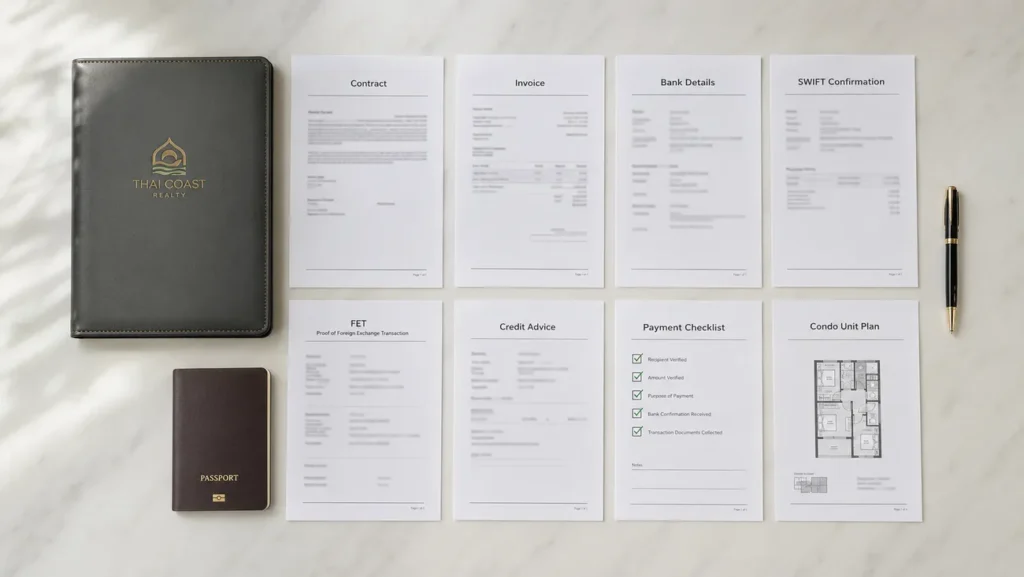
Important Things to Know Before Sending Money
The type of ownership—freehold, leasehold, or other structure—determines the requirements for proof of payment. This is the first thing you need to clarify before discussing banking options.
The bank route is arranged in advance — at both banks, taking into account available correspondent banks, currencies, and compliance requirements. Bank details and the purpose of the payment are verified through official channels, not just via messaging app correspondence.
When purchasing a freehold condominium using foreign financing, the buyer must obtain a bank document confirming the receipt of funds from abroad in accordance with the requirements of the specific transaction and the relevant Land Office. The name, format, and procedure for obtaining such confirmation depend on the bank and the transfer route, so these details should be clarified before sending the money.
All banking documents must be kept — from the shipping confirmation to the document confirming receipt. Losing these documents may cause difficulties during registration or in subsequent transactions involving the property.
Specific rules—such as fees, available routes, and the list of required documents—should be checked immediately before each transfer: the banking environment is constantly changing, and instructions that were current a few months ago may no longer reflect the current situation. Up-to-date information on the regulation of foreign exchange transactions is published on the website Bank of Thailand; requirements for documents when registering a right — on the website Department of Lands.
 Real estate in Georgia
 Real estate in Cyprus
 Real estate in UAE
 Real estate in Bali
 Real estate in Montenegro
 Real Estate in Spain
 Real Estate in Saudi Arabia
 Real Estate in Turkey
 Real Estate in Zanzibar
 +66 98 432 7651
 hello@thaicost.com
 Boat Lagoon Marina, 22/1 Moo 2, Thepkasattri Rd, Koh Kaew, Phuket 83000, Thailand




 Get TOP-7 catalog of objects