
 +66 98 432 7651



The first thing most buyers hear from friends and random sources is: “Just bring your passport—that’s all you need.” In practice, a passport is indeed the most important personal document for a foreigner, but it’s just the beginning. The full set of documents depends on the type of property, the form of ownership—freehold (full ownership) or leasehold (long-term lease), — the payment method, the buyer’s marital status, the stage of construction, and whether the registration is being handled in person or through a representative.
What Documents Do Foreigners Need? A Brief Answer
To purchase freehold condominium A foreign buyer will typically need:
- International Passport — to identify the buyer.
- Sales Contract — specifies the property, price, and terms of the transaction.
- Bank Confirmation — A FET or other bank document confirming the receipt and use of funds in accordance with the purpose of the purchase.
- Information on the Foreign Quota — confirms that, following the transaction, the established limit on foreign ownership in the condominium will not be exceeded.
- Certificate of No Debt — certifies that there are no outstanding general expenses owed to the condominium legal entity. This certificate is legally required for the registration of the transfer of title to a completed unit: The Condominium Act requires proof that there are no such outstanding debts at the time of registration.
- Title Documents and Seller's Documents — confirm ownership and the authority to sell.
- Power of Attorney — if the buyer or seller is not present in person at the time of registration.
For villas, leaseholds, and other forms of ownership, the package varies: In addition, the documents related to the land parcel and the building, the lease agreement, and—if the relevant legal structure is used—the documents pertaining to superficies or usufruct are reviewed.
Later in this article, we'll go over each document in detail: Who issues it, when to receive it, what to check before paying, and what documents you'll need to present at the land administration office.
The transaction involves not just one “set of documents,” but several separate groups. Each is responsible for its own stage:
Buyer's Personal Documents — verify the identity and information of the foreign buyer.
Bank Documents — For most foreign buyers of freehold condominiums, proof of funds received in Thailand and the legal basis used for title registration are required. For certain categories of buyers, different legal bases and forms of proof are required.
Documents for the property — confirm exactly which property is being sold, who owns it, and what rights to it have been registered.
Documents from the seller or developer — confirm the identity, authority, and right of the other party to dispose of the real estate.
Agreements and Attachments — specify the price, form of ownership, payment terms, property specifications, transfer dates, and other terms of the transaction.
Documents for the Land Office — are used directly when registering a transfer of ownership, a long-term lease, or another registrable right.
After registering, it is important for the buyer to save Final Transaction Archive: title and registration documents, contracts, bank statements, and receipts. These may be needed in the event of a future sale, lease, inheritance, or transfer of funds abroad.
The article breaks down each group by steps: what to check before payment, what to prepare for registration, and what to keep after the transaction.
General List of Documents by Group
Below is a summary list that covers most transactions. The exact composition is always determined by the type of property, the structure of the transaction, and the requirements of the specific land administration office, bank, developer, and condominium management organization (condominium legal entity). Before beginning preparations, it is worth familiarizing yourself with “How to Buy Real Estate in Thailand"…to understand when and why each document is included in the transaction."
| Group | Key Documents | Who provides | When you need |
|---|---|---|---|
| Buyer's Personal Documents | International passport; for joint purchases—marriage certificate, spouse’s documents | Buyer | At every stage |
| Bank Confirmations | Proof of an international transfer; Foreign Exchange Transaction Form (FET) or other bank document confirming receipt of foreign currency | Recipient Bank in Thailand | Prior to freehold registration |
| Contracts | Reservation Agreement; Purchase Agreement; Attachments (floor plan, specifications, payment schedule) | Seller / Developer | At the signing stage |
| Documents for the property | Condominium unit title deed; certificate of foreign ownership quota; certificate of no outstanding debt; house registration book, if applicable | Condominium (legal entity) / Seller | Before Registration |
| Seller's / Developer's Documents | Passport or ID card; title document; corporate documents and the signatory’s authorization (for legal entities); power of attorney | Seller / Developer | Before signing the contract |
| Land Administration Documents | Original passports; title deed; bank statements; contract and Land Department registration forms; certificate of foreign quota; certificate of outstanding debt; power of attorney (for remote transactions) | The buyer and seller jointly | On the day of registration |
| Receipts and Final Documents | A registered title document or a copy of the leasehold agreement; receipts from the land administration office; proof of all payments | Land Administration / Parties to the Transaction | After registration |
How many documents does a buyer typically gather?
Depending on the type of property, a foreign buyer usually has to prepare, review, and retain 20 to 40 different documents, including personal documents, bank statements, contracts, property documents, registration forms, and post-registration documents. The more complex the transaction structure (for example, a leasehold, a villa, or a transaction conducted through a company), the more documents will need to be reviewed.
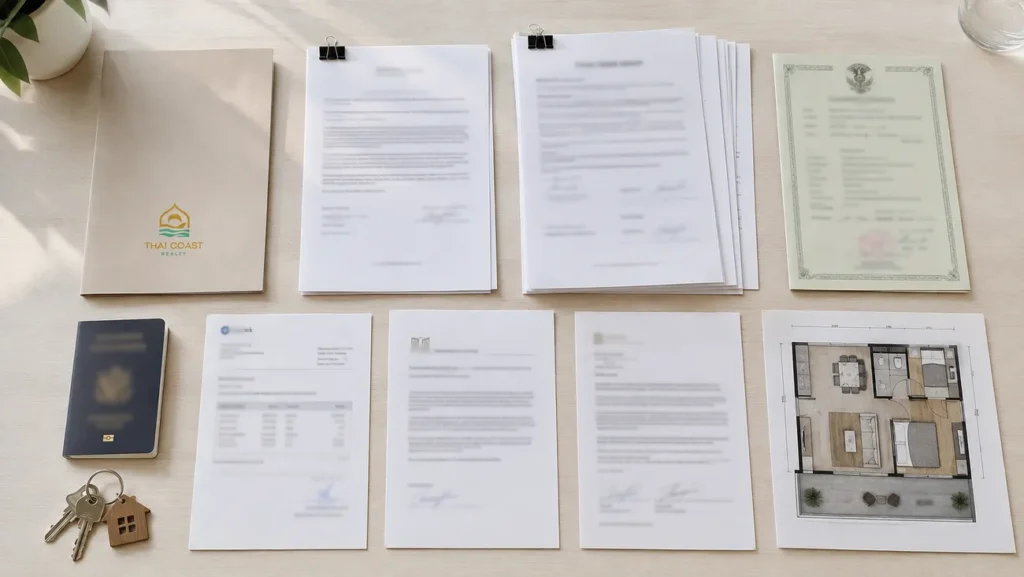
Documents of a Foreign Buyer
Personal documents are the first thing that all parties to the transaction check: the seller, the developer, the bank, and the land registry office. Any inconsistencies among them can halt the registration process even when all other documents are in order.
Passport and Personal Information
For most foreigners, a valid international passport serves as the primary form of identification. The spelling of the name in all transaction documents—including the contract, bank transfers, and land administration forms—must exactly match the spelling on the passport. A discrepancy of even a single letter, or different transliteration variations across documents, can serve as grounds for denying registration or requesting additional clarification.
Before signing the contract, make sure your passport does not expire before the expected date of registration. If you plan to renew your passport between the first payment and registration, you must notify the developer or seller in advance—you will need supporting documents linking the old and new passports. Copies of the passport are typically signed by the owner; however, specific requirements may vary among different developers and land administration offices.
The right to purchase real estate and the right to reside in Thailand are separate issues. Holding a specific type of visa is not usually a requirement in and of itself for purchasing a freehold condominium. However, the Land Department verifies the passport and documents confirming identity and the applicable basis for foreign ownership. Requirements for residence in the country and for property ownership are regulated separately.
Marriage and Joint Purchases
The buyer’s marital status has a greater impact on the required documentation than many people expect. Depending on the structure of the transaction, the spouses’ property regime, and the requirements of the land administration office, a married buyer may be asked to provide a marriage certificate, a translated copy of the document, and a spousal consent form in the prescribed format. In the case of divorce, a divorce decree is required. A joint purchase by two foreign buyers requires the presence of both parties or a properly executed power of attorney from the absent party.
Transactions in which one of the spouses is a Thai citizen require special attention. Thai citizens face no restrictions on their right to own land; however, this does not mean that a foreign spouse automatically acquires a share in such property. The structure of a joint purchase with a Thai citizen should be reviewed by an independent attorney.
A practical list of errors that occur at this stage:
- different ways of transliterating the name as it appears in the passport, contract, and bank transfer;
- a passport that had expired by the time of registration;
- missing signatures on copies of documents;
- the payment was sent from a third party's bank account, whose name does not match the buyer's name;
- The marriage documents have not been prepared in advance, which is delaying the transaction;
- The power of attorney contains errors in the scope of authority or personal information.
Bank Documents and FET
This is one of the most technically complex areas of documentation preparation—and one where errors most often occur due to oversimplified explanations.
For most foreign buyers purchasing a freehold condominium by transferring funds into Thailand, the purchase price must be transferred from abroad in foreign currency and confirmed by a document from a Thai bank. Different grounds for ownership and methods of verifying funds apply to certain categories of buyers, including some cases involving permanent residency or investment status. The requirements for a specific transaction should be clarified in advance.
Depending on the amount and the bank's procedures, the Thai bank issues Foreign Exchange Transaction Form (FET) or another bank confirmation of the receipt and conversion of currency, which must contain the information necessary for registering the transaction. A FET or other document issued by the bank must be submitted to the land registry office, provided that it confirms the receipt of funds, contains the necessary information about the transfer, and is accepted for the registration of the specific transaction. For transactions below the established threshold, the bank may issue a different certificate instead of the standard FET—the specific format should be clarified with the bank in advance.
It is important to understand two distinctions. First: The Bank of Thailand’s foreign exchange control regulations govern how foreign exchange transactions are conducted through authorized financial institutions. Second: to register a property title with the Land Department, you must provide documentary proof of the funds’ import—an FET or a similar bank document in the required format.
It cannot be guaranteed in advance that a single specific document will be accepted in all cases. Before transferring funds, you must confirm the payment instructions with the developer and coordinate the document format with the bank and the specialist assisting with the registration.
Before sending money, request written payment instructions. These instructions must specify the recipient, bank, account number, currency, purpose of the payment, the buyer’s information, and the item being paid for.
The payment description typically includes the purpose of the transfer, the project name, the unit number, and the buyer’s full name exactly as it appears on their passport. Example format:
For the purchase of a condominium, [name of condominium], unit [unit number], by [buyer's full name].
This text should not be used without prior approval: the receiving bank, the developer, or the supervising specialist must confirm the final wording before the funds are transferred.
The least risky option is a transfer from the buyer’s account, specifying the buyer’s full name, the project name, and the unit number. A transfer from a spouse, relative, company, or other third party must be coordinated in advance with the receiving bank, the developer, and the land registry, as additional documents may be required to verify the purpose of the payment and the sender’s relationship to the buyer. If the existing set of documents does not meet the bank’s or the land registry’s requirements, additional proof of the funds’ origin and purpose may be required.
Bank documents should be retained after registration: they confirm the initial import of funds and may be required by the bank when subsequently transferring proceeds from the sale abroad. Requirements for foreign exchange transactions are governed by the Bank of Thailand’s regulations.

| Bank Document | This confirms | Who issues it? | Why save it? |
|---|---|---|---|
| Foreign Exchange Transaction Form (FET) | Inflows of Foreign Currency from Abroad | Thai recipient bank | Registration of freehold title with the land administration office; confirmation of the import of funds followed by the transfer of proceeds |
| Bank credit advice / bank confirmation letter | Details and parameters of the received transfer | Thai recipient bank | Additional Confirmation of the Transaction |
| SWIFT message / payment order | Sender information, sending bank, amount, and purpose | Sender's Bank | Proof of payment route; resolution of potential disputes |
| Bank Statement | Account Transactions | Thai Bank | Verification of calculations, the source, and the flow of funds; use for tax purposes depends on the circumstances and applicable law |
| Bank Letter Regarding the Scheduling of a Transaction | Explanation of the purpose of the translation, if required | Bank (upon request) | Additional confirmation for the land administration office or in cases of complex transaction structures |
The type of ownership—freehold or leasehold—directly affects the requirements for banking documents and the registration process. For more information on these two types, see the article “Freehold and Leasehold in Thailand".
Condominium Documents
In Thai legal terms, a condominium is a building registered in accordance with the Condominium Act, where a separate title deed is issued for each apartment. This fundamentally distinguishes it from marketing-term “apartments” or ordinary residential buildings, where units do not have individual title deeds.
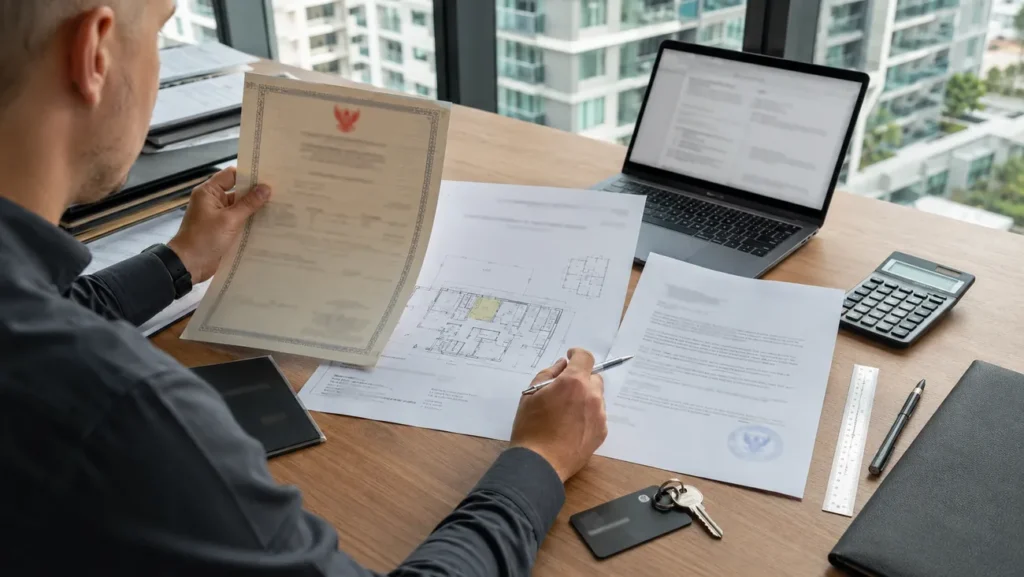
Degree and Foreign Quota
Condominium Unit Title Deed — This is a document confirming ownership of a specific unit. Before signing the contract, the buyer must verify that the owner’s name, unit number, square footage, and building details match the information specified in the contract and the agent’s offer.
The Thai Condominium Act limits the share of foreign owners in a single building: the total area of units owned by foreigners and foreign legal entities must not exceed 49% of the total area of all units in the relevant registered condominium. This is called foreign quota — foreign quota. Before registration, you must obtain a statement or certificate from the condominium's legal entity, confirming that, taking into account the planned transfer, the total area of units owned by foreign nationals will not exceed the established limit. Without this document, the land administration office will deny registration of freehold title to a foreign national. For more details on the quota mechanism, see the article “Foreign Quota in Thailand".
Certificates from the managing organization
The condominium, as a legal entity, maintains internal records of unit owners, calculates common expenses for building maintenance, and issues the certificates required for the registration of a transfer. The Land Department maintains the official registration records of ownership. Outstanding balances on general expenses may prevent the issuance of the certificate required to register the transfer of the unit. Before proceeding with the final settlement, you should obtain a current certificate confirming that there are no outstanding balances and include in the contract a provision requiring the seller to pay all charges accrued prior to the transfer of the property.
| Condominium Deed | What to Check | The main risk in the absence of |
|---|---|---|
| Condominium Unit Title Deed | Owner's name, unit number, square footage, building | Incorrect description of the property; inability to register |
| Information on the Foreign Quota | Confirmation that the established foreign ownership limit will not be exceeded after the transaction is registered | Land Administration Office's Refusal to Register Freehold |
| Certificate of No Outstanding Debt | No outstanding general payments | Inability to obtain a certificate; delay in registration; dispute over debt repayment |
| Property Registry (Blue or Yellow Book) | Registration of Residents at the Address | Confusion Over Ownership Rights |
| Legal Entity Information | Contact Information, Articles of Incorporation, Management | Challenges with Move-In and Management |
| Agreement and Attachments | Consistency of the Description of the Property with the Title Deed | Differences in area and configuration |
| Inspection or Acceptance Report | Actual Status of the Unit | Hidden defects without established liability |
| Receipts for Previous Payments | Confirmation of Payment According to Schedule | Dispute Over Debt |
This deserves a separate explanation property registry (house registration book) — a blue (tabien baan) or yellow book. This document certifies the residents’ registration at the address, not ownership. It neither confirms nor replaces a title deed. Buyers should clearly distinguish between these two different documents, which are sometimes confused in marketing materials.
Documents from the seller and the developer
The reliability of a transaction is largely determined by how thoroughly the other party’s documents are verified before the money is transferred. A detailed approach to this stage is described in the article “Property Inspection When Buying Real Estate in Thailand".

The seller is an individual. Before signing the contract, you should check the following:
- the seller's passport or Thai ID card;
- title deed — The seller's name must match the name on the title.;
- the seller's marital status: if the property is jointly owned by spouses, the consent of the other spouse may be required;
- the existence of liens, mortgages, or restrictions on sale;
- outstanding debts to the condominium or the management company;
- a power of attorney, if the seller’s interests are represented by a third party—its authenticity and the scope of authority.
The seller is a legal entity. In addition to the above, the following are checked:
- the company's incorporation documents and a current affidavit;
- the authority of the person signing the contract;
- the existence of a corporate resolution authorizing the transaction (if required by the articles of incorporation);
- documents confirming that the company has the right to dispose of a specific asset.
The developer, when purchasing during the construction phase (off-plan). The set is significantly more extensive:
- the developer's right to the land parcel on which construction is underway;
- a valid building permit;
- approved project documentation;
- an environmental permit or EIA—if required for a project of this scale and location;
- the procedure specified in the contract for completing construction, registering the building as a condominium, and subsequently obtaining an individual title deed for the unit;
- if the land or project is pledged to a bank—the conditions for releasing a specific unit from the encumbrance upon final settlement and registration of the buyer’s title;
- layout and materials specifications;
- Refund terms in the event of a delay or failure to complete construction.
Copies provided by the developer itself do not replace an independent verification. Permits for construction and land use should be verified through the appropriate government agencies.
Check out the latest residential complexes in Thailand





 Phuket, Bang Tao
 from 43.95m²

What documents differ between new construction and the resale market?
| Document or Verification | Off-plan from the developer | A completed property owned by the owner |
|---|---|---|
| Reservation Agreement | Usually, the following is required: | Can be used |
| SPA and Payment Schedule | Required; construction timelines and repayment schedules are particularly important | The price, settlement date, and registration date are set |
| Land Documents for the Project | Checked before payment | The title document for a specific property is being verified |
| Building Permit | Being checked | The legality of the existing structure is verified, if applicable |
| EIA | Checked if required by the project | Usually refers to documentation for a project that has already been completed |
| Foreign Quota | To be confirmed prior to the future transfer of freehold title | To be verified before final settlement |
| Certificate of No Debt | Appears when a registered unit is transferred | Required prior to registering the transfer of title |
| Bank Confirmation | Assembled as payments are received | Being prepared for the registration date |
| Acceptance Certificate | To be signed upon completion of construction | Saves the object's state before transfer |
Contracts at Different Stages of the Transaction
The contractual documentation is prepared in several stages. Each document records a specific aspect of the transaction and carries a different level of legal weight.
Reservations and Deposits
A reservation agreement or reservation form is the first contractual document signed when selecting a property. It specifies the unit, price, currency, form of ownership, and standard amenities, as well as the deposit terms.
A reservation document does not constitute a registered title to property. It confirms the intention but does not transfer ownership. The buyer should carefully review the terms for the return of the deposit: under what circumstances the amount is refunded, and under what circumstances it remains with the seller. It is also important to specify the timeframe within which the parties must enter into the main contract.
Sales Contract
A sale and purchase agreement (SPA) is the primary legal document for the transaction. It is not a standard form but rather a contract specifically drafted for a particular property. When reviewing it, you must ensure that the following items are correct:
- Accurate information from both parties—the names match those on their passports;
- a detailed description of the property—unit number, floor, square footage;
- type of ownership—freehold or leasehold;
- price and payment currency;
- a detailed payment schedule;
- registration procedure—who, when, and at which land administration office;
- Allocation of Taxes, Fees, and Commissions Upon Registration;
- the timeline for the transfer of the property;
- a complete list of included items, including furniture;
- liability for delays on the part of the developer or seller;
- terms of termination and the procedure for refunds;
- Governing Law and Language of the Contract.
The Thai text is used when submitting documents to government agencies. The contract itself must explicitly state which language version of a private contract takes precedence between the parties. The buyer must review the Thai text regardless of whether a translation is provided.
A practical list of contract attachments that should be included in the signed set of documents:
- unit layout;
- specifications for building materials;
- list of furniture and equipment;
- payment schedule;
- floor plan showing the location of the facility within the building;
- complex rules;
- management terms or rental pool, if applicable;
- acceptance form;
- The developer's warranty obligations.
Apartments, Villas, and Leaseholds: A Comparison of Options
Different types of transactions require fundamentally different documents. What works for a freehold condominium does not work for a land lease for a villa, and vice versa.
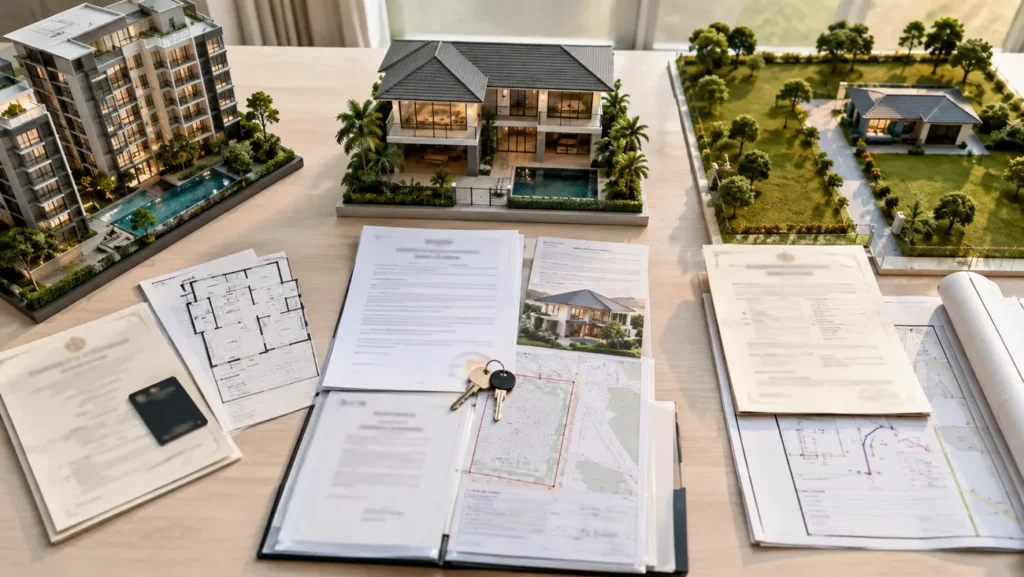
| Script | Buyer's Rights | Key Documents | What Is Recorded |
|---|---|---|---|
| Completed freehold condominium | Full ownership of the unit | Title document, FET, quota, debt-free certificate | Transfer of Ownership in Land Management |
| Off-plan condominium | Right of claim; freehold upon completion | Reservation Agreement, SPA, developer’s permits, land title documents | Registration of Title After Completion of Construction |
| Leasehold apartment | Long-term lease, typically 30 years | Lease Agreement, Registration of a Long-Term Lease | Registration of a Lease Agreement with the Land Administration Office |
| Villa on Leased Land | Lease of a land parcel and, if properly documented, separate, confirmed rights to the building | Land Lease Agreement, Building Documents, Superficies / Usufruct | Registration of a Lease and/or Real Property Right in a Building |
| Superficius | A registered right to own and use a structure located on another person's land | Registered Superficies Agreement | Separate Registration of Rights with the Land Administration Office |
| Usufruct | A registered right to use another person’s property and derive benefits from it within a specified period, without acquiring ownership | Registered Usufruct Agreement | Separate Registration of Rights with the Land Administration Office |
| Registering the property under a Thai company | This is possible only if the requirements regarding the company's status, ownership structure, and actual business activities are met | Corporate documents; property documents | Registered to a company; requires legal review |
Freehold condominium
This is the most common form of purchase for foreigners. The primary title document confirming ownership of a unit in a registered condominium is the condominium unit title deed, which contains the owner’s registered details. This right is also reflected in the Land Department’s registration records. When purchasing on the secondary market, the existing title is transferred to the new owner; for the initial transfer from the developer, the procedure depends on the completion and registration of the condominium. For most foreign buyers purchasing a unit based on the transfer of funds into Thailand, the registration requirements include compliance with the foreign ownership quota and the submission of a bank confirmation of the funds’ receipt, as accepted by the Land Department. Different requirements and documents apply to certain categories of buyers.
Find an apartment in Pattaya that's right for you

 LOVE IT Wongamat Beach


Leasehold
A long-term lease (leasehold) is an arrangement under which a foreign national does not own the property but leases it, typically for 30 years, with the option to renew under the terms of the contract. A contractual promise to extend a lease does not automatically constitute a registered right for the future term. Under the Thai Civil Code, a real estate lease agreement entered into for a term of more than three years is enforceable for only three years unless it is registered with the Land Office. It is important to verify: the correct description of the property; the exact term; registration of a long-term lease if the lease exceeds three years; conditions for transferring rights to third parties; the procedure for early termination; and the landowner’s obligations.
Villa
The purchase of a villa by a foreigner is a legally more complex scenario because, as a general rule, foreigners cannot own land in Thailand in freehold. In practice, various structures are used: land lease, superficies (the right to erect and use a structure on someone else’s land), or usufruct (the right to use property for a registered term). Leasehold, superficies, and usufruct have different legal natures: each right requires a separate legal basis and registration with the Land Department, which may be reflected in the land title, official forms, and registration records.
The set of documents for the villa may include:
- a title document for the land parcel (chanot or other type);
- a land lease agreement registered with the land administration office;
- building permit;
- documents confirming the legality of the construction and the rights to the structure: a building permit, a purchase or construction agreement, registration records, and other documents pertaining to the specific property;
- a registered right of superficiary interest or usufruct;
- documents regarding right of way and easements;
- Confirmation of connection to utilities.
The property registry may be included in the package, but it does not in itself prove ownership of the house.
For more information on opportunities for foreigners, see the articles “How a Foreigner Can Buy a Villa in Thailand".
Registering a property under a Thai company is possible only if the requirements of the Land Code and the Foreign Business Act are met—regarding the company’s status, ownership structure, source of funding, and actual business activities. Using a company or Thai nominal shareholders solely to circumvent the ban on foreign land ownership creates the risk of an investigation and the loss of rights to the property. The structure must serve a genuine, legitimate business purpose and be reviewed by independent experts.
In resort areas, where villas make up a significant portion of the real estate market, buyers often encounter structures that separate the rights to the land from those to the building. In Bangkok and Pattaya, condominiums are widely available to foreign buyers; however, the required documentation is determined not by the city but by the legal status of the specific property.
When each document is created
| Stage | What the buyer receives or checks |
|---|---|
| Before Booking | Seller's identification information, title documents, information on encumbrances, and foreign quota status |
| When booking | Boat Rental Agreement, Deposit Receipt, Description of the Selected Unit |
| Prior to signing the SPA | Results of the legal review, documents from the developer or seller, draft contract, and attachments |
| Before the funds are transferred | Written banking instructions and agreed-upon payment description |
| After the translation | FET, credit counseling, or other accepted banking documentation |
| Before Registration | Proof of foreign quota, debt-free certificate, and power of attorney (if necessary) |
| At the Land Administration Office | Registration forms, original passports, title documents, and bank documents |
| After registration | Title deed with the new owner's information, receipts, registered documents, and a complete record of the transaction |
Documents for the Land Administration Office
Land Administration — a regional office of the Land Department where ownership, lease, and other real estate rights in Thailand are registered. This is where the transfer of ownership or the registration of a long-term lease takes place. The procedure is not limited to simply submitting a set of documents: the Land Department reviews each document, and any discrepancy can result in a delay in registration.
The official list of documents that may be required from a foreign buyer for the registration of title is published at Thailand's government portal.
A practical step-by-step guide to preparing for registration:
- Preliminary Check — Check all documents for names, object numbers, and dates.
- Prepare the originals and certified copies in the required number of copies.
- Obtain bank confirmations—FET or other documents—in the required format.
- Obtain a statement regarding the foreign ownership quota and a debt-free certificate from the condominium's legal entity.
- Agree on the calculation of taxes and fees and determine who is responsible for paying them.
- Submit a complete set of documents to the land administration office.
- Both parties or their representatives sign the registration forms.
- Pay government fees and taxes.
- An employee of the land administration office makes changes to the registry.
- The parties receive the registered documents.
A typical set of documents for registration with the land administration office includes:
- the buyer's and seller's passports (originals);
- a document establishing title to the property;
- a private sales contract, as well as the required registration applications and forms from the land department—the exact set depends on the type of transfer and the branch’s requirements;
- bank confirmation of funds received (FET or another accepted document)—if the purchase is made based on the import of funds;
- a certificate regarding the foreign quota;
- a certificate of no outstanding debt;
- corporate documents and the signatory's authority (for legal entities);
- power of attorney (for remote transactions);
- documents regarding marital status and the spouse’s documents—if required based on the parties to the transaction, the property regime, and the requirements of the land administration authority;
- Proof of payment of government fees.
The Land Office has the right to request additional documents depending on the type of property, the parties’ citizenship, marital status, method of representation, and the specifics of the particular transaction. Requirements may vary by branch. You should confirm the current list in advance with the specialist assisting with the registration.
How long does it take to receive the documents?
| Document | It is usually obtained | When is the best time to ask? |
|---|---|---|
| Foreign Quota Certificate | 1–3 business days | Until the final settlement |
| Debt-Free Certificate | usually on the day of the request or within 1–3 business days | A few days before registration |
| FET or bank confirmation | Usually on the day the funds are received or within a few business days—depending on the bank | Immediately after the transfer is credited |
| Power of Attorney | depends on the country of registration | Before the registration date is set |
| Title Deed | is transferred on the day of registration | After the transaction is registered |
Remote Purchases and Power of Attorney
Many buyers purchase real estate in Thailand while residing in another country. This is possible, but it requires careful preparation of the necessary documents.

Power of Attorney grants the representative the right to act on behalf of the buyer in specific legal transactions. The form of the power of attorney must correspond to the specific transaction. A power of attorney for signing a contract and a power of attorney for registration with the land registry are different documents with different scopes of authority. Vague wording such as “to manage property” is insufficient for registering the transfer of title.
If the power of attorney is signed outside of Thailand, the Land Office may require notarization of the signature, a translation into Thai, and consular legalization, or another valid method of authenticating the document. Until the Apostille Convention enters into force for Thailand, an apostille alone does not ensure that a foreign document will be recognized under the simplified procedure set forth in the Convention. The Convention is expected to enter into force for Thailand on February 28, 2027. The necessary procedures for notarization, translation, and legalization should be confirmed in advance with the receiving land office and the relevant Thai consulate. As a rule, the original power of attorney must be submitted to the land office on the day of registration.
Remote Transaction Checklist:
- verify the identity and reputation of the representative who will act under a power of attorney;
- agree on a precise list of responsibilities—signing the contract, billing, acceptance, and registration;
- obtain a bilingual power of attorney (in Thai and the language of the country where it is signed);
- Check with your local land administration office to find out what type of certificate is accepted;
- Do not send a large payment until an independent inspection of the facility has been conducted;
- arrange for a video inspection or an independent inspection to be conducted by a representative;
- receive scans of registered documents immediately after registration;
- Ensure that the originals are received safely—either by courier or in person.
A power of attorney for an agent does not eliminate the need for a legal review of the documents pertaining to the property and the seller. It merely authorizes the agent to perform specific actions.
What Does the Buyer Receive After Registration?
Once the transaction is complete, the buyer should have a complete set of records, which will be needed in the event of a sale, lease, inheritance, or any disputes.
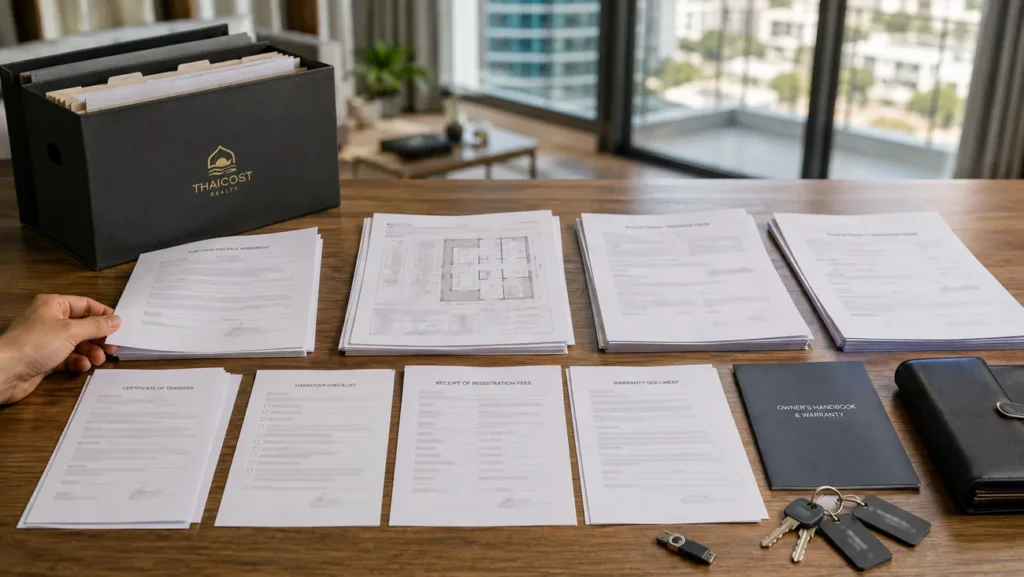
The final package, depending on the type of transaction:
- primary title document — condominium unit title deed with the owner's registered information, supported by a registration record from the Land Department;
- a registered copy of the leasehold agreement;
- building permits (when purchasing a villa);
- a registered right of superficiary interest or usufruct;
- a signed copy of the purchase agreement, including all attachments;
- specifications, floor plan, list of furniture and equipment;
- proof of all payments made;
- receipts from the land administration office confirming payment of fees;
- bank confirmations and FET;
- a transfer deed or other document evidencing the actual transfer of the property, if required by the contract;
- acceptance report documenting the unit's condition;
- warranty documents from the developer;
- complex rules;
- contact information and documents of the managing organization;
- keys, access cards, and meter readings as of the date of transfer;
- insurance documents, if applicable.
| Post-Transaction Document | Where to store | What is it used for? |
|---|---|---|
| Condominium Unit Title Deed | The original is in a secure storage facility; a digital copy | Sale, Inheritance, Mortgage, Confirmation of Title |
| FET and Bank Confirmations | Archive along with the contract | Proof of the initial import of funds; bank transfer of proceeds from a subsequent sale |
| Agreement and Attachments | A complete copy with signatures | Dispute with the developer; clarification of terms; termination |
| Acceptance Certificate | Along with the contract | Claims for Hidden Defects; Warranty Claims |
| Land Administration Receipts | Transaction Archive | Proof of payment of registration fees and taxes; documentary evidence of the transaction value for legal or tax audits |
| Warranty Documents | A separate folder | Service; Troubleshooting |
| Correspondence Regarding Changes to the Terms and Conditions | Electronic Archive | Evidence of Agreements; Disputes |
Keep a single, comprehensive file for the transaction: originals, certified copies, bank documents, contracts, attachments, correspondence regarding changes, and receipts for each payment.
| Document | It is recommended to store |
|---|---|
| Title Deed | constantly |
| SPA | constantly |
| FET | constantly |
| bank documents | constantly |
| Land Office receipts | constantly |
| warranty documents | the entire warranty period |
Errors in Documents: What Could Derail Registration
Many delays and additional requests during registration are due to inconsistencies and avoidable errors in the documents.
The customer's name is spelled in different ways in the passport, the contract, and the bank transfer. Consequence: The Land Administration may request additional documentation or postpone registration. Prevention: Agree on a single spelling before signing the contract.
The money was sent from a third party's account. Consequence: A bank or land administration office may refuse to accept the submitted set of documents without additional proof of the funds' origin and intended use. Prevention: Agree on the structure of the transfer in advance with the receiving bank, the developer, and the land administration office.
The payment description does not match the purchase of the item. Consequence: FET will not accurately reflect the purpose of the operation. Prevention: Coordinate the payment details with the developer and the bank before sending the payment.
There is no certificate regarding the foreign quota. Consequence: The Land Administration will deny a foreign national's application for freehold registration. Prevention: Request a certificate from the condominium's legal entity well in advance.
The person signing the contract on behalf of the seller is not listed as the owner in the title document. Consequence: The transfer of rights cannot be registered without documents confirming that person's authority. Prevention: Verify the original power of attorney, corporate authorization, inheritance documents, or court documents before depositing any money.
The power of attorney does not cover the required action. Consequence: The representative will not be able to register or accept the property. Prevention: Draft a power of attorney that includes a list of specific actions and coordinate its format with the land administration office.
The agreement was signed without any attachments. Consequence: controversial features, layout, or materials. Prevention: Never sign an SPA without agreed-upon attachments.
The advertising schedule differs from the contractual schedule. Consequence: Upon transfer, the property may turn out to be smaller or have a different layout. Prevention: Check the square footage and floor plan based on the contract, not the marketing materials.
Outstanding balances owed to the condominium association have not been verified. Consequence: Without a current certificate, registration of the unit’s transfer may be delayed, and a dispute may arise between the parties regarding the repayment of the debt. Prevention: Request a debt-free certificate before making the main payment.
The lease agreement, which is for more than three years, has not been registered. Consequence: A term exceeding three years generally cannot be enforced as a registered long-term lease. Prevention: Register the contract with the land administration office and verify that the ownership rights have been recorded in the land records.
The buyer accepted the promise to extend the leasehold as an unconditional right. Consequence: Once the term expires, renewal will require separate negotiations. Prevention: Specify all renewal terms in the contract; understand the difference between a promise and a registered right.
The buyer considers the house book to be proof of ownership. Consequence: a false sense of security without any real legal basis. Prevention: Require a document establishing title; do not confuse a tenant's registration with ownership.
The bank documents have not been saved. Consequence: the inability to verify the initial import of funds when transferring proceeds abroad in the future. Prevention: Keep the FET and all bank confirmations together with the contract.
Payment was made prior to the due diligence process. Consequence: The funds were transferred for a property with unresolved encumbrances. Prevention: Conduct an audit before the principal amount is paid.
Pre-Payment Checklist
- Determine the object type — a condominium, villa, or apartment without a separate title deed.
- Determine the form of ownership — freehold, leasehold, superficies, or another type of ownership structure.
- Verify the seller's identity and authority — Verify the name against the title document and confirm the right to dispose of the property.
- Verify the title document — the original, not a copy; verify all the property details.
- Check for restrictions and encumbrances — mortgage, lien, easement, prohibition on alienation.
- Confirm the foreign quota — For a freehold condominium, obtain a certificate of the condominium as a legal entity.
- Review the contract and its attachments — price, property description, schedule, fees, warranties, termination.
- Check the developer — For off-plan properties, make sure you have the necessary permits and land documents.
- Approve the banking instructions — Obtain written payment details, including the payment description; clarify which bank document will be issued once the transfer is received and accepted by the selected land administration office.
- Verify documents for the Land Administration Office — Check with a specific branch for the current list.
- Determine the allocation of registration expenses — Agree on who will pay the transfer fee for registering the transfer of title, withholding tax, special business tax, or stamp duty, if applicable to the specific transaction.
- Verify the Power of Attorney — When conducting a remote transaction, verify that the authority is valid and that the identification document is in the correct format.
- Conduct a technical acceptance inspection — to document the condition of the property prior to the final payment.
- Get and save the final archive — Collect all originals, copies, and bank statements in a single repository.
Find a property in Thailand that fits your needs and budget. Answer a few questions—the experts at Thaicost will suggest suitable properties in Pattaya, Phuket, Koh Samui, or Bangkok, taking into account the type of ownership and stage of completion. Go to the property search
Main Page
There is no single set of documents that applies to all types of transactions involving Thai real estate. A passport is just the starting point. Before sending funds, you must agree on the payment details, currency, sender’s name, and payment purpose, as well as clarify in advance which bank document will be issued after the transfer is received and accepted by the selected Land Office. The seller’s and property’s documents are verified before the principal amount is paid, not after it has been transferred.
The key differences in the required documentation are determined by the form of ownership. For most foreign buyers, a freehold condominium requires proof of eligibility under the foreign ownership quota and a bank document confirming the receipt of funds. For a leasehold property, a registered long-term lease agreement with clearly defined terms is required: without registration, an agreement entered into for more than three years is enforceable only for up to three years. For a villa, separate verification of land documents and the structure of rights to the building is required, each of which requires a separate legal basis and registration.
You should check the specific requirements of the Land Office in advance: different offices may request additional documents. After registration, all originals, bank statements, and contract attachments should be kept in a single file—they will be needed in the event of a sale, withdrawal of funds, inheritance, or potential disputes.
Before transferring funds and signing the contract, confirm the exact set of documents required for the selected property with a lawyer and the specialist handling the registration process.
Document requirements may vary depending on the type of property, the structure of the transaction, the bank, and the specific Land Office. Before transferring funds and signing the contract, you should verify the current set of required documents for the selected property.
 Real estate in Georgia
 Real estate in Cyprus
 Real estate in UAE
 Real estate in Bali
 Real estate in Montenegro
 Real Estate in Spain
 Real Estate in Saudi Arabia
 Real Estate in Turkey
 Real Estate in Zanzibar
 +66 98 432 7651
 hello@thaicost.com
 Boat Lagoon Marina, 22/1 Moo 2, Thepkasattri Rd, Koh Kaew, Phuket 83000, Thailand




 Get TOP-7 catalog of objects