
 +66 98 432 7651


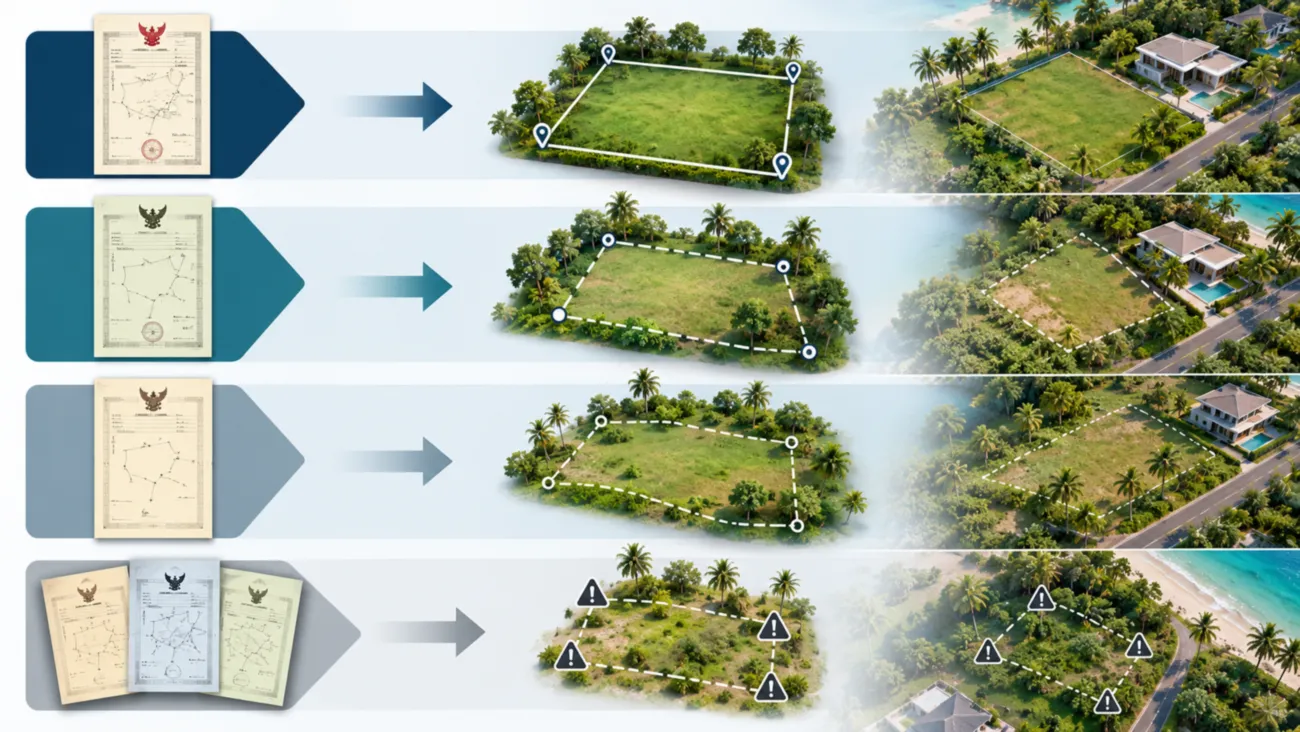
The seller says that all the paperwork is in order and shows you a copy of the title deed. You’re holding a sheet of paper with Thai characters, several diagrams, and stamps—and you don’t understand exactly what it certifies.
In real estate transactions in Thailand, the term title deed It is often used as a general term for documents pertaining to a property. However, legally, the Chanote land title must be distinguished from certificates of ownership and use of a plot—these are different legal categories with different scopes of rights. In addition to land documents, there is a separate certificate for an apartment in a registered condominium. All of these may be referred to as “title deeds” in conversation with a real estate agent, but they denote fundamentally different things.
This article explains the different types of documents used in Thailand, what each one certifies, what you need to check before transferring money, and what rights a foreign buyer has. If you want to gain a broader understanding of the purchasing process, start with the article “How to Buy Real Estate in Thailand".
Quick Answer: What You Need to Know About Title Deeds in Thailand
Title Deed is the general term for documents that confirm ownership rights to real estate in Thailand. For a plot of land, the most comprehensive title document is the Chanote (Nor Sor 4 Jor). Nor Sor 3 Gor and Nor Sor 3 confirm other categories of land rights. A separate title deed is issued for an apartment in a registered condominium. Before purchasing, you must verify the document, the owner, and any encumbrances at the Land Office.
| Question | Key Fact |
|---|---|
| Primary Title to Land | Chanote (Nor Sor 4 Jor) |
| Other Common Documents | Nor Sor 3 Gor, Nor Sor 3 |
| Foreign Ownership Quota for Condominiums | No more than 49% of total apartment area |
| The typical maximum lease term for real estate | 30 years |
| When Is Lease Registration Required? | For real estate leases with a term of more than 3 years, for the entire term |
| Exception for Foreign Land Ownership | Zone 1, with investments of 40 million THB or more and additional permits |
| Where to check registered rights | Land Office for the property's location |
| When to Conduct an Inspection | Before the non-refundable deposit and again before registration |
The terms depend on the property, the type of right, and applicable law. The existence of a Chanote does not guarantee that the transaction is legally sound.
What Is a Title Deed?
In the Thai real estate registration system, a document confirms not merely the fact of ownership, but the specific scope of rights: full ownership, recognized rights of possession and use of the land, the right to long-term use, or merely an administrative record of land occupation. One type of document allows for sale, mortgaging, and inheritance; another permits only the cultivation of the land without the possibility of alienation.
The Department of Lands of Thailand is responsible for registering property rights., its regional offices—the Land Office—are located in every province. It is there that transfers of title, liens, easements, and leases are registered. Information from the Land Office is crucial for determining registered rights and encumbrances. However, legal consequences may also arise from other documents, contracts, and court orders—these must be evaluated separately.
It is crucial to distinguish between a document and a legal right. A land title contains information about a parcel of land and registration records regarding the rights to it. After the document is initially issued, new transfers of rights and encumbrances may be registered, so it is necessary to verify not only the date of issuance and a copy of the document, but also the current status of the registration records: the owner may have changed, or the plot may have been mortgaged or placed under development restrictions. A sales contract, payment receipt, the developer’s marketing brochure, and even a notarized copy of the document are no substitute for a current extract from the registry. The property’s promotional description and the registry entry are different sources, and they often differ.
Having a copy of the title deed does not replace the need to verify the current registration of the owner, the rights to the property, and any encumbrances at the Land Office.
Suppose a seller shows you a scanned Chanote with the previous owner’s name on it. In the registry, the property has already been transferred to a third party, and the lot has an outstanding mortgage. You can’t tell this without making an inquiry at the Land Office.
Types of Land Titles
Thai land law distinguishes between several categories of documents that differ fundamentally in terms of the scope of rights, the precision of boundary definitions, and the ability to enter into transactions. It is essential to understand this hierarchy before you agree to make a deposit.
Chanote (Nor Sor 4 Jor)
Chanote (Chanote, Nor Sor 4 Jor) — the highest-level land document in Thailand. It certifies the registered ownership of a plot of land with officially established boundaries. Surveying is conducted using aerial photography and geodetic markers, and the coordinates are entered into the state registry. It is this document that makes it possible to register sales, mortgages, long-term leases, easements, and other encumbrances through the Land Office.
In doing so. Chanote does not automatically guarantee that there will be no problems. A plot of land with a Chanote may have a registered mortgage, zoning restrictions, an easement in favor of a neighbor, or structures built without a permit. The presence of a Chanote confirms the validity of the land title document, but not the legal soundness of a specific transaction. You can read more about the structure and characteristics of this document in a separate article titled “Chanot in Thailand".
Nor Sor 3 Gor and Nor Sor 3
Nor Sor 3 Gor — a separate category of certificate of lawful land use that confirms state-recognized rights of possession and use, but not full ownership in the same sense as a Chanote. A Nor Sor 3 Gor allows for many transactions, including the transfer of rights and the creation of a lien; however, The boundaries of the plot are less precisely defined...than in Chanote: the survey was conducted with less detail, and discrepancies with the actual boundaries on the ground are possible. Before the transaction, it is necessary to verify that the actual location of the boundary markers matches the information in the documents.
Nor Sor 3 — a certificate of ownership and use of a plot of land with even less clearly defined boundaries. For certain registration procedures involving a Nor Sor 3, a public notice procedure applies, typically requiring a 30-day period. It is necessary to check with the Land Office in advance to determine whether this is required for a specific transaction and how it affects the processing time for the transaction.
Sometimes you may hear that a Nor Sor 3 Gor or Nor Sor 3 can be “converted to a Chanote.” Such a procedure does exist, but it requires following the established process at the Land Office. Depending on the legal basis and the characteristics of the plot, additional surveying may be required. The outcome and timeline are not guaranteed—they depend on the specific plot, the existence of disputes with neighbors, and the position of the local office. You shouldn't purchase a property with the expectation that it will eventually be converted to a Chanote as a guaranteed outcome.
Documents with Restricted Access
Sor Kor 1 — a notice of land occupation, not a title document. Such a document records the fact that the plot has been occupied but does not confirm ownership or the right of possession recognized under the Land Code. It cannot be used as the basis for registering a sale or a mortgage through the Land Office in the usual manner.
By Bor Tor 5 — a document related to registration with local administrative authorities. It may be used as a basis for taxation or in resolving administrative matters, but is not a title document as defined in the Land Code.
Sor Por Kor 4-01 (SPK 4-01) This falls under the special land use regime established by the agricultural reform. Rights under this regime are limited by the designated use of the land and the terms of the relevant legislation. Special re-registration procedures are provided for certain rights holders; however, these do not convert such plots into ordinary, freely tradable real estate under the Chanote system.
These documents are not “weak Chanote” documents—they fall into a fundamentally different legal category. It is important to distinguish between administrative, tax, and title documents. The ability to register a transfer of rights depends on the category of the land document, the nature of the right being transferred, and compliance with the established procedure. An administrative or tax record does not, in and of itself, confirm ownership of a plot of land.
What kinds of titles are there in Thailand?
| Document and Thai designation | What right does this affirm? | Accuracy of Boundaries | Transferability of Rights | The Main Risk for the Buyer |
|---|---|---|---|---|
| Chanote (Nor Sor 4 Jor) Land Title / N.S. 4 J. | Full, registered title to the land | High, official land surveying | Sale, Mortgage, Lease, Easement, and Other Registered Rights | Mortgages, encumbrances, zoning restrictions, illegal structures |
| Nor Sor 3 Gor N.S. 3 G. | Recognized rights to ownership and use of a plot of land (certificate of utilization); not equivalent to a Chanote | The boundaries have been defined based on cartographic data, but need to be verified | The transfer of rights is possible provided that the established procedure is followed | Border discrepancies, legal restrictions, and complications in the registration process |
| Nor Sor 3, Year 3 | Recognized rights to possession and use of a plot of land; not equivalent to full ownership under the Chanote system | Less well-defined boundaries | The transfer of rights is possible; public notice is required for certain registration actions | Border disputes, additional procedures, registration delays |
| Sor Kor 1, Sept. 1 | Notice of Land Occupancy That Does Not Constitute a Full Land Title | Official borders are not established based on such a document | Does not constitute an independent basis for standard registration of a land sale | The lack of a valid title and the inability to register the transaction in the usual manner |
| Por Bor Tor 5 ภ.บ.ท.5 | An administrative or historical tax document that does not establish ownership | Does not establish the legal boundaries of the lot | Does not constitute grounds for standard registration of a transfer of ownership | Mistaking a Tax Document for a Land Title |
| Sor Por Kor 4-01 S.P.K. 4-01 | Land Use Rights Under the Agricultural Reform Framework | These are defined by specific documents and procedures | Subject to specific legislation and the terms and conditions of provision | Restrictions on the Transfer, Use, and Development of Land |
A Chanote is generally preferred for land transactions. Nor Sor 3 Gor and Nor Sor 3 may also be used to formalize the transfer of rights, but require a separate assessment of their legal status, the accuracy of their boundaries, and the registration process. If the seller is offering a property with lower-category documents, it is essential to consult an independent attorney to understand the legal implications of such a purchase before making any payments.
For a foreigner, eligibility to purchase land is reviewed on a case-by-case basis: even a Chanote does not override statutory restrictions.
How to Read Chanote
Understanding the contents of the Chanote allows you to ask the right questions of the seller and your attorney even before the formal review begins. The document has a front and a back, each of which contains specific information.
Chanote documents typically bear the heading “โฉนดที่ดิน” and the designation “N.S. 4 J.” In reference materials, land documents are also distinguished by their layout and color elements. However, the color of the seal, the image of Garuda, or the appearance of the form cannot be used as independent evidence of authenticity. The document category and current registered rights must ultimately be confirmed through the Land Office.
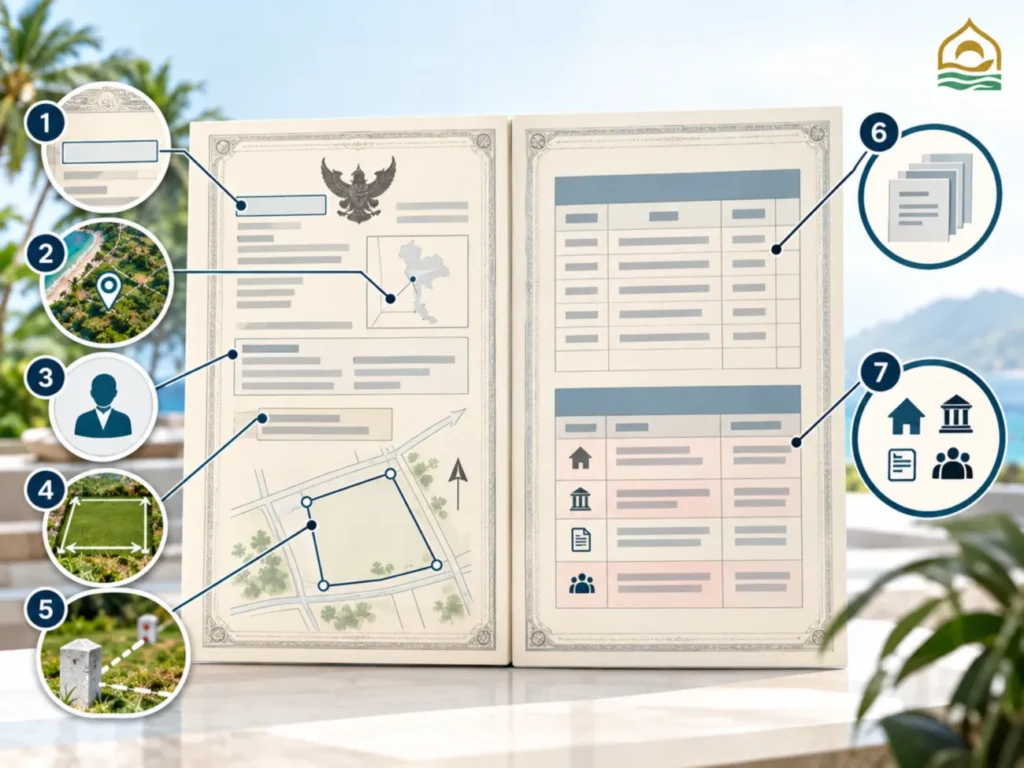
On front side The following are usually listed:
- Title Number — the unique identifier of the document in the registry of a specific Land Office.
- Province, district, subdistrict (tambon), and plot number — allow you to locate an object in the registry.
- Name of the Registered Owner — You must verify the information not only against the seller’s identification document but also against the most recent registration records. Do not rely solely on the name visible on the front of the copy: the history of transfers of ownership is reflected in the entries on the back and in the registry records.
- Lot area in Rai, Ngan, and Square Wah (square wah): 1 Rai = 1,600 m², 1 Ngan = 400 m², 1 Square Wah = 4 m². For example, a plot measuring 1 Rai, 2 Ngan, and 50 Square Wah has an area of 1,600 + 800 + 200 = 2,600 m².
- Site Plan indicating the configuration and cadastral landmarks.
On on the reverse side The following are recorded:
- Registered transfers of ownership, with dates.
- Mortgage — if the property is mortgaged, this information must be included here.
- A long-term lease (leasehold) registered with the Land Office.
- Easements—the right of way or the right to install utilities for the benefit of neighboring properties or other parties.
- Usufruct or superficies—if such rights have been registered.
The appearance of the forms and the completeness of the entries may vary depending on the region and the year the document was issued. The legal validity of a specific entry must be verified with the Land Office, not just based on a copy provided by the seller.
Example: How to Verify Chanote Data Before Purchasing
Suppose a seller is offering a villa on a lot measuring 1 Rai, 2 Ngan, and 50 Square Wah, and the listing description states 2,800 m².
According to the land title document, the area is:
1,600 + 800 + 200 = 2,600 m².
The difference from the advertisement is 200 m². This does not prove fraud, but it does require an explanation: the advertisement may have included an adjacent property, the lot may have been described incorrectly, or the seller may have included an area for which they do not have the appropriate rights.
Before purchasing, you must verify the title number, the cadastral map, the current owner, and the actual boundaries. If the property is being sold together with a villa, the ownership of the building and the building permits must be verified separately.
This is a hypothetical example; it does not describe an actual transaction.
What to Look for in the Document
| Field or record | What does that mean? | What to Check | A Possible Problem |
|---|---|---|---|
| Owner's Name | A person with a registered right | With the seller's passport, power of attorney, and most recent registration records | Discrepancy: The seller and the owner are different individuals |
| Parcel number and subarea | Identification in the registry | Including the property address and information from the Land Office | The title refers to a different lot |
| Area | Recorded measurements | With a marketing description and actual measurements | Discrepancy with the advertisement or the actual property |
| Site Plan | Configuration and Guidelines | With the actual boundaries on the ground | Overlapping with an adjacent lot or road |
| Mortgage (turnover) | Security in favor of the creditor | Existence/absence of a record, validity | Upon transfer of title, a mortgage may continue to encumber the property if it has not been paid off or released in accordance with established procedures |
| Rent (turnover) | Tenant's Registered Right | Term and Conditions | The buyer purchases the property with an existing tenant |
| Easement (turn) | Third-Party Rights to a Portion of the Lot | Nature and Scope of the Easement | Restrictions on the development or use of part of a lot |
After reviewing the document, it is important to remember: Even a correctly filled-out Chanote in the seller's possession does not constitute a current extract from the registry. You should check the encumbrance status directly at the Land Office shortly before the transaction.
Title Deed for an Apartment and a Villa
The type of document depends not only on the type of property but also on its legal structure. The three situations that buyers most commonly encounter are structured differently from a legal standpoint.

1. An apartment in a registered condominium. For an apartment in a condominium registered under Thailand’s Condominium Act, a separate certificate of ownership is issued for that specific apartment. The land on which the condominium is built has its own land title (typically, Chanote), which constitutes the common property of all unit owners. The buyer receives registered ownership of the specific unit and a corresponding share in the condominium’s common property, including rights to the land beneath the building as part of the common property. This share is not a separate parcel of land that can be sold separately or registered in one’s own name. It is important to understand this distinction when reviewing documents.
Does an apartment in a complex under construction have a title deed?
When purchasing an apartment that is still under construction, a separate title deed for the apartment may not yet have been issued. The buyer enters into a contract with the developer but does not become the registered owner of the apartment simply by signing the contract or making payments.
Before purchasing, you must verify the project’s land title, the developer’s right to use the land, building permits, the prescribed procedure for registering the condominium, and the terms of the future transfer of ownership.
It is important to verify separately whether the land on which the project is located is encumbered by a mortgage and how the specific apartment will be released from any such encumbrances by the time of transfer.
2. A villa on its own lot. In this case, it is necessary to separately verify the land title (Chanote or Nor Sor 3 Gor) and the legal status of the building. The building permit, information about the developer, the building transfer agreement, and the registered rights to the land plot should be considered together. Ownership of the building does not automatically arise from a land lease agreement, and the mere presence of a building does not mean that it was constructed in compliance with all permitting requirements.
3. A villa or house on leased land (Leasehold). This is a common practice, especially in areas where it is difficult for foreigners to purchase land. Under a standard long-term real estate lease in Thailand, the lease term is generally limited to thirty years. Leases with a term of more than three years must be registered with the Land Office to ensure they remain valid for the entire agreed-upon period. Renewal does not occur automatically — It depends on the law, the text of the contract, and the ability to enter into and register a new agreement. A foreign buyer may enter into a land lease and, provided there is an appropriate legal basis, separately acquire or register rights to a building: the scope of these rights must be verified based on the documents for the specific transaction. For more details on the differences between these forms of ownership, see the article “Freehold and Leasehold in Thailand".
What documents are required for different types of properties?
| Object Type | What rights does the buyer acquire? | What documents are checked? | Special Considerations for Foreigners | Major Legal Risk |
|---|---|---|---|---|
| Freehold Apartment in a Condominium | Registered ownership of an apartment | Apartment title deed, condominium registry, certificate regarding the foreign ownership quota | Permitted provided that the foreign quota on area is observed | Exceeding the Quota or Failure to Register a Condominium Under the Law |
| Leasehold Apartment in a Condominium | Registered Long-Term Apartment Lease | Lease Agreement, Registration with the Land Office | It is permitted | Lease Term, Renewal Terms, Assignment |
| Villa with a leasehold on the land | Registered land lease; rights to the building are acquired and confirmed separately, depending on the contracts and the legal structure of the property | Land title, lease agreement, building documents, building permit | A foreign national may lease a land parcel in accordance with the procedure established by law; rights to the structure are verified and registered separately | Lease term, no guaranteed renewal, unregistered rights to the building |
| House on its own lot (Thai owner) | Land rights are determined by the type of land title document: Chanote certifies ownership, while Nor Sor 3 Gor certifies recognized rights of possession and use. Rights to a structure are verified separately. | Chanote or Nor Sor 3 Gor, building permit, building documents | A foreign national cannot register land in their own name through the standard procedure | Nominal owner, encumbrances, structures built without permits |
If the villa seller tells you that the property has a “title deed,” ask for clarification—is it a Chanote land title, a building title, or a land lease agreement? The answer will determine the nature of the rights.
Check out residential complexes in Thailand


 Pattaya, Wongamat
 starting at 40.5 m²

 Phuket, Bang Taostarting at 45 m²


 Phuket, Layanfrom 654.40m²

How much does it cost to register a transfer of title in Thailand?
| Payment | General guideline |
|---|---|
| Standard fee for registering a transfer of title | 2% of the government-assessed value |
| Mortgage Registration | Typically, 1% refers to mortgage amounts under the standard rate, subject to established limits and exceptions |
| Stamp duty, where applicable | Usually 0.5% of the corresponding tax base |
| Specific Business Tax, if applicable | Usually 3.3% of the corresponding tax base |
| Withholding Tax on Transfers | Calculated based on the seller's status and the provisions of the Revenue Code |
This does not mean that all of the listed payments are always charged at the same time or paid by the buyer. The tax base, the applicability of a specific tax, and the allocation of expenses depend on the transaction. Temporary exemptions may be available for certain categories of buyers and properties.
Standard registration fee rates may differ from temporary preferential rates. In particular, special measures may apply only to buyers who are Thai citizens and to properties that meet the established price limits. A foreign buyer cannot automatically expect to qualify for a preferential rate: before the transaction, it is necessary to verify the current conditions and obtain a payment estimate from the Land Office.
What Documents Should You Check Before Buying a Freehold Apartment?
| Document | What is it for? | Where to get or check |
|---|---|---|
| Condominium Unit Title Deed | Confirms the registered right to a specific apartment | Salesperson, Land Office |
| Condominium Registration Documents | Confirm the legal status of the building | Legal Entity, Land Office |
| Foreign Quota Certificate | Confirms that a foreign national may register an apartment within the quota | The legal entity managing the condominium |
| Debt-Free Certificate | Confirms that there are no outstanding debts related to the apartment owed to the condominium's legal entity | Legal Entity |
| Buyer's Profile | Verifies the identity of the foreign purchaser | Buyer |
| Confirmation of a Valid Source and Transfer of Funds | Required to meet registration requirements, where applicable | Bank, transfer documents |
| Seller's Documents and the Representative's Authority | Confirm the seller's right to dispose of the apartment | Salesperson, Land Office |
When purchasing an apartment in a complex under construction, a separate title for a specific unit may not yet exist. In such cases, it is necessary to separately review the land documents, permits, the contract with the developer, and the possibility of future registration of the condominium.
Official grounds: Thai Government — Documents Required for the Registration of Foreigners' Rights. The list specifically mentions real estate documents, documents from the parties, a certificate of no outstanding debt, and confirmation of the foreign quota.
Can a foreigner hold a title?
Foreign national are not entitled to purchase a plot of land in Thailand for personal ownership under standard procedures. This restriction is established by the Land Code and applies regardless of the type of land title: even if a plot has a Chanote, a foreigner does not have the right to register it in their own name.
Even if a plot of land has a Chanote, this does not mean that a foreign buyer is entitled to register ownership of that land in their name.
Apartments in Registered Condominiums — The situation is different. A foreign national may purchase an apartment in a registered condominium as a freeholder, provided that the conditions prescribed by law are met. The total area of apartments owned by foreign nationals must not exceed 49% total apartment area in the condominium. This limit is calculated based on area, not on the number of units, as confirmed by an official statement from the Thai government. Before registering, you must confirm the availability of the foreign quota and prepare documents proving a specific foreign buyer’s eligibility to purchase—including documents confirming the transfer of funds from abroad, when required. The general procedure for a foreigner to purchase an apartment is described at the Thai government's website. The details of the foreign quota are discussed in the article “Foreign Quota in Thailand".
Why does a homebuyer need an FET or a bank confirmation of the transfer?
When registering a freehold apartment in a foreign buyer’s name, the Land Office verifies not only compliance with the foreign ownership quota but also that the grounds for the purchase are in accordance with the law. In a common scenario involving a purchase funded with funds transferred from abroad, supporting bank documents are required.
For the relevant foreign exchange transactions, the Foreign Exchange Transaction Form (FET) or another acceptable bank confirmation is used. The form and set of documents depend on the amount, the method of transfer, and the buyer’s legal status.
Before sending funds, it is recommended that you coordinate with the receiving bank regarding the payment description, the buyer’s information, and the confirmation requirements for the Land Office. Do not assume that any bank transfer will automatically be acceptable for registration.
Legal alternatives for foreigners include a long-term land lease (Leasehold) registered with the Land Office and—provided there is a proper legal basis—rights to the structure. Section 96 bis of the Thai Land Code provides a special opportunity for a foreigner to acquire a plot of land not exceeding 1 rai (1,600 m²) for personal residence. The process requires an investment of at least 40 million baht, compliance with investment and land location requirements, and approval from the Minister of the Interior. Meeting the investment threshold alone does not guarantee that a permit will be issued. This mechanism is not a generally available method of acquiring land and requires an individual legal review of its applicability to a specific situation. The official terms and conditions are available on the website Department of Lands.
The diagram showing nominal owners: A foreigner registers a plot of land in the name of a Thai individual or establishes a Thai company in which Thai shareholders are listed only in name. Thai law expressly prohibits the use of nominee structures to circumvent restrictions on land ownership. Such a scheme creates serious legal risks, including the potential invalidity of the transaction. All options for the legal acquisition of land or use of a land plot by a foreigner are discussed in the article “Can a foreigner buy land in Thailand?".
Not sure what type of real estate is right for a foreigner?
Answer a few questions about your budget, the region, and the purpose of your purchase. Thaicost will help you find apartments and villas that match your preferred type of ownership.
Find a Property
How to Check a Title Deed
At this stage, buyers often mistakenly assume that a copy of a document is sufficient proof of ownership—and make a deposit before the key details of the transaction have been clarified.

You should complete the document review before making a non-refundable deposit. It is best to agree in writing in advance on the terms for refunding the deposit if any legal obstacles are discovered.
Below is a checklist that you should go through before signing any binding purchase agreement.
- Obtain the documents from the seller. Ask for not only a copy of the title deed, but also documents verifying the identity of the registered owner. If the seller is acting under a power of attorney, you must verify that it is current and determine the scope of the authority granted.
- Identify the type of document. Determine exactly what you have in front of you: a Chanote, a Nor Sor 3 Gor, a Nor Sor 3, or another type of document. The scope of your rights and the list of required additional verifications depend on this.
- Verify the identity of the registered owner. The name on the document must match the seller’s name or the information in the power of attorney. If there is no match, you must verify the legal basis for the authority of the person with whom you are negotiating.
What should you check if the seller is a company or a representative?
— If the seller is an individual, you must verify their identity against their registration records and confirm the representative’s authority if the transaction is conducted under a power of attorney. In some cases, documents regarding marital status or spousal consent will be required.
— If the property is registered in the name of a company, the authorities verify the legal entity’s current registration information, the signatory’s authority, documents regarding the directors, and corporate approval of the transaction, if required.
— In the case of a sale of inherited property, the inheritance documents and the authority of the estate administrator are subject to additional verification.
— The presence of an agent’s signature or a company seal does not, in and of itself, confirm the right to dispose of the real estate. - Request up-to-date information from the Land Office. Only by contacting the Land Office can you obtain up-to-date information about the registered owner and the status of property rights—not just the information recorded in the seller’s copy of the document. The procedure for obtaining information and copies depends on the type of request and the requirements of the relevant Land Office; Check in advance which documents are required—an ID, property details, a power of attorney from the owner, or other proof of authority. An independent attorney can arrange for a review and evaluate the information obtained.
How to Arrange a Title Search Through the Land Office:
— Obtain the land title number from the seller, along with information about the property's location and copies of both sides of the document.
— Identify the Land Office where the property is registered.
— Check with a salesperson, authorized representative, or independent attorney to find out the procedure for accessing the necessary registration information.
— Request a verification of the registered rights holder, the history of rights transfers, and any existing encumbrances.
— Compare the information you have obtained with the seller's documents, the contract, and the actual property.
— If there are any discrepancies, postpone entering into a binding contract until the causes have been clarified.
— Re-check for any material encumbrances immediately before registering the transaction.
The availability of individual extracts, certified copies, and registration documents depends on the nature of the request and the requirements of the relevant Land Office. An online map or photograph of the title does not replace a legal review. - Check for encumbrances. The reverse side of the Chanote and the Land Office registry list mortgages, registered leases, easements, usufruct, and superficies. A registered mortgage does not automatically prevent a sale, but it does require resolution—either repayment or removal of the encumbrance—before or at the time of the transaction. It is important to determine which encumbrances remain after the transfer of title, which must be removed, and which consents are required for registration.
- Compare the boundaries, area, and actual land use. The area listed in the property’s advertising description may differ from the area listed in the documentation—and this isn’t always the seller’s fault. The actual boundaries of the lot on the ground must be verified against those in the documents—especially on lots with complex topography, where cadastral data and actual contours require additional verification. Make sure the lot has legal access. If there is no direct access to a public road, a legal basis for access must be established—such as a registered right of way or another applicable mechanism. The mere existence of a road does not, in and of itself, confirm a legal right to use it. A screenshot, QR code, or online map is no substitute for a legally valid border check.
- Check the documents for a building or apartment. For a villa: a building permit, confirmation that the actual structures comply with the permitted specifications, and legal proof of ownership of the structure by a specific individual. Ownership of a building does not automatically arise from a land title document or a land lease agreement. For an apartment: registration of the condominium in accordance with the law and a current certificate regarding the foreign ownership quota.
- Obtain an independent legal opinion. An independent attorney, not affiliated with the seller or developer, must review all the collected documentation and the results of the inspections. This is not a mere formality, but a necessary step in any real estate transaction in Thailand.
- Review the key checks before registration. The status of encumbrances may change between the time of the initial review and the date of registration. It is recommended that you update the information on the current status of the registry immediately before signing the documents at the Land Office.
A title deed review is part of, but not the entirety of, the due diligence process. Tax liabilities, building permits, zoning compliance, and a number of other factors that go beyond the scope of the land registry are reviewed separately.
Major Risks and Mistakes
Some legal issues involving real estate are identified during the preliminary review—provided it is conducted in a timely manner. Below are specific situations that require special attention.
The seller is not the registered owner. A broker or agent may not be associated with the registry records. If the name on the document does not match the seller’s name, the transaction cannot proceed without verifying the legal basis for the agent’s authority.
This document pertains to a different site. The lot number listed on the title deed may refer to an adjacent lot rather than the one indicated by the seller. The lot number must be verified against the Land Office’s registry records.
The boundaries do not match the actual location. A fence, road, or structure that, according to the seller, is part of the lot may be located outside its documented boundaries—or, conversely, the boundary as documented may encroach on someone else’s land.
Outstanding mortgage. A mortgage registered with the Land Office remains valid until the encumbrance is removed. A buyer who fails to check the back of the document and the registry risks purchasing a mortgaged property.
Registered easement. The right of way across a parcel of land or the right to install utilities for the benefit of third parties limits the possibilities for development and use. The nature of these restrictions depends on the specific type of easement.
The absence of a confirmed legal access route. If a plot of land does not have direct access to a public road, a legal basis for access must be established. Under certain circumstances, Thai civil law provides for a right of necessary passage through a neighboring plot; however, the route, conditions of use, and possible compensation may become the subject of a dispute. Legal access to the property must be clarified before purchase; one should not rely solely on the road that is currently in use.
A promise to transfer Nor Sor 3 to Chanote after payment. This procedure requires following the established process at the Land Office and is not an obligation that the seller can guarantee.
A lot in a restricted zone. Coastal areas, forests, protected areas, and water intake zones—construction in these areas may be restricted or prohibited regardless of whether a Chanote is held.
What is advertised as a freehold actually turns out to be a leasehold. The form of ownership must be clarified before any payments are made, not after.
Red Flags to Watch for Before Buying
| Sign | What could it mean? | How to check | What Should a Buyer Do? |
|---|---|---|---|
| The seller is not listed as the owner in the registry | Lack of Authority or Fraud | Request to the Land Office | Suspend negotiations, request a power of attorney or an explanation |
| The lot number in the document does not match the property | The document was presented at a different polling place | Check against the registry | Do not sign anything until the matter is clarified |
| Mortgage on the back of the Chanote | The lot is pledged to the lender | Check the status at the Land Office | Determine the repayment terms before the transaction |
| The seller is offering a Nor Sor 3 Gor or a Nor Sor 3 instead of a Chanote | A different legal status for rights, less clearly defined boundaries | Legal Review of the Document and Boundaries | Assess the risks with an independent attorney |
| The area shown in the advertisement exceeds the area shown in the document | Misleading Information or Error | Check all sources | Document the discrepancy in writing |
| A promise to transfer the title to Chanote “after the transaction” | An attempt to circumvent the actual status of an object | Check with the Land Office to see if such a procedure exists | If the buyer is counting on a Chanote, make the completion of the transaction contingent upon its prior issuance |
| Lack of Verified Legal Access | The legal basis for using the road has not been established; there may be additional rights of way that require legal review | Verify the registered easement, direct access to a public road, and applicable laws regarding the right of way | Establish the legal basis for access prior to purchase |
| Nominal Thai owner | An Illegal Scheme to Circumvent Restrictions | Legal Review of the Structure | Reject this plan |
Not every encumbrance constitutes an absolute obstacle to a transaction: a registered mortgage can be paid off at the time of the transfer of funds, and an easement may not affect the area designated for planned development. The legal consequences of each specific encumbrance depend on its type and the circumstances of the transaction. However, a hidden encumbrance that the seller has not disclosed is grounds for renegotiating the terms or withdrawing from the negotiations.
Key Points to Consider When Verifying a Title Deed in Phuket, Koh Samui, Pattaya, and Bangkok
The Thai land documentation system is uniform throughout the country; however, specific properties in different regions raise different practical issues during inspections. Below are the key points to keep in mind in the four main regions.
- Phuket. In areas with complex topography, it is particularly important to compare cadastral data with actual boundaries, verify actual access to the property, and ensure that the structure complies with building permits and zoning restrictions in that specific area.
- Koh Samui. If the proposed plot on the island is registered under Nor Sor 3 Gor or Nor Sor 3, an additional review is required: verify the actual boundaries, the existence of registered access, and the legal status of any structures. Some properties are sold on a leasehold basis—it is necessary to review the lease term and the terms of the agreement.
- Pattaya. The market includes both condominiums and single-family homes with land parcels. For apartments, it is essential to verify the title deed and the foreign ownership quota; for single-family homes, it is essential to separately verify the land title and building documents.
- Bangkok. When purchasing an apartment, a foreign buyer must verify that the condominium is registered in accordance with the law, obtain an up-to-date certificate regarding the foreign ownership quota, ensure that there are no liens on the apartment, and properly complete the transfer of title at the Land Office.
Real Estate in Phuket


 Phuket, Bang Taostarting at 108 m²
 Phuket, Rawaistarting at 38.3 m²
 Phuket, Bang Taofrom 269.92m²

What to Do Before Making a Purchase
Below is a step-by-step guide that you can use as a personal checklist. Also, check which “Documents Required for a Foreigner to Purchase Real Estate in Thailand"will be required of you as a buyer."
- Ask the seller for a copy of the title deed and the registered owner's identification.
- Specify the type of document (Chanote, Nor Sor 3 Gor, or other) and its corresponding legal status.
- Verify that the seller and the registered owner are the same person, or that the seller’s authority has been properly documented.
- Through an independent attorney, request up-to-date information about encumbrances from the Land Office.
- Verify the existence of mortgages, easements, and other registered third-party rights; determine which of these remain in effect after the transfer of title.
- Verify that there is a legal access road to the property and that the actual boundaries match those in the document.
- For a condominium unit: verify that the condominium is registered in accordance with the law and obtain an up-to-date certificate regarding the foreign ownership quota.
- Before signing a binding agreement or making a non-refundable deposit, obtain a written legal opinion from an independent expert.
A Common Mistake — Obtain the Chanote and the reservation agreement from the seller and pay a deposit even before checking for encumbrances. The absence of an agreed-upon condition regarding the refund of the deposit in the event that legal issues are discovered can significantly complicate the process of recovering it.
Are you looking for real estate in Thailand? You can start by browsing apartments and villas in Pattaya, Bangkok, Phuket, and Koh Samui, taking into account your budget, type of ownership, and your goals. Find a property with Thaicost.
Conclusion
A title deed is not the only factor to consider when assessing the security of a purchase. This term encompasses an entire class of documents, each with fundamentally different scopes of rights, levels of boundary precision, and transaction options. The term “title deed” alone is not enough to understand exactly what you are purchasing: full ownership of the land, a recognized right to possess and use it, a long-term lease, the right to a unit in a condominium, or an administrative certificate of occupancy for the property.
Before entering into a financial commitment, it is important to determine the type of document, its correspondence to the property, the identity of the registered owner, and the current status of encumbrances. This information should be verified at the Land Office, not based on a copy provided by the seller. This article is for informational purposes only and does not replace an independent legal review of a specific property prior to a transaction.
 Real estate in Georgia
 Real estate in Cyprus
 Real estate in UAE
 Real estate in Bali
 Real estate in Montenegro
 Real Estate in Spain
 Real Estate in Saudi Arabia
 Real Estate in Turkey
 Real Estate in Zanzibar
 +66 98 432 7651
 hello@thaicost.com
 Boat Lagoon Marina, 22/1 Moo 2, Thepkasattri Rd, Koh Kaew, Phuket 83000, Thailand




 Get TOP-7 catalog of objects