
 +66 98 432 7651



When a real estate agent offers a villa or a plot of land “registered under a Thai company,” the buyer’s first question is usually: Is this standard practice or a way to get around the law? The answer depends on what exactly the phrase “Thai company” means in that particular transaction.
As a general rule, a foreign national is not entitled to directly register land in Thailand in their own name — This restriction is established by the Land Code. One of the structures currently being considered in the market is owning real estate through a legally operating Thai company. This is not a way to automatically circumvent the restrictions.
Such an arrangement may be lawful if the capital structure complies with applicable requirements, the Thai shareholders are genuine participants with verifiable investments, and actual control and economic benefit are not concentrated in the hands of a foreign entity, regardless of the shareholder composition. The existence of genuine business operations helps confirm the validity of the structure, but it is not, in and of itself, a universal legal test for the right to own land. If, however, a “Thai company” is backed by nominal shareholders with no actual investments or independent interests, this constitutes a scheme that is expressly prohibited under Thai law.
The registration of a legal entity does not, in and of itself, make a transaction legal. Below, we break down the mechanics of corporate ownership, the transaction process, mandatory due diligence checks, costs, and alternative options—ranging from freehold apartments to registered leaseholds. This will help you evaluate a specific offer before making a deposit.
Buying Real Estate Through a Thai Company: The Basics in a Minute
A foreigner may acquire a stake in a Thai company that legally owns real estate; however, the company’s shares do not confer personal ownership rights to the land. Land rights are subject to the restrictions set forth in Section 97 of the Land Code, and the use of nominal Thai shareholders is prohibited.
| The Main Question | Short answer |
|---|---|
| Can a foreigner own land directly? | As a general rule—no, except for specific legal exceptions |
| Maximum foreign ownership percentage for a company that does not meet the relevant criteria under Section 97 | 49% |
| Additional restriction | Foreign shareholders must not account for more than half of the total number of shareholders |
| Who owns the land? | A company registered by its owner |
| Is it possible to use Thai nominee shareholders? | No, that's not allowed. |
| Standard transfer fee for the transfer of real estate | 2% of the official appraised value |
| SBT when this tax is applied | 3.3% with local tax |
| Stamp duty in lieu of SBT, where applicable | 0,5% |
| Tax Withholding on Real Estate Sales by a Company | Typically, 1% of the greater of the transaction price and the appraised value |
| An Alternative to a Villa | Registered land lease, typically for up to 30 years |
| An Alternative for an Apartment | A private freehold unit within the foreign quota, 49%, of the condominium complex |
Important: Compliance with numerical limits does not guarantee the legality of the corporate structure. The nature of the investment, the composition of the participants, and the actual circumstances of the transaction are verified separately. The taxes listed in the table primarily apply to the transfer of real estate, not automatically to the purchase of company shares.
How Purchases Through a Company Work
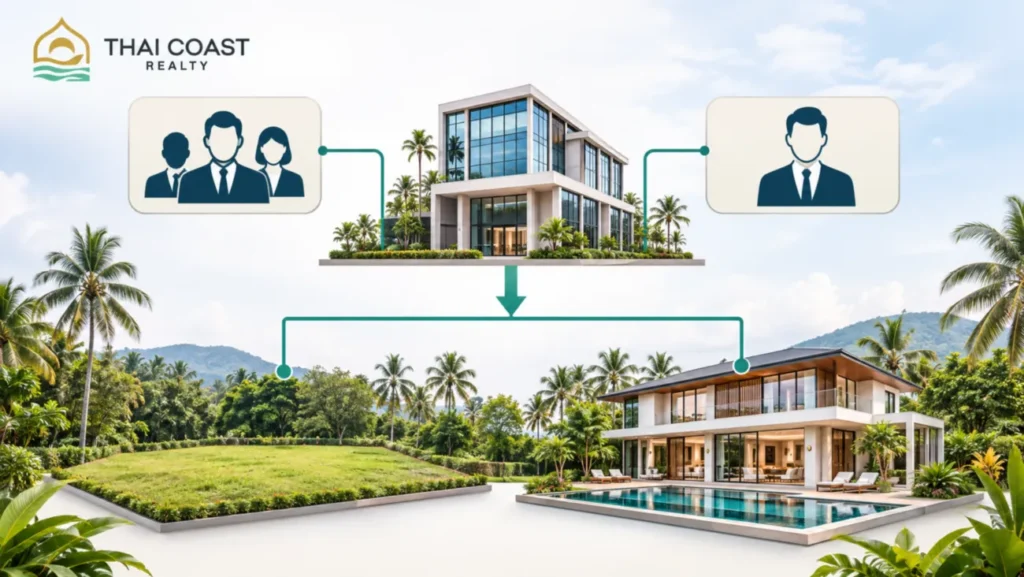
The principle of corporate ownership works as follows. A Thai limited liability company—Private Limited Company (Co., Ltd.)—purchases a plot of land on which a villa or house is located. The title is registered with the Department of Lands in the name of legal entity, rather than physical ownership. A foreign buyer acquires a stake in the company’s authorized capital—but does not become the personal owner of the land or building.
This is a fundamental distinction. A shareholder owns a stake in the company; the company owns the real estate. These are not the same thing.
Let's consider a hypothetical example. A villa worth 12 million baht registered in the name of a Thai company. A foreign buyer acquires 49% shares of this company. In this example, it is assumed that both the land and the building belong to the company; In a real-world transaction, the title to the building must be verified separately—the building and the land may have different titles. The foreign shareholder becomes a minority shareholder in the legal entity; the building and land themselves remain registered in the company’s name.
What exactly does a buyer receive when purchasing 49% shares?
| What the buyer receives | What does that mean? |
|---|---|
| 49% of the company's capital | An ownership interest in a legal entity, rather than land parcel 49% |
| Shareholder Rights | The right to participate in corporate decision-making and other rights in accordance with the class of shares and the law |
| The ability to receive dividends | Provided there are distributable profits and the decision-making procedure is followed |
| The opportunity to become a director | When properly appointed, the scope of authority is defined by the registration documents |
| Right to Use the Villa | It does not arise automatically from ownership of shares; the basis for use must be established separately |
| The ability to sell shares | Depends on corporate documents, transfer restrictions, and applicable rules |
| Individual Right to Own Land | Does not occur |
| Guaranteed control over Thai shareholders | Does not occur |
Even if a foreign shareholder has invested the bulk of the funds in the purchase of the property, this does not mean that the land and the building belong to him personally. Before purchasing shares, it is necessary to determine what specific rights they confer and how the buyer will legally use the property.
Decisions regarding real estate—such as leasing, selling, or renovating—are made through the company’s governing bodies: the shareholders’ meeting and the board of directors. A foreign shareholder may serve as a director; however, their signing authority is determined by the company’s registration documents—specifically, the joint signature requirements. Actual management of a business in Thailand requires a separate review of immigration regulations and, if necessary, a work permit. The position of director, signing authority, and special voting conditions in corporate documents are not equivalent to personal property rights to the ground.
The number of shares and actual control over the company are not the same thing. Holding 49% of the capital does not necessarily mean holding 49% of the votes. A shareholder’s actual rights depend on the classes of stock, voting procedures, the articles of incorporation, and applicable corporate law. At the same time, special voting rights and control mechanisms must be separately reviewed for compliance with land restrictions and the prohibition on nominee arrangements.
When a buyer is offered not a newly formed company, but the existing structure with the property already registered, the structure changes fundamentally. In this case, shares in an existing legal entity are purchased. The company retains its obligations, while the buyer acquires the shares along with the associated economic risks—the company’s tax liabilities, potential debts, legal risks, and undisclosed encumbrances can all affect the value of the stake being acquired. Registration of the new owner with the Department of Lands in such a situation does not happen — The land is still registered in the company's name, just as it always has been.
Can a Thai company own land?
Thai law does not explicitly prohibit a legal entity registered in Thailand from owning land. However, this does not mean that any company is entitled to purchase any plot of land. The feasibility and legality of such ownership depend on the structure of the legal entity itself, the nature of its activities, and how actual control is exercised.
A Legitimate Company and Nominee Shareholders
Two key laws— Land Code и Foreign Business Act B.E. 2542 (1999) — govern different aspects of the matter; however, a single transaction may require compliance with both regimes.
The Land Code restricts direct land ownership by foreign nationals. When a legal entity claims ownership rights, the Land Department evaluates its shareholder structure. Under Section 97 of the Land Code, entities considered “foreign” for the purposes of land rights include, in particular, companies in which foreigners own more than 49% of the capital. or Foreign shareholders account for more than half of the total number of shareholders. If these criteria are met, the regulatory authority has the right to deny registration or initiate an audit. The 49/51 capital ratio is one of the criteria, but not a universal guarantee of legality: The number of foreign shareholders, the presence of genuine Thai investments, and the existence of actual business relationships are also important factors. Nominal arrangements are evaluated on a case-by-case basis, taking into account the circumstances and applicable regulations.
The Foreign Business Act regulates the types of activities available to foreign companies or companies with foreign ownership. The Land Code sets forth restrictions on land rights, while the Foreign Business Act sets forth restrictions on specific types of business activities. The criteria of one law cannot be automatically applied to the provisions of the other, but both may be applicable simultaneously.
The following present a particular legal problem: nominal shareholders — Thai citizens who are formally listed as company shareholders but who, in reality, act in the interests of a foreigner: they do not contribute their own funds, have no real economic role, and have no independent interests in the business. This practice is expressly prohibited by law. The official website of the Thai government explicitly states this: Foreigners are strictly prohibited from using Thai nationals as nominal shareholders, citing Section 36 of the Foreign Business Act.
Signs that may indicate fictitious ownership: the absence of documented contributions from Thai shareholders; the inability to determine the source of their investments; a company with no actual business operations, whose sole asset is a villa on the coast. The mere presence of Thai shareholders does not in itself indicate a violation, but the lack of evidence of their actual participation is a compelling reason for further investigation.
Inspections in 2026
In 2026, Thai government agencies significantly tightened their oversight of foreign-owned companies that hold land assets.
In October 2026, the Department of Business Development (DBD) reported on interagency cooperation with the Department of Lands to investigate arrangements in which foreigners use Thai legal entities to effectively circumvent land ownership restrictions. In late October, the DBD also published information on expanded interagency cooperation in this area. The focus is on the targeted identification of nominee schemes, rather than a blanket audit of all companies with foreign shareholders.
Scope of Inspections: Official Data for October 2026
According to information from Thailand’s Department of Public Relations dated October 19, 2026, the Department of Lands identified 1,397 legal entities suspected of illegally holding land on behalf of foreigners. These entities accounted for 2,360 land parcels with an estimated total value of approximately 14.01 billion baht.
| 1 397 | 2 360 | 14.01 billion |
| legal entities under investigation | land parcels | bat — declared value |
The agencies also identified 13,088 legal entities and individuals for priority inspections and enforcement actions.
These figures reflect suspected violations and announced investigative measures, not the number of companies found guilty by a court. Not all foreign participation in Thai business constitutes a violation.
The fact that a company is included in the audit sample does not prove that it has committed a violation. Legitimate foreign ownership of an operating business with actual Thai shareholders is not the same as a shell company created solely to circumvent land restrictions.
Practical advice for buyers: before paying the deposit It is necessary to verify the structure of the share capital, the documentary evidence of investments by Thai shareholders, the existence of actual business operations, and the legality of the basis for land ownership. A company registered many years ago does not automatically become “verified” simply because of its age.
Who Is Suited for Corporate Ownership?
Corporate ownership has practical justification in a number of specific situations. Let’s examine them objectively—without exaggerating their universality.
An established business in need of real estate. If a company is actually in business—managing a hotel, boutique villa, or restaurant, or providing other services—and acquires real estate for the purposes of that business, the corporate structure may be justified. In this case, the company’s activities, capital, and operating history must be documented.
A joint venture with authentic Thai partners. A genuine partnership with Thai partners may be permissible if all applicable requirements are met, including Section 97 of the Land Code, the restrictions under the Foreign Business Act, and the regulations specific to the type of business. A 49/51 ownership ratio does not automatically grant permission to own land. It is essential that the partnership be genuine—with mutual rights, obligations, and commercial risks.
Investment projects with a corporate rationale. Certain real estate-related activities—such as asset management, construction, and leasing—may lead an entity to have a legitimate corporate purpose. The legality of each such case is assessed on a case-by-case basis.
An active company with a history, assets, and operations. If a buyer is offered shares in a company that has actually been in operation for several years, pays taxes, owns several assets, and has a proven track record—this is fundamentally different from a “paper company” created for the sole purpose of acquiring a villa.
The corporate approach will most likely won't work a foreign buyer who simply wants to purchase a villa for vacation use or as a rental investment and is offered the services of nominal Thai shareholders who do not actually participate in the business. The investment purpose alone does not make such an arrangement permissible.
Not sure how best to register real estate in Thailand?
Find apartments and villas that fit your budget and purchasing goals. Compare freehold and leasehold properties and learn what questions you should ask about the type of ownership before closing the deal.
How to Register Real Estate in a Company's Name
The process depends significantly on whether a new company is being formed or shares in an existing legal entity are being purchased.
New Company
The sequence of steps that must be completed before registering the transfer of ownership:
- Assessment of a legitimate business purpose. Before registering a company, you must ask yourself: Is there a genuine economic rationale for the corporate structure? A legal entity established solely to circumvent land restrictions does not receive legal protection.
- Independent legal advice. Hiring a Thai attorney who specializes in real estate and corporate law is a mandatory step, not an optional one. An independent opinion from a Thai attorney with expertise in these areas allows you to assess the legal risks associated with a specific structure, taking into account current legislation.
- Registration of a Legal Entity. If there are valid grounds, the following steps are taken: drafting a memorandum of association and articles of incorporation, determining the authorized capital, and establishing a shareholder structure with actual Thai shareholders and their documented capital contributions. Registration is carried out through the Department of Business Development.
- Preparation of corporate and financial documents. Corporate records, shareholder registry, meeting minutes, the company's bank account, and proof of the source of funds for the real estate purchase.
- Due diligence on the land parcel and building. Verify the land title (Chanote or other applicable title), boundaries, encumbrances, access, and building permits—regardless of how “reliable” the seller may seem. For more details on exactly what is checked, see the section below.
- Drafting a sales contract. The contract is entered into between the seller and the company as the buyer. It must reflect the actual terms of the transaction, including the payment terms and liability for hidden defects.
- Registration of the transfer of title with the Department of Lands. The transfer of ownership is registered in the company's name; the applicable taxes and fees associated with the transfer are paid.
- Follow-up support. After the acquisition, the company is required to maintain accounting records, file tax returns, and hold annual general meetings. This is not a one-time procedure, but an ongoing obligation.

Who receives the money: the real estate agent or the company owner?
When purchasing through a Thai company, you must first determine the subject matter of the contract. A company’s purchase of real estate and the purchase of shares in an existing company are not the same transaction.
| Script | What to Buy | Who Receives Payment |
|---|---|---|
| A new company is purchasing a villa | Land and a building, or the corresponding rights thereto | Real estate agent under contract with a company |
| A foreigner buys shares in an operating company | Shares of a legal entity | Stock Seller |
| The company is acquiring an additional property | Real Estate as a Company Asset | Seller of a Specific Property |
| The company is selling its villa | Real estate owned by the company | Selling Company |
When purchasing shares, it is important to separately document the price per share, the payment terms, the conditions for transferring documents, corporate resolutions, and confirmation that there are no undisclosed obligations.
You should not transfer the entire amount to the personal account of an agent or other intermediary based solely on verbal promises. The recipient’s account details and the payment procedure must be verified in advance by an independent attorney. The possibility of using an escrow account or another controlled payment mechanism is determined by the terms of the specific transaction.
Banking and documentation requirements may differ between a freehold condominium and the purchase of shares in a Thai company. The requirements for the Foreign Exchange Transaction Form for a foreign freehold cannot be automatically applied to any corporate transaction.
Acquisition of an Operating Company
Purchasing shares in an existing company that already owns a villa or a plot of land is a fundamentally different transaction. Technically, ownership of the property does not transfer to anyone else: the land remains registered under the same legal entity. Only the shareholders change.
This means that the buyer evaluates not just an asset (the villa), but also everything that has accumulated over the course of the company’s history: tax debts, unfulfilled obligations, legal disputes, creditors, and undisclosed agreements. When shares are sold, the buyer may be unaware of certain obligations the company has—which is why independent legal, tax, and accounting audits are necessary. Being confident in the condition of the villa does not guarantee that the company is “in good standing.”
What you need to confirm before paying for the shares:
- financial statements for the past few years and the results of an independent audit;
- tax history and no outstanding debts to the Revenue Department;
- legal and administrative disputes in which the company is a party;
- the validity and content of all corporate documents;
- full compliance of the shareholder structure with the DBD documents;
- the absence of encumbrances on the real estate owned by the company.
Hiring an independent lawyer and accountant is not just a formality. Learn more about “How a Foreigner Can Buy a Villa in Thailand"under various legal frameworks" can be discussed in a separate article.
How to Buy a Ready-Made Thai Company with a Villa
1. Get a quote and documents
Determine the specific legal entity, the property owner, the composition of the shares being sold, the price, and the terms of the transaction.
2. Check the company
Obtain DBD documents, information about shareholders, financial statements, proof of tax obligations, and information about material contracts.
3. Inspect the land and the building
Verify the title, the registered owner, any encumbrances, the building permit, and the legal right to use the property.
4. Approve the share purchase agreement
Specify the number and class of shares, the price, the seller’s representations, the terms of payment, the procedure for transferring control, and liability for breaches.
5. Complete the transfer of shares
Sign the necessary documents, update the company's shareholder registry, and complete the applicable corporate and registration procedures.
6. Obtain corporate documents
To confirm their rights as shareholders, the authority of the directors, access to corporate records, and the legality of the continued use of the real estate.
This is a general procedure, not a universal legal guideline. The required documents and procedures depend on the company, the classes of stock, the agreement, and the circumstances of the transaction. The buyer does not become the owner of the land as a result of the transfer of shares.
Villas in Phuket


 Phuket, Bang Tao
 from 272m²

 Phuket, Thalangfrom 425m²
 Phuket, Thalangfrom 388m²
 Phuket, Bang Taostarting at 650 m²
How to Check a Company and a Property
This is one of the most important sections for any buyer. The review is divided into two separate sections: legal entity и the property itself. You can't mix them up: a "clean" company may own a troubled property, and vice versa.

Documents for Verifying a Company and Real Estate
| Document / Verification | This confirms | What kind of risk does it help identify? |
|---|---|---|
| Registration documents with the DBD (company certificate, affidavit) | Date of Incorporation, Authorized Capital, Registered Address, Company Status | A company in liquidation or with delinquent obligations |
| List of Shareholders (Bor Or Jor 5) | The reported list of shareholders as of the date of the relevant list; in addition, the company’s current shareholder registry, history of changes, and actual sources of funds are verified | Hidden Foreign Shareholders; Signs of Nominal Ownership |
| Articles of Incorporation and Memorandum of Association | Scope of Activities, Voting Procedures, and Powers of Directors | Non-standard voting rights, conflicts with the Land Code or the FBA |
| Authority of the Signatory/Director | A person's authority to sign contracts on behalf of the company; conditions for joint signing | Transactions That Are Invalid Due to an Exceeding of Authority |
| Financial Statements for the Past 2–3 Years | Financial condition and reported liabilities; hidden debts are verified through additional inquiries, contracts, creditor confirmations, and a tax audit | Signs of Insolvency and Hidden Liabilities |
| Status of Tax Liabilities at the Revenue Department | Tax returns, tax payment receipts, and the results of an independent tax audit | The company's tax liabilities that could affect the value of the shares being acquired |
| Litigation and Debt Risks | Participation in Lawsuits, Arbitration, and Unenforced Judgments | Possible loss of an asset or forced collection |
| Source of Funds for the Purchase of Real Estate | The source of capital the company used to pay for the property | Signs of Fictitious Investments by Thai Shareholders |
| Land title document: Chanote (Nor Sor 4 Jor) or other applicable title | Document type, registered owner, area | Discrepancy from the claim; weak title without a survey |
| Encumbrances, mortgages, and easements on the property | Existence of Liens, Easements, and Other Restrictions on Rights | Inability to dispose of the property without the bank's consent |
| Property boundaries, access to the road | Consistency with cadastral data; proof of legal entry | An isolated plot of land with no right of access, or boundary disputes |
| Building Permit | The Legality of the Constructed Building | Illegal construction or alterations without approval |
| Building documents: building permit, approved plans, documents certifying completion or occupancy of the building (if applicable); EIA—only for projects subject to environmental impact assessment requirements | Compliance of the Actual Construction with the Permitting Documentation | The difference between what is permitted and what has been built |
DBD's Open Services These are suitable for an initial status check—to verify the company’s status, authorized capital, and registration status. To confirm the shareholder structure, you must obtain a current official extract or list of shareholders and verify it against corporate documents and actual funding. Prior to the transaction, an official verification of the land title, the registered owner, and any encumbrances must be conducted through the relevant Land Office. This verification can be arranged by an independent Thai attorney or a duly authorized representative of the buyer.
The age of a company is not proof of its legitimacy. A company registered ten years ago may have the same problems as a new one—including accumulated tax debts or outdated corporate documents.
More about the procedure Property Inspections When Buying Real Estate in Thailand — in a separate manual.
How much does it cost to buy and maintain?
The corporate structure gives rise to two categories of expenses: lump-sum (upon purchase) and regular (for the entire duration of ownership). Ignoring the latter is one of the most common mistakes made when calculating a budget.
Acquisition and Maintenance Costs
| Expense Item | When it happens | What determines the amount? | What to Check Before Paying |
|---|---|---|---|
| Registering a New Company | When starting a company | Authorized Capital, Legal Services Package | Is everything included in the price—until the documents are ready? |
| Legal Due Diligence of a Company and a Property | Before signing the contract | Complexity of the structure, number of assets | The scope and content of the legal opinion; whether it is limited to the basic registry |
| Registration fee for the transfer of title (transfer fee) | When registering with the Land Department | As a general rule, 2% is the official appraised value, unless an applicable exemption applies | Who—the seller or the buyer—is responsible for this expense under the contract? |
| Specific Business Tax (SBT) or Stamp Duty | Upon transfer of rights | The applicability of the SBT (typically 3.3%, including the local stamp tax) depends on the nature and circumstances of the sale; when the SBT is applied, stamp tax is generally not levied on the same transfer; For a corporate seller, the SBT cannot be determined based solely on the length of ownership | Check with a tax advisor regarding the structure |
| Withholding Tax on Sales | When a company sells real estate | When a Thai company sells real estate, it typically withholds 1% of the greater of the contract price and the appraised value; the specific calculation should be confirmed with the Land Office and a tax advisor | Check with a tax advisor regarding the structure |
| Corporate Income Tax (CIT) | Annually / upon sale | The company's revenue and expenses for the period | Do not confuse this with transfer taxes—these are different obligations |
| Accounting and Tax Reporting | Every year | Volume of transactions, service provider | Get a quote from a specific accounting service provider |
| Annual Audit (Required for Co., Ltd.) | Every year | Authorized Capital, Turnover | Companies are required to undergo an audit regardless of their size |
| Annual General Meeting and Corporate Responsibilities | Every year | Administrative expenses, notary/lawyer | Find out what's included in the corporate support package |
| Land Tax (Land and Building Tax) | Every year | Type of Use, Cadastral Appraised Value, Current Tax Exemptions | Refine the rate by property category |
| Utilities and Property Management | Monthly / as incurred | Property area, management company | Report separately from corporate expenses |
Do not confuse the purchase of shares with the purchase of real estate. The transfer fee, SBT, stamp duty, and withholding tax listed in this table apply to real estate transactions. When purchasing shares in an existing company, ownership of the land is not typically re-registered; therefore, such a transaction requires a separate calculation of taxes on the transfer of shares, potential liabilities of the parties, and corporate expenses.
The specific fee rates charged by law and accounting firms vary and must be calculated based on an individual estimate—it is incorrect to cite “market average” figures without specifying a particular provider or year.
An Illustrative Example of a Calculation (These are approximate figures and do not represent market rates):
For a property with an official appraised value of 8 million baht, the standard transfer fee would be 160,000 baht at a rate of 2%. However, this is only one of several possible payments. Below are two hypothetical scenarios involving SBT or stamp duty, as well as withholding tax, when a company sells real estate.
Example of a calculation of fees and taxes for a property valued at 8 million baht
To illustrate, let’s assume that the official appraised value and the contract price are the same, at 8 million baht. The seller is a Thai company.
| Payment | Rate | Preliminary Calculation |
|---|---|---|
| Transfer fee | 2% | 160,000 ฿ |
| Specific Business Tax, if applicable | 3,3% | 264,000 ฿ |
| Stamp duty, if stamp duty applies instead of SBT | 0,5% | 40,000 ฿ |
| Withholding Tax on Sales by a Company | 1% | 80,000 ฿ |
If SBT is applied: the total estimated amount of these three payments is 504,000 baht.
If a stamp duty is applied instead of the SBT: the total estimated amount is 280,000 baht.
This is merely an illustration of the taxes and fees associated with the transfer of real estate. It does not imply that both scenarios are available at the parties’ discretion, nor is it a calculation for the purchase of company shares.
The amount does not include legal services, corporate expenses, any other potential liabilities, or corporate income tax. The allocation of payments between the parties is determined by the agreement and applicable rules.
How much does it cost to set up and maintain a Thai company?
The cost of corporate ownership consists of government fees, legal and accounting services, and the company’s annual obligations. There is no single flat rate for comprehensive real estate management through a Co., Ltd.
| Consumption | How to Calculate the Amount |
|---|---|
| State Registration of a Company | Check the applicable DBD rate |
| Preparation of Corporate Documents | Law Firm Cost Estimate |
| Opening a Bank Account | Terms and Conditions of a Specific Bank |
| Review of an Existing Company | Separate Cost Estimate for Corporate and Tax Due Diligence |
| Annual Accounting | Commercial Proposal from an Accounting Service Provider |
| Mandatory Audit | Independent Auditor's Estimate |
| Preparation and Submission of Reports | Check whether the services are included in the annual package |
| Changes in Shareholders and Directors | Cost of documents, registration of changes, and legal services |
According to information from the official DBD, individual electronic statements and corporate documents are charged at established rates. For example, there are packages containing registration information for 200 baht and a certified copy of the Bor Or Jor 5 shareholder list for 100 baht. These fees apply to specific documents, not to the company’s registration or maintenance.
Before making a purchase, ask the service provider for a written estimate covering the formation or purchase of a company, a comprehensive review of its history, and three years of ongoing support. It is especially important to clarify whether the estimate includes auditing, financial reporting, and the preparation of corporate resolutions.
The tax implications depend fundamentally on how the transaction is structured: whether the company is selling real estate or a shareholder is selling shares. These are two different tax regimes with different rates and obligations. For more details, see the article “Taxes and Fees When Buying Real Estate in Thailand".
Would you like to understand the total cost of the purchase?
Please specify the type of property, your desired location, and your budget. Thaicost’s specialists will help you compare available listings and estimate the costs associated with purchasing them. The legal and tax terms of each transaction are reviewed individually.
"Calculate the budget and select projects"
Key Risks
Corporate real estate ownership carries risks that must be viewed objectively—neither exaggerating nor downplaying them.
Risk — Consequence — How to Check
| Risk | Possible consequence | How to check |
|---|---|---|
| Nominal Thai shareholders without actual investments | The identification of a nominee arrangement may result in sanctions under the FBA and, in the event of a violation of land restrictions, measures under the Land Code, including the obligation to divest the land under circumstances provided for by law; the specific consequences depend on how the violation is classified. | Provide documentary evidence of each Thai shareholder's capital contribution; the source of funds must be verifiable |
| Foreign control through corporate mechanisms, contrary to the shareholding structure | Lack of transparency in the mechanisms governing actual control and the derivation of economic benefits may serve as grounds for an additional audit. The legal consequences depend on the established facts and on which provisions of the Land Code or the Foreign Business Act have been violated. | Assess the director's authority, voting procedures, and shareholder agreements |
| Corporate Dispute with Thai Shareholders | Blocking of decisions, inability to dispose of real estate | Review the bylaws, voting procedures, and mechanisms for resolving deadlocks |
| A company's undisclosed tax liabilities or legal obligations | A buyer of shares acquires a stake in the business, the value of which may decline due to existing and hidden liabilities; the company remains legally liable for its debts | Tax returns, proof of tax payments, and the results of an independent tax audit of the company; court records; financial audit |
| Inconsistencies in the Structure of Permits and Licenses | Demolition of illegal structures or fines; inability to legalize them | Request the building permit and related documentation; physically verify them against the actual structure |
| Problems with the land title document | Non-transferability of rights; boundary disputes; expropriation | Check the Chanote at the Land Department; order a cadastral survey if necessary |
| Challenges in Selling Stock | Buyers may factor corporate risks and the company's unknown track record into the price; there is a limited pool of investors willing to accept such a structure | Assess the applicable taxes and market demand in advance |
| Enhanced Inspections by the DBD / Land Department in 2026 | Requests for documents, administrative investigations, orders | Ensure that the company's structure meets the requirements prior to the transaction |
What will happen if the Thai shareholders are deemed to be nominal shareholders?
If the authorities determine that Thai citizens are technically holding shares on behalf of a foreign national in violation of the law, the consequences could affect both the participants in the structure and the company’s land assets.
| Possible consequence | Legal Basis |
|---|---|
| Verification of Funding, Shareholders, and Beneficial Owners | The Powers of Government Agencies in Auditing Land and Corporate Structures |
| Liability for Prohibited Nominal Participation | Section 36 of the Foreign Business Act |
| A fine of 100,000 to 1,000,000 baht, imprisonment for up to three years, or both | For persons whose liability is established under Section 36 of the Foreign Business Act. The court may also order the termination of unlawful participation or nominal ownership of shares. |
| Imprisonment for a term of up to three years for a person subject to liability under this provision | Section 36 of the Foreign Business Act |
| Court Order to Cease Unlawful Participation | Section 36 of the Foreign Business Act |
| The Obligation to Transfer Land Upon a Finding of Unlawful Possession | Applicable provisions of the Land Code, including Section 94 |
Sanctions are not imposed automatically upon the discovery of a foreign shareholder. A specific violation must be established, and liability depends on the role of each party and the applicable law.
A practical example. The buyer is being offered a company established several years ago: its sole asset is a villa in Phuket. Thai shareholders formally hold 51% shares. The seller cannot provide documentary evidence of their initial contributions, financial statements for the past two years, or tax certificates. Registration with the DBD is in order, but the corporate register has not been updated since the initial registration.
In such a situation, the transaction cannot be considered verified. The following must be requested: bank statements confirming contributions by Thai shareholders; audited financial statements; tax returns and proof of tax payments for the periods under review, available official information on outstanding debts, and the results of an independent tax audit of the company; the original Chanote and a certificate of encumbrances from the Land Department; a building permit and documentation for the building.
Red flags that indicate it’s wise to halt a transaction:
- the seller refuses to provide corporate documents or claims they are unavailable;
- financial statements are missing or have not been audited;
- Thai shareholders cannot verify the source of their contributions;
- Chanote does not match the property description;
- There are structures on the property that were built without a building permit;
- The seller insists on an immediate deposit before the verification process is complete.
Company, freehold, or leasehold
Corporate ownership is not the only option for a foreign buyer. The choice between a company, a freehold apartment, and a registered leasehold depends on the type of property, the buyer’s objectives, and their willingness to assume corporate obligations.
A Comparison of Methods of Real Estate Ownership
| Criterion | Thai company | Freehold condominium | Registered leasehold |
|---|---|---|---|
| Which property is suitable? | Land with a building, villa, commercial real estate | Apartment in a registered condominium | Villa, house, land — under a lease agreement |
| Who is the legal owner of the asset? | The company is the owner of those properties for which it holds registered rights; title to the land and rights to the building are confirmed separately | A foreign buyer in person | Landowner; the buyer obtains the right to lease the land |
| Legal Restrictions | Land Code (Section 97), Foreign Business Act, corporate law | “Foreign Quota": up to 49% of condominium area | No more than 30 years per contract under Section 540 of the CCC; leases with a term exceeding three years must be registered to remain in effect beyond three years |
| Corporate Commitments | Accounting, auditing, taxes, meetings—annually | No | No |
| Key Risks | Nominee shareholders, corporate conflicts, regulatory audits | Foreign Quotas Are Full in Popular Projects | Renewal is not guaranteed by law; it depends on the contract and the owner |
| How to Transfer Rights | Sale of shares or sale of real estate by a company | Direct Sale of an Apartment | Assignment of Lease Rights When Such a Condition Is Included in the Contract |
| When This Option Is Appropriate | An established business with real Thai partners | Buying an apartment for personal use or to rent out | A villa for long-term use without a corporate structure |
Which form of ownership should you consider in your situation?
| The buyer's goal | What to Consider First |
|---|---|
| Buy an apartment to live in | Personal freehold under the foreign quota |
| Buy an apartment for long-term rental | Freehold, with a review of the project guidelines and applicable lease regulations |
| Buy a villa for a family vacation | A registered land lease with separately verified rights to the building |
| Purchase Real Estate for an Operating Business | A corporate structure, provided there is a legitimate business purpose and genuine partners |
| Buy a villa through a company with nominal Thai shareholders | Do not enter into the transaction as proposed; seek an independent legal opinion and a lawful alternative |
| Buy an operating company with a villa | Conduct corporate, land, tax, and financial due diligence |
| Buy real estate with the intention of reselling it | Compare taxes, the process for transferring ownership, and restrictions for potential buyers |
For a private buyer, the absence of corporate expenses and the need to interact with Thai shareholders may be an advantage of a freehold condominium or a registered leasehold. However, the final choice depends on the type of property and the terms of the specific transaction.
Freehold apartment Purchasing a unit in a condominium within the applicable foreign ownership quota often makes it possible to completely avoid a corporate structure and the associated annual expenses. For a buyer looking for an apartment in Bangkok, Pattaya, or Phuket, this is often the simplest legal route.
When making a purchase villas The situation is more complicated. The land and the building may have different legal statuses: in some cases, it is possible to register ownership of the building separately from the leased land parcel. Whether this arrangement is applicable depends on the specific contract and the type of land title document.
Is it possible to own a house without owning the land?
In Thailand, the rights to a parcel of land and the building on it may belong to different parties. Under certain circumstances, a foreign buyer may hold title to the building provided they have a legally registered right to use the land.
When evaluating this option, a lawyer should review the land lease agreement, the basis for the ownership of the building, the construction documentation, and the possibility of registering the relevant rights. In some legal frameworks, the right of superficies—a separate right associated with owning a structure on land owned by another party—may be considered.
However, the right to a home does not eliminate the restrictions and risks associated with the land. The lease term, access, transfer of rights, termination of the contract, and the fate of the building must be legally agreed upon.
Registered leasehold A lease with a term of up to 30 years is entered in the land registry and grants the lessee a protected right of use. Renewal for a second or third term is not automatic and is not guaranteed by law—it depends on an agreement with the landowner at the time the initial term expires. It is important to clearly understand the difference between the registered term and contractual promises regarding renewal before signing.
For more information on the differences between these modes, see the article “Freehold and Leasehold in Thailand", but rather about "Can a foreigner buy land in Thailand?", — in a separate article.
Residential complexes in Thailand
 Pattaya, Wongamatstarting at 40.5 m²

 Phuket, Katafrom 28m²


Features of Popular Resorts
Basic property laws apply throughout Thailand; however, local market conditions, typical properties, and document verification practices vary significantly from one resort to another.

Pattaya (Chonburi Province). The market offers both condominiums with direct freehold titles for foreigners and villas on individual plots of land. When purchasing a villa, it is particularly important to verify the Chanote land title and corporate documents: in the province, there are plots with different types of land titles, some of which entail a limited set of rights. It is essential to ensure that the plot is located in a zone that permits residential construction.
Phuket. Villas with land plots are widely available in Phuket; when reviewing a transaction, it is important to verify the title, the legality of the ownership structure, and restrictions on construction on slopes. When using a corporate structure, particular care must be taken to verify the composition of shareholders and the basis for land ownership. When inspecting a villa, it is necessary to verify the existence of legally established access to a public road and ensure that the actual building complies with the permitting documentation. These risks should be assessed separately for each plot.
Koh Samui (Surat Thani Province). The island’s unique characteristics include plots on slopes and in mountainous areas, complex terrain, and engineering infrastructure that is not always properly documented. When purchasing villas through a company here, it is particularly important to verify access rights to the property, the water and sewer systems, and the existence of a valid building permit. The land classification deserves special attention.
Bangkok. In the capital, a significant portion of the housing supply available to foreign buyers consists of apartments in registered condominiums, which can be purchased directly under the foreign quota. Corporate ownership structures are less common for residential properties here, but are found when purchasing office or retail space. When comparing a direct apartment purchase with corporate ownership, it is important to evaluate not only the property itself but also the additional costs and obligations associated with each option.
How to Sell Real Estate Through a Company
There are several ways to exit an investment through a corporate structure, and the choice between them affects the taxes, timing, and complexity of the transaction.
Real estate sales by the company. The company, as the legal owner, sells the property directly. A registration fee applies upon transfer of title, as well as a withholding tax and, if applicable, a specific business tax. The company continues to exist after the transaction is completed and may be liquidated separately.
Sale of the company's shares. A shareholder sells their stake in the company to a new buyer. Technically, ownership of the real estate does not transfer—only the owners of the legal entity change. The company’s liabilities remain legally with it; the buyer of the shares acquires a stake in the business, the value of which may decrease due to existing and hidden liabilities. The tax consequences of selling shares differ from those of a direct sale of real estate.
Restructuring. In some cases, it makes sense to consider changing the structure before a sale—for example, converting to a leasehold or transferring the property to another legal entity. The feasibility of such options depends on the specific situation and requires a legal and tax assessment.
Liquidation of a company. If the company is no longer needed after the sale of the property, it must be properly dissolved—including settling tax obligations, conducting an audit, and notifying the DBD. This is a separate process that requires time and expense.
Selling through a company isn't always faster or cheaper Direct sale of the asset. Buyers may factor corporate risks and the company’s unknown history into the price. The legal and tax structure for exiting the investment should be evaluated well in advance of the sale.
Compare real estate options before making a deposit
Browse freehold apartments and villas with affordable design options. Our selection tool will help you narrow down your choices based on budget and location, and our legal review will help you evaluate a specific transaction.
"Get a personalized selection"
What to Consider Before Buying
A Thai company may be the legal owner of real estate—provided it was established for a genuine business purpose, its Thai shareholders are bona fide participants with documented investments, and its structure complies with the requirements of the Land Code and the Foreign Business Act. The registration of a legal entity and the formal allocation of shares do not, in and of themselves, guarantee this.
10 Questions to Ask the Seller Before Paying a Deposit
- Which company owns the land?
- What is for sale: real estate or company stock?
- What percentage and what classes of shares are being offered?
- Who are the other shareholders, and how are their investments verified?
- Who will be the director, and what will his or her responsibilities be?
- Are there any current DBD documents and a shareholder registry?
- Is it possible to verify the original land title and any encumbrances?
- Are there any audited financial statements and tax documents?
- How is the buyer's use of the villa legally formalized?
- What are the terms for refunding the deposit if the inspection reveals any issues?
Three steps you must complete before making any payment:
- Verify the Legality of the Corporate Structure — shareholders, their contributions, the articles of incorporation, powers, and compliance with legal requirements.
- Check the property itself and the company's obligations — land title documents, encumbrances, building permits, tax history, and legal risks.
- Compare corporate ownership with other legal options — A freehold apartment, a registered leasehold, or another type of arrangement may better suit your goals and eliminate unnecessary corporate burdens.
An independent legal due diligence review helps identify and assess risks—it does not automatically eliminate them, but it ensures that the decision to purchase is an informed one. To obtain an assessment of a specific property, the transaction structure, and applicable ownership options, consult with specialized Thai lawyers and qualified real estate professionals. Learn more about “How to Buy Real Estate in Thailand", and compare the approaches as they apply to your situation.
 Real estate in Georgia
 Real estate in Cyprus
 Real estate in UAE
 Real estate in Bali
 Real estate in Montenegro
 Real Estate in Spain
 Real Estate in Saudi Arabia
 Real Estate in Turkey
 Real Estate in Zanzibar
 +66 98 432 7651
 hello@thaicost.com
 Boat Lagoon Marina, 22/1 Moo 2, Thepkasattri Rd, Koh Kaew, Phuket 83000, Thailand




 Get TOP-7 catalog of objects