
 +66 98 432 7651



Sale and Purchase Agreement (SPA) — the main contract that sets forth the rights and obligations of the buyer and seller when purchasing real estate in Thailand. Unlike the registration document, which is filed with a government agency, the SPA is a private agreement between the parties. It is this agreement that specifies the terms under which ownership is transferred, who bears the costs, what happens in the event of construction delays, and whether a refund is possible. It is critically important for a foreign buyer to review the contract before any substantial payment is made: Once the contract has been signed and the advance payment has been made, it is practically impossible to unilaterally change the terms.
In short. An SPA is a private contract between the buyer and the seller that does not replace state registration of title. Signing the contract and the transfer of ownership are two separate events. The security of the transaction depends on three factors: the legal soundness of the property, the terms of the contract, and proper registration with the Land Office. All three must be verified in advance.
Sales Contracts in Thailand: Key Figures
| Indicator | Meaning |
|---|---|
| Foreign ownership quota for freehold properties | No more than 49% of total apartment area in the condominium |
| Registration fee (transfer fee) | Standard 2% official appraised value |
| Specific Business Tax | 3.3% of the tax base, if the tax applies |
| Stamp duty | 0.5% of the tax base when SBT is not applied |
| Term of a Standard Real Estate Lease | Up to age 30, as a general rule |
| Rental Registration | Required for protection periods exceeding 3 years |
| Warranty on Major Structural Components | 5 years for applicable regulated contracts |
| Warranty on Other Components | 1 year for applicable regulated contracts |
| Compensation for a delay | A minimum of 0.01% per day for the relevant regulated contracts; the basis and terms of calculation are determined by applicable regulations |
| Transfer of Ownership | When registering at the Land Office |
Rates and terms depend on the type of property, the structure of the transaction, and applicable regulations. Fees are not necessarily calculated based on the contract price. There is no single mandatory amount for the deposit and down payment across all transactions.
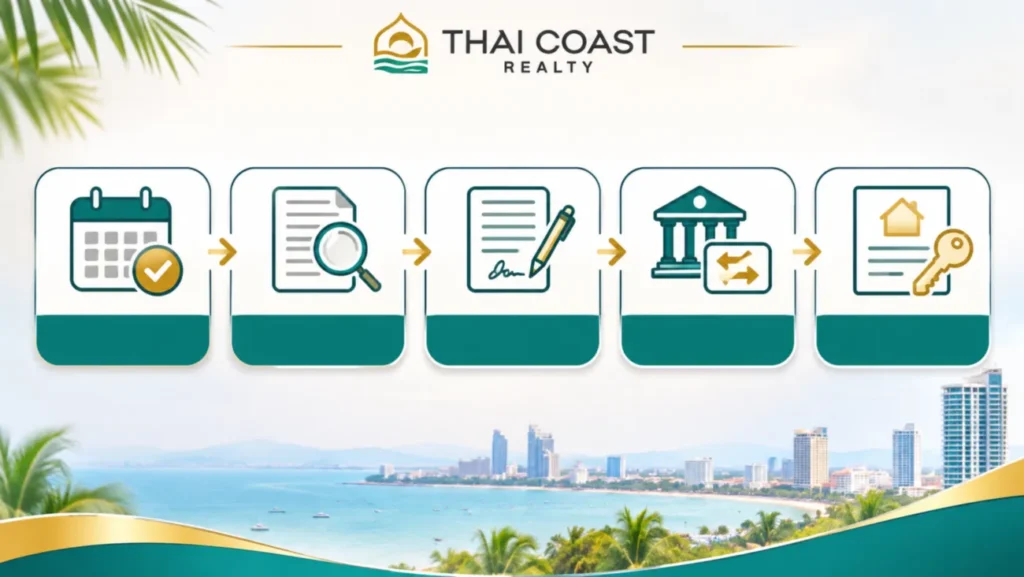
What types of contracts are drawn up when making a purchase?
A real estate transaction in Thailand typically involves several documentary stages. It is important to understand that none of the interim documents replaces the government registration of the transfer of title.
First in chronological order is Reservation Agreement (reservation agreement) — a brief document that formalizes the intention to purchase a specific property. A reservation fee is paid along with it. This is not the actual purchase agreement: as a rule, it does not specify detailed terms of liability, construction timelines, or the full scope of amenities. A reservation agreement is sometimes formalized without a separate document—in the form of a receipt or booking form. The refund of the booking fee depends on the type of transaction and applicable regulations. For reserving apartments in regulated condominium sales, special mandatory conditions will take effect on January 31, 2025, including provisions regarding the refund of the fee in specified cases.
The key document of the transaction is— Sale and Purchase Agreement (SPA). It is this document that describes the property, the price, the payment schedule, the terms, the parties’ responsibilities, the return policy, and the termination procedure. The SPA is signed between the buyer and the seller as a private agreement. For housing sales subject to regulation, mandatory requirements regarding the contract’s content apply: transfer deadlines, liability for delays, and warranties. Applicability depends on the type of property and the seller; when reviewing the contract, it should be checked against the current notice from the Contracts Committee and its clarifications. OCPB.
Is there a required format for an SPA agreement?
In Thailand, not all SPA agreements can be considered entirely unrestricted in terms of content. For certain sales of apartments in registered condominiums, a statutory contract form prescribed by the Condominium Act applies. For some sales of houses and land lots by developers, special requirements regarding the standard form also apply.
If a provision in a contract with a developer violates mandatory requirements and places the buyer at a disadvantage, it may be invalid. Therefore, it is not enough to simply verify the presence of a signature and a seal; the contract must be compared with the applicable mandatory requirements.
For other transactions, including many sales on the secondary market, the terms are largely determined by agreement between the parties, subject to the mandatory provisions of Thai law.
When reviewing the contract with the developer, ask an independent attorney to compare the SPA with the applicable official form, including provisions regarding the transfer of ownership, timelines, warranties, liability, and termination.
The third level — official registration document, which is processed directly at the Land Office upon transfer of ownership. This is not the same as an SPA: the information from the SPA is entered into the Land Office’s standard forms, and only after these documents are signed and the government fees are paid does the buyer become the registered owner.
When acquiring a leasehold interest (leasehold) a lease agreement is entered into, rather than an agreement transferring ownership of the leased property. However, some transactions—particularly those involving villas—may simultaneously include a separate agreement for the purchase of the building and a lease agreement for the land. Each document requires its own legal review. To protect an agreed-upon lease term of more than three years, registration with the Land Office is required; a leasehold does not involve a transfer of ownership of the land.
In transactions involving new construction, developers may provide additional documents: specifications, floor plans, a rental management agreement, and a novation or assignment agreement. Each of these documents must comply with the terms of the main SPA.
Documents Required for Buying Real Estate in Thailand
| Document | What is it for? | When they sign | The Main Risk |
|---|---|---|---|
| Reservation Agreement / Booking Form | Confirms intent, reserves the property | Before the main spa treatment, or sometimes right along with it | Unclear Terms for Refunds of Reservation Deposits |
| Sale and Purchase Agreement (SPA) | Establishes the terms of the transaction, as well as the rights and obligations of the parties | After the terms have been agreed upon, before making large payments | Unfavorable terms regarding penalties, deadlines, and termination |
| SPA Attachments (Plan, Specifications, Bill of Materials) | Refining the property's specifications | Along with the spa | Discrepancy Between the Actual Object and the Contractual Specifications |
| Land Office Registration Document | Officially transfers ownership | On the day of registration with the Land Department | Incorrect information, encumbrances, refusal to register |
| Lease Agreement (for a leasehold) | Establishes a long-term right of use | Before or at the same time as the payment | Unclear terms regarding renewal, assignment, and termination |
| Management Agreement (Rental Management) | Regulates the leasing of a property | Separately or in conjunction with the spa | Obligations Not Related to Ownership |
A private SPA sets forth the parties' agreements, but in and of itself does not create a registered property right. The buyer receives a title document (such as a Condominium Unit Title Deed) only after completing the registration process at the Land Office.
“How to Buy Real Estate in Thailand“
Are you looking for an apartment in Thailand with a deed of ownership?
Not all properties have the same ownership structure. It is important for a foreign buyer to understand in advance whether foreign freehold is available and what documents will be required for registration.
What to Check in a Contract Before Signing It
Reviewing the terms of the SPA is the most important part of working with the document. Mistakes here can be costly: it is extremely difficult to correct unfavorable terms after the contract has been signed and a large payment has been made. Reading the contract must be combined with an analysis of the title documents: the terms of the SPA will not protect the buyer if the property itself has legal issues.
How to Read an SPA: 12 Key Sections of the Agreement
The numbering and section titles vary by seller. The example below shows a sample structure for reference, not a required sequence of items.
| Section of the Contract | What the buyer needs to understand |
|---|---|
| Parties | Who is selling the property, and who is authorized to sign the contract? |
| Property Description | How is an apartment, villa, or plot of land identified? |
| Purchase Price | What is the final price? |
| Payment Schedule | When, how much, and to whom to pay |
| Conditions Precedent | What requirements must be met before registration? |
| Completion and Transfer | When an asset is transferred and a right is registered |
| Representations and Warranties | What the seller affirms regarding their rights and the subject matter |
| Inspection and Defects | How Defects Are Identified and Corrected |
| Taxes and Fees | Who Pays Each Tax and Fee |
| Default and Termination | What Happens When Obligations Are Breached |
| Assignment | Can the contract be transferred to another buyer? |
| Notices and Disputes | How to Send Notifications and Resolve Disputes |
The absence of a separate heading does not always mean that a required provision is missing: some provisions may be combined within a single section. You should review the content and legal validity of the contract.
Parties, Subject Matter, and Title to Property
The first thing any lawyer checks is whether the parties to the contract correspond to the actual owners and the legal status of the property. This is a basic but critically important step.
For completed project Verify that the seller is the registered copyright holder and that the representative has the appropriate authority. To off-plan (For a property under construction), be sure to verify the following separately: the developer’s title to the land, the developer’s rights to carry out the project, the existence of necessary permits, and the authority of the person signing the contract—since a separate unit title for a specific apartment may not yet exist at this stage.
Also, make sure that:
- Property Description (unit number, building, floor, square footage, address) verified as correct—for a completed apartment, the SPA data is cross-checked against the registered title; for a property under construction, when a separate title deed for the apartment has not yet been issued—against the approved design plans, permitting documentation, and attachments containing the specifications of the future unit;
- object unencumbered a mortgage, a lien, a registered lease, an easement, or any other encumbrance.
The title documents vary depending on the type of property. Chanote (Nor Sor 4 Jor) — the strongest land title, confirmed by precise coordinates. The right to an apartment in a condominium is certified by a separate document — Condominium Unit Title Deed (Nor Sor 5). These are two different documents: one confirms ownership of a plot of land, and the other confirms ownership of a specific apartment. It is unacceptable to confuse them during an inspection.
Is it possible to buy an apartment if it has a mortgage?
The existence of a registered mortgage does not always mean that the transaction is impossible. However, the buyer must understand how the encumbrance will be removed before or at the same time as the transfer of title.
If the property is mortgaged to a bank, you must request confirmation of the outstanding balance and agree with the mortgagee on the procedure for repayment and release of the mortgage before signing the SPA.
The contract should specify what portion of the price will be used to pay off the debt, who will receive the money, what documents the bank will issue, and what happens if the mortgage cannot be paid off by the agreed-upon date.
Do not transfer the full purchase price to the seller based solely on a promise to pay off the mortgage after receiving the money. The payment and registration procedures must be agreed upon with the bank, the seller, the Land Office, and an independent attorney.
Price, Payments, and Terms
The financial terms of the SPA must be set forth in full detail—leaving no room for ambiguity.
Please check:
- total cost the property and what is included in it (finishes, furniture, parking space, storage room);
- the currency of the contract and payments — The amount may be specified in Thai baht, U.S. dollars, or euros;
- payee: the seller's or developer's account information, including exact details;
- linking payments to construction phases When purchasing a new construction property, each installment must correspond to a specific phase of construction, rather than abstract deadlines;
- completion date и date of readiness for registration: There may be a gap between them, and it is important to understand this;
- Price Change Terms and Conditions: The seller must not have the unrestricted right to unilaterally revise the price;
- additional expenses, which are not included in the price: sinking fund (capital repair fund), common area maintenance (fee for maintaining common areas), utility connections;
- Procedure to Follow in Case of a Delay: Does the contract specify the seller's liability for failing to meet the deadline for transferring the property—and does this liability meet the mandatory minimum standards for consumer protection applicable to this type of contract?
Be sure to check that all the attachments are included: apartment floor plan, technical specifications, Configurations and Furniture Lists. The absence of an annex means that the requirements for the property are not actually specified in the contract.
Liability and Termination
This is a section that people often skim over—and it is precisely here that the most costly terms are found.
Check out:
- the seller's right to withhold payment In the event of the buyer’s default: some contracts provide for the retention of all payments made. However, a provision for the full retention of all amounts should not be automatically considered lawful: the refund depends on the legal nature of the payment, the circumstances of the breach, the terms of the contract, and the applicable mandatory provisions;
- Consequences of Late Payment On the part of the buyer: penalty, termination, notice periods;
- Seller's Liability In the event of a delay in the handover of the property: check not only the agreed compensation but also the mandatory minimum consumer protection provisions for this type of contract. For residential sales contracts subject to the relevant OCPB regulations, mandatory guarantees and liability for delays are provided; official guidelines specify a minimum compensation for delays of 0.01% per day. The calculation terms, applicability, and grounds for recovery must be verified according to the regulatory act governing the specific contract—the rate cannot be automatically applied to all real estate purchase contracts in Thailand;
- warranty against defects: term, scope of the warranty, procedure for filing a claim;
- right to terminate the contract each of the parties and the conditions under which it arises;
- Terms and Procedures for Refunds: Within what timeframe and in what amount is the money refunded upon termination;
- force majeure: How broadly is it defined, and does it allow for the exclusion of liability for any delays?;
- Governing Law and Language of the Priority Application: If the contract is bilingual, does it specify which version takes precedence in the event of discrepancies? In the event of discrepancies between the language versions, the outcome of the dispute depends on the terms of the contract and the assessment of the evidence— A definitive version should be agreed upon, and an accurate Thai translation should be prepared for registration and court proceedings;
- Dispute Resolution Procedure: negotiations, mediation, Thai court.

Audit of Key Terms in the SPA
| SPA Area | What to Check | A Dangerous Situation | What Needs to Be Agreed Upon |
|---|---|---|---|
| Parties | Verification that the seller’s name matches the title (for a completed property) and the signatory’s authority; for off-plan properties—verification of the developer’s rights to the lot | The seller and the copyright holder are different entities, without any explanation of the structure | Verification of Authority Prior to Signing |
| Property Description | For a completed property—verification of SPA data against the registered title. For off-plan properties—verification against approved plans, permits, and contract attachments. | Discrepancies between the contract data and the property documents | Documentary evidence of the facility's characteristics, taking into account the stage of construction |
| Price and Currency | Total cost, including all additional charges | The price does not include furniture, a parking space, or mandatory reserve funds | Complete list of what is included and excluded |
| Payment Schedule | Link to stages, recipient details | A payment not tied to a specific stage of construction | A clear table with dates or events |
| Appendices | Availability of a plan, specifications, and package contents | SPA Without Apps | Signing all attachments at the same time as the SPA |
| Deadline | A specific date or period; mandatory liability for a violation | Unrestricted right to reschedule without consequences | Compensation for Delays or the Right to Cancel |
| Refunds | Return Policies and Timeframes Upon Termination; Nature of Each Type of Payment | Returns "at the seller's discretion" or not provided for | The specific timeframe and refund amount for each reason |
| Retention in the Event of Refusal | Grounds and Amount of Withholding; Applicable Mandatory Provisions | A clause stipulating that all payments will be fully withheld in the event of any refusal | Verifying the Validity of a Condition with an Independent Attorney |
| Warranty | Warranty Period and List of Covered Items | There is no warranty, or the warranty is limited to one month | The mandatory minimum requirements for this type of contract, plus additional terms and conditions |
| Priority Language | Specifying Version Priority in Case of Discrepancies | Conflict between versions without specifying priority | Direct reference to the version with priority; accurate Thai translation |
| Termination | Grounds, Notice, Time Limits | Unilateral withdrawal by the seller without compensation | Symmetrical bases for both sides |
| Dispute Resolution | Court, arbitration, mediation, applicable law | Unclear Jurisdiction, Notification Procedures, and Dispute Resolution | Mediation as a First Step |
The following are listed below: Illustrative examples of phrasing for discussion with a Thai lawyer—not ready-made legal templates. Their purpose is to show what meaning should be established in specific circumstances:
Example wording regarding a refund if registration is not possible: “If the Land Department refuses to register the transfer of ownership for reasons beyond the Buyer’s control, the Seller must refund all payments received in full within [N] days of the official refusal.”
Example of wording regarding the package contents: "The transfer of the Property shall be carried out in accordance with Appendix No. [X], which contains a detailed list of furniture, equipment, and finishing materials. No items may be substituted without the Buyer’s written consent."
Both examples provide general guidelines. The specific wording should be drafted or reviewed by an independent Thai attorney, taking into account the applicable laws and the circumstances of the transaction.
“Inspecting Real Estate Before Buying in Thailand“
New construction, resale, and leasehold
The type of property and the method of acquiring the right determine not only the content of the contract but also which risks take priority during its review. SPAs with identical structures may contain fundamentally different terms depending on exactly what is being purchased.
When buying a new home (off-plan) The main risks stem from the fact that the property has not yet been built. The contract with the developer specifies the features that will be implemented in the future. The following are of fundamental importance here: Construction completion date and date of readiness for handover, the developer’s liability for delays, conditions governing changes in floor area (a slight deviation of the actual floor area from the planned area is common practice, but the permissible extent of such a deviation and its consequences must be explicitly specified in the contract), and warranty obligations for structural elements and finishes. For housing sales contracts subject to the relevant OCPB regulations, there are mandatory requirements regarding construction timelines, transfer of title, liability for delays, and warranties against defects. Official guidelines specify a five-year warranty for major structural elements, a one-year warranty for other elements, and minimum compensation for delays of 0.01% per day. The calculation terms, applicability, and grounds for recovery must be verified in accordance with the regulatory act governing the specific contract. Official Clarifications from the OCPB These reflect a number of relevant points—it is worth reviewing them when working with a developer's contract.
What Documents Should You Request from the Developer Before Signing the SPA?
When purchasing an apartment under construction, it is important to review not only the contract but also whether the project can legally be completed.
| Document or proof | Why Check? |
|---|---|
| Land Title | Verify land rights and the existence of encumbrances |
| Developer's Documents | Specify the legal entity and the signatory's authority |
| Building Permit | Confirm the approved construction parameters |
| EIA approval, if required | Verify the project's environmental approval |
| Approved Plans | Verify the building, floor, square footage, and features of the apartment |
| Construction Schedule | Compare the contract deadlines with the actual stage of the project |
| Documents Related to a Land Mortgage | Find out if there is a lien and how it will be removed |
| Conditions for the Future Registration of a Condominium | Assess the possibility of obtaining a separate title deed for the apartment |
The presence of a promotional brochure, a construction site, or a signed SPA does not automatically confirm that all necessary permits have been obtained. The required documents vary depending on the project.
When buying on the secondary market The property already exists, and the key issue is its actual condition and legal status. The following are verified: whether the seller matches the registered owner; the absence of encumbrances; the presence of any outstanding utility bills or fees owed to the property management company; the actual condition of the apartment; and the contents of the furniture (if the property is being sold furnished). The SPA must contain precise Inventory of Furniture and Equipment, the release date, and the procedure for the final settlement—which generally takes place at the same time as registration.
Leasehold (long-term lease agreement) — a distinct legal arrangement. The buyer obtains the right to use the property for a specified period, but does not acquire ownership of the land. As a general rule under the Civil and Commercial Code, the term of a real estate lease may not exceed 30 years; a lease for more than three years must be registered to protect the term exceeding three years. A promise of automatic renewal under the “30+30+30” scheme does not create a guaranteed right to 90 years—this is an agreement between the parties. When analyzing a leasehold agreement, pay particular attention to the terms regarding assignment (the ability to sell the leasehold right to a third party), the inheritance of leasehold rights, and early termination of the agreement. Special regimes must be analyzed separately.
A villa purchase agreement requires separate analysis: it may include different rights to land and buildings. The building can be purchased outright, while the land beneath it is leased. These are legally distinct entities with different documentation requirements.
“How a Foreigner Can Buy a Villa in Thailand“
Comparison of Contracts: New Construction, Resale, Leasehold
| Criterion | New building | Secondary Market | Leasehold |
|---|---|---|---|
| Legal Framework | SPA with the developer and its attachments; supplemental agreements—if necessary | SPA between individuals or with a company | Lease Agreement Registered with the Land Office |
| The property at the time of the transaction | Not built or under construction | Exists, available for viewing | Land or a property under a long-term lease |
| Key Risks | Delays, non-compliance with specifications, developer insolvency | Encumbrances, Debts, Hidden Defects, Fraud | Lease Term, Renewal Terms, and Restrictions on Assignment |
| Priority During Inspection | Due Date, Mandatory Defense, Guarantee | Clear title, encumbrances, condition | Term, Extension, Assignment, Termination |
| Ownership of the Property After the Transaction | It depends on the structure of the purchase (for example, a registered foreign freehold in a condominium or a leasehold) | It depends on the entity and its legal structure | Registered Leasehold Interest |
| Payments | According to the construction schedule | All at once or on agreed-upon dates | In a lump sum or in installments, as specified in the contract |
| Document after registration | Condominium Unit Title Deed or other | Condominium Unit Title Deed or other | Registered Lease Agreement |
| Standard Form | For regulated sales—mandatory content requirements | Less standardized | Standard Land Office Forms |
New Developments in Thailand: Compare Projects and Purchase Terms


 Phuket, Patong
 starting at 44.77 m²

 Phuket, Thalangfrom 475m²
 Phuket, Rawaifrom 46.30m²

Deposits, Payments, and Refunds
The financial terms of a transaction are often the biggest source of misunderstandings. A reservation fee, earnest money, and a portion of the purchase price are different legal categories with different consequences in the event of termination.
Reservation Fee (booking fee) — an initial payment. It confirms your intention to purchase, but its legal nature and refund terms must be specified in the specific Reservation Agreement. Effective January 31, 2025, mandatory requirements apply to the reservation of apartments in regulated condominium sales, providing for a refund under certain circumstances. Terms may vary for other types of transactions. Never make a reservation payment until you have received a signed document specifying the refund policy..
After signing the SPA, the buyer typically makes an initial payment (down payment), toward which any previously paid reservation fee may be credited. Subsequent payments for new construction are tied to the stages of construction; for resale transactions, they are tied to the date of registration.
Tutorial Example (not a mandatory market standard): an apartment priced at 5,000,000 THB. Reservation fee: 100,000 THB. Initial payment under the SPA: 20% of the purchase price, i.e., 1,000,000 THB, of which 100,000 THB is deducted from the reservation deposit. The balance due in the first phase is 900,000 THB. Subsequent installments are 10–15% at each agreed-upon construction phase (illustrative figures, not a market standard). The final payment is due on the day of registration at the Land Office. Specific amounts depend exclusively on the terms of the particular transaction and the agreements between the parties.
When a buyer might lose their deposit
| The Situation | What to Check at a Spa |
|---|---|
| The buyer changed their mind | Grounds for Withholding and the Legal Nature of the Payment |
| The seller backed out of the deal | Right to a Refund, Compensation, and Timeframes for Compliance |
| The developer has put construction on hold | Right to Cancel, Return, and Receive Compensation in Accordance with Applicable Regulations |
| The international quota is not available | Refund Policy in Case of Unable to Check In |
| A mortgage or other encumbrance has been identified | The seller's obligation to remove the obstacle prior to registration |
| The bank denied the buyer's loan application | Is there a funding requirement, and do special rules apply? |
| Significant defects have been discovered | The right to demand rectification, modification of the terms, or termination |
Whether a deposit is refundable is not determined by the payment description alone. A lawyer must evaluate the text of the contract, the circumstances of the breach, and the applicable laws. In certain regulated transactions, the buyer has mandatory rights that cannot be waived by contract.
Escrow: Is it possible to avoid transferring money directly to the seller?
Escrow is a payment mechanism in which the buyer's funds are transferred to an independent, authorized intermediary and released to the seller once the agreed-upon conditions have been met.
In Thailand, there is a specific law governing escrow—the Escrow Act B.E. 2551 (2008). However, the use of this mechanism when purchasing real estate is not a universal, mandatory procedure.
If the parties wish to use escrow, they must agree in advance on its availability, the intermediary’s authority, the terms for transferring and returning funds, the associated costs, and the relationship to registration with the Land Office.
A seller's or developer's regular bank account cannot automatically be considered an escrow account.
Return Policy In the event of termination, the consequences depend on the legal nature of the payment, the circumstances of the breach, the terms of the contract, and the applicable mandatory provisions. A reservation fee, a deposit, and a portion of the price may have different consequences; a provision stipulating the full retention of all amounts should not be automatically considered lawful. If registration is impossible for reasons beyond the buyer’s control (e.g., denial of a foreign quota or the discovery of encumbrances), a reasonable contract provides for a full refund. It is advisable to explicitly stipulate the grounds and procedure for refunds in the SPA. In this regard, The absence of a relevant provision does not preclude the buyer’s rights as provided for by the mandatory provisions of Thai law: For regulated contracts with developers, such provisions may establish separate grounds for refunds and seller liability.
Do not transfer a substantial amount based solely on verbal promises. The terms of the refund, the payee, and the purpose of the payment must be clearly specified in signed documents before the transfer is made.
What to Check Before Transferring a Deposit
- Has a Reservation Agreement with refund terms been signed?
- Is the payee the same as the seller under the SPA?
- If an apartment in a condominium is being purchased under a foreign freehold title, has the availability of the foreign quota for that unit been confirmed?
- Has the title document been checked for encumbrances?
- Have the payment details and bank information for the transfer been provided in writing?
- Has a deadline been agreed upon for signing the full SPA after the reservation?
- Have you consulted with an independent Thai attorney regarding the refund terms and the nature of each type of payment?
- Have you kept all receipts and transfer confirmations?
Documents of a Foreign Buyer
When purchasing real estate in Thailand, a foreign buyer must gather several categories of documents. The exact list depends on the type of property, the structure of the transaction, and the bank through which the payments are processed.
A foreign buyer typically needs a valid passport and documents related to the chosen purchase structure. To register the transfer of title, the Land Office additionally verifies the seller’s documents, the property’s title documents, and the legally required supporting documentation. The exact set of documents depends on the parties involved and the nature of the transaction—the Department of Lands’ official list includes different documents for individuals, companies, and representatives.
When purchasing through a representative, you will need to Power of Attorney. If a power of attorney is drawn up outside of Thailand, the requirements regarding its form, certification, and legalization must be agreed upon in advance with the relevant Land Office. Depending on the country and the method of execution, notarization, consular legalization, and a translation into Thai may be required. The requirements for a private SPA and for registration documents may differ. As of November 2026, the Apostille under the Hague Convention does not yet apply to documents for Thailand: The Convention will enter into force for the country on February 28, 2027—until that time, a single Apostille is not sufficient.
When it comes to foreign freehold ownership in a condominium, an important factor is proper documentation verifying the source and method of receipt of the funds. When registering foreign ownership of an apartment, the grounds set forth in Section 19 of the Condominium Act apply, and the requirements for supporting documents are established by Section 19 ter. To make a purchase under Section 19(5), you must provide proof of the legally required method of funds transfer in an amount equal to at least the value of the apartment—this may be a Foreign Exchange Transaction (FET) or another form of bank confirmation accepted by the Land Office. The specific document and the procedure for obtaining it should be agreed upon in advance with the Land Office and the bank—requirements may vary depending on the structure of the transaction.
What to Discuss with the Bank Before Sending Money
Before making an international wire transfer to purchase an apartment under the foreign quota, the buyer must coordinate with the receiving Thai bank and the Land Office:
- In whose name should the transfer be made, and who will be listed as the buyer?
- In what currency and by what method should the funds be received?
- What payment description should be provided?
- What document will the bank issue for registration?
- What amount must be supported by documentation?
- How will reservation payments that have already been made be taken into account?
- What documents will be required if the funds are received in multiple transfers?
You should not assume that any international translation automatically constitutes acceptable proof for the Land Office. The requirements depend on the legal basis for the acquisition and the method of payment.
Foreign Quota In a condominium, there is a statutory limit: no more than 49% of the total area of the entire condominium may be owned by foreigners. This restriction applies to area, not to the number of units. To confirm eligibility for the quota Request this from the condominium's legal entity (from the condominium's legal entity) a valid certificate of area. When dealing with a developer, be sure to clarify separately who is authorized to issue a document that the Land Office will accept.
When purchasing from a legal entity, you will need the company’s articles of incorporation, proof of the signatory’s authority, and, if necessary, additional corporate documents for the Land Office.
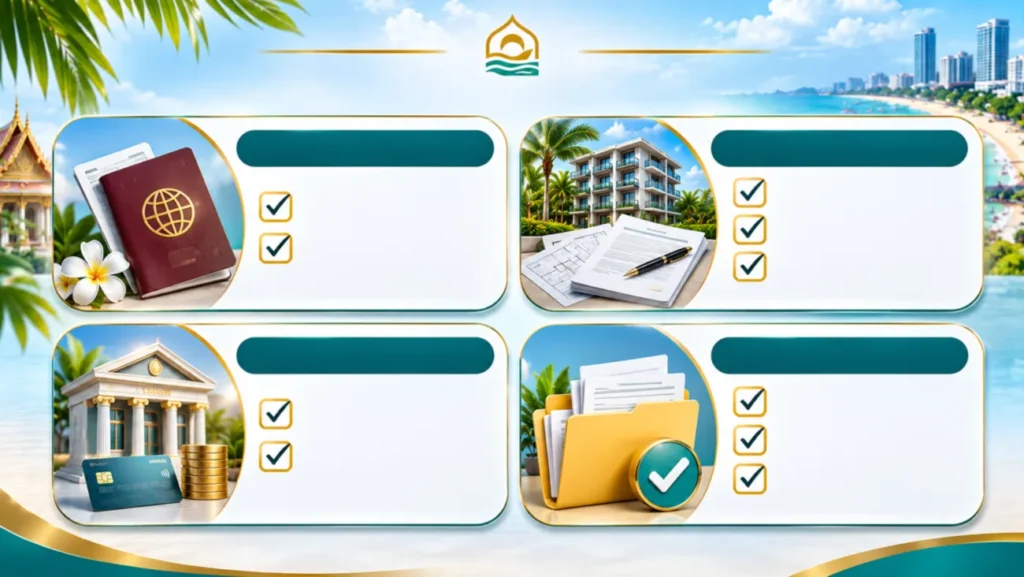
Documents Required Before Registration at the Land Office
- Original passports (of the buyer and seller or their authorized representative).
- A power of attorney that has been executed, notarized, and, if necessary, legalized in accordance with the requirements of the relevant Land Office. The procedure for executing the power of attorney must be clarified prior to registration.
- The original or a certified copy of the SPA.
- Title deed (Condominium Unit Title Deed or other).
- Acceptable proof of the origin and method of transfer of funds from a Thai bank—for a freehold apartment under the foreign quota.
- Confirmation of the availability of a foreign quota from the condominium's legal entity.
- Receipts for payment of registration fees and taxes.
- A statement from the property management company confirming that there are no outstanding balances for common area maintenance.
- Documents of a legal entity—when the company is a party to a transaction.
“Documents Required for a Foreigner to Purchase Real Estate in Thailand“
Transaction Registration and Expenses
A real estate transaction in Thailand is legally finalized in Land Office (Land Department). That is where the official registration documents are signed, government fees are paid, and the actual transfer of title takes place. The SPA itself, no matter how detailed it may be, does not confer ownership rights on the buyer.
Prior to registration, the Land Office verifies the title document for any encumbrances, ensures the accuracy of the information, and confirms that all required documents have been submitted. If necessary, an agency official may request additional supporting documentation. Both parties to the transaction (or their representatives acting under a power of attorney) must be present at the registration. After signing the forms and paying the fees, the buyer receives the original title document with the amendments incorporated—this serves as confirmation of the registered right.
A practical approach is to coordinate the timing of the final payment with the registration once the Land Office has confirmed that the transfer can proceed. It is important to explicitly document this procedure in the SPA in advance: The phrase “payment is made at the time of registration” must be included in the contract.
What to Check Before Making the Final Payment and Receiving the Keys
Before the final payment is made, the buyer is advised to inspect the property and prepare a written report noting any observations.
Check the square footage and floor plan, the condition of the walls, windows, and doors, the plumbing, electrical system, air conditioners, furniture, and equipment as specified in the appendices to the SPA. Record the meter readings and verify the presence of keys and access cards.
If any defects are found, prepare a list of issues that includes photographs, deadlines for rectification, and the person responsible. The possibility of withholding part of the payment until the defects are rectified must be agreed upon in the contract in advance.
Acceptance and registration of ownership are two different processes. Their dates may coincide or differ, depending on the structure of the transaction.
Registration fees consist of several components. As of November 2026, the standard transfer fee rate is 2% of the official appraised value. The 0.01% discount is valid through June 30, 2027, but applies only to transactions that meet the relevant conditions— exclusively for individual buyers who are Thai citizens — and should not be factored into a foreign buyer’s calculations. The specific tax rates and tax base depend on the type of property, the seller’s length of ownership, and current programs—all of which must be verified as of the transaction date.
Transaction Registration Fees
| Consumption | Basis for Calculation | Who Pays (By Law / In Practice) | What to Include in the Contract |
|---|---|---|---|
| Transfer fee (registration fee) | 2% of the official appraised value (standard rate); allocation—Article 457 of the Civil Code | By law, it is divided between the parties; in practice, it is divided by mutual agreement | Who bears the cost, or how is it divided? |
| Withholding tax (income tax withheld at source) | For individuals—under a special progressive tax schedule; for legal entities—under different rules; tax base—appraised value | Salesperson | Confirm that the seller is responsible for this expense |
| Specific Business Tax (SBT) | Applies to the sale of a property that has been owned for less than 5 years (in specified cases) | Seller; sometimes split as agreed | Specify directly in the SPA |
| Stamp duty | Typically 0.5% of the assessed tax base; applies when a specific transfer is not subject to SBT. The applicability of SBT depends on the nature of the sale, the seller’s status, the length of ownership, and any exemptions; SBT and stamp duty are not paid simultaneously for a single transfer. | Salesperson | Check with a tax advisor to determine whether this applies to a specific transaction |
| Legal Due Diligence | Under an agreement with an attorney | Buyer | Hire an independent attorney before signing the SPA |
| Translation and Representation Services | By agreement | Buyer | Agree in advance |
| Sinking fund (one-time contribution to the capital repair fund) | A fixed amount per square meter; set by the condominium association | Buyer (in an initial transaction) | Confirm the amount and include it in the budget calculation |
| Common Area Maintenance (Advance Payment) | Several months in advance; set by the managing organization | Buyer | Confirm the amount before signing the SPA |
The property price and the final purchase price are two different figures. Registration fees, taxes, and mandatory contributions can add a significant amount to the SPA price. The allocation of these costs between the parties must be agreed upon and specified in the contract well in advance, rather than being worked out on the day of registration.
“Taxes and Fees When Buying Real Estate in Thailand“
Example of a Cost Estimate for Buying an Apartment for 5 Million Baht
Suppose a foreign buyer purchases a finished apartment in a condominium for 5,000,000 THB. For the purposes of this example, the official appraised value is also 5,000,000 THB.
| Article | Calculation | Amount |
|---|---|---|
| Price of the apartment | About the SPA | 5,000,000 THB |
| Transfer fee | 2% × 5,000,000 | 100,000 THB |
| The buyer's share of the transfer fee | If a 50/50 split has been agreed upon | 50,000 THB |
| Sinking fund | According to the condominium documents | On an individual basis |
| Maintenance of Common Areas | By rate and payment period | On an individual basis |
| Legal Services | Under an agreement with a lawyer | On an individual basis |
| Bank Fees | Based on bank rates | On an individual basis |
Total for this example: 5,050,000 THB, assuming the buyer pays half of the transfer fee, excluding other expenses.
If, under the SPA, the buyer pays the entire transfer fee, the amount will be 5,100,000 THB.
This calculation does not include withholding tax, SBT, or stamp duty, which, in this scenario, are assumed to be paid by the seller. Their applicability and allocation must be verified separately.
This is a model for educational purposes only and does not represent a universal purchase price. Actual costs depend on the official appraisal, the terms of the SPA, and the status of the seller and the property.
The standard transfer fee rate 2% has been confirmed by Thai government sources.
Is it possible to sign a contract remotely?
It is possible to purchase real estate in Thailand remotely, but it requires more thorough preparation of documents. Signing the SPA without traveling to Thailand in person is legally permissible, but registration at the Land Office will require either your personal presence or a properly executed Power of Attorney per representative.
If a power of attorney is executed outside Thailand, the requirements regarding its form, certification, and legalization must be agreed upon in advance with the relevant Land Office. Depending on the country and the method of execution, notarization, consular legalization, and a translation into Thai may be required. As of November 2026, the Hague Apostille Convention does not apply to documents intended for Thailand — It will take effect in the country on February 28, 2027. Until that date, a single apostille is not sufficient. The requirements for a private SPA and for Land Office registration documents may differ—check with a Thai lawyer well in advance.
It is best to exchange draft contracts prior to signing in writing—via email—and to keep a record of the agreed-upon versions. The final version of the SPA must be reviewed by a lawyer. prior to signing, not afterward. Scanned copies of the signed pages may be accepted in the early stages, but the original SPA documents are generally required for registration and retention by the parties.
Money transfers for remote purchases are processed through Thai banks, with proper confirmation provided. Handling the registration at the Land Office through a representative is a viable option, but the buyer must obtain the original title document with a notation confirming the transfer of title. Whether to send the document via international mail or have it held by a trusted representative is a matter that must be agreed upon in advance.
Secure Remote Signing
- Request the complete SPA draft well in advance—at least 5–7 business days before signing.
- Have the contract reviewed by an independent Thai attorney whom you have chosen yourself, rather than one recommended by the seller.
- Check with a lawyer and the relevant Land Office regarding the requirements for a power of attorney: the form, the scope of authority, and the applicable legalization method, keeping in mind that the apostille is not valid for Thailand until February 28, 2027—consular legalization or another form of legalization may be required.
- Prepare a power of attorney with the required certification and legalization, and submit it to a lawyer or representative in Thailand.
- Transfer the money through a Thai bank and obtain the appropriate confirmation before registration.
- Coordinate with the representative regarding the procedure for verifying registration at the Land Office and obtaining the registered document.
- Make sure that the originals of the SPA and the title document are handed over to you or securely stored.
“Buying Real Estate in Thailand Remotely“
Are you planning to buy real estate in Thailand without traveling there in person?
Start by selecting properties that fit your budget, location, and preferred form of ownership. Once you’ve chosen suitable options, you can arrange for a separate legal review of the documents and the contract.
Get a personalized selection of properties
Hazardous Conditions and Buyer Mistakes
Below is a practical analysis of the most common issues found in contracts. Some of these can be resolved through negotiations before signing; others are reasons to postpone or reconsider the deal.
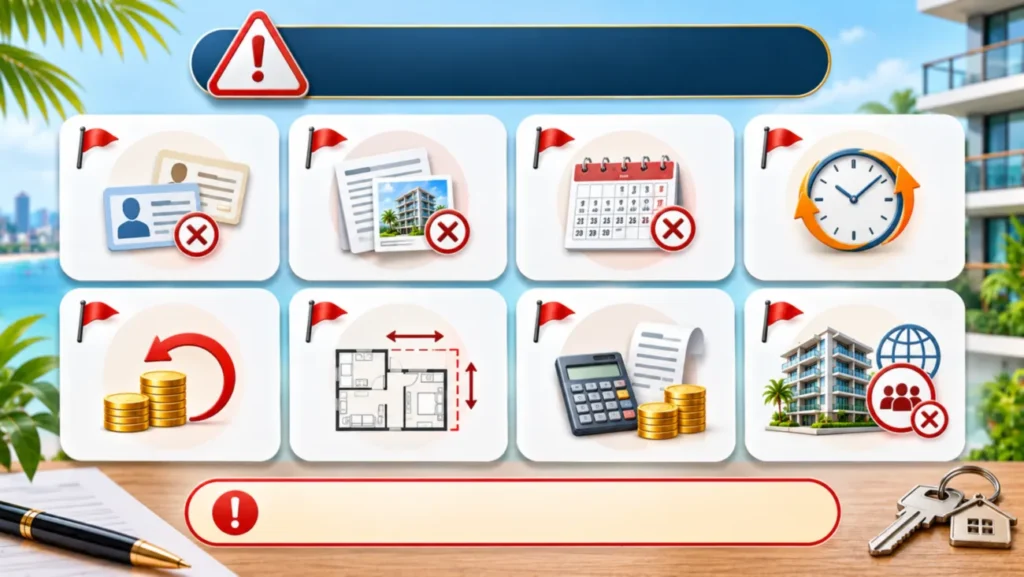
When to Sign an SPA, and When to Postpone the Deal
| The Situation | Recommended Action |
|---|---|
| All documents have been reviewed, and the key terms have been agreed upon | We can proceed to signing after the legal review |
| The seller's authority has not been verified | Postpone the signing |
| The developer's rights to the lot have not been verified | Postpone the signing |
| No confirmation of the foreign quota | Don't rely on the seller's promises; ask for confirmation |
| There is a mortgage without an agreed-upon withdrawal mechanism | Do not make the final payment until the procedure has been agreed upon |
| The grounds for a refund have not been specified | Agree on the terms before making a substantial payment |
| The developer refuses to provide the required documents | Consider canceling the transaction after consulting a lawyer |
1. Incorrect identification of the seller. When purchasing a completed property, the seller is not the same as the registered owner, and the seller’s authority has not been verified. When purchasing off-plan, there are no documents confirming the developer’s rights to carry out the project. Consequence: Registration is not possible or will require additional documents. Action: Request and verify proof of authority before signing.
2. Discrepancy between the property and the documents. The property data in the SPA do not correspond to the title documents or project documentation. Consequence: The discrepancy will become apparent during registration. Action: For a completed property, verify the SPA against the registered title deed; for off-plan properties, verify it against the project plans, permits, and attachments.
3. No registration date. The SPA does not specify a specific deadline for registering the transfer of rights. Consequence: The seller can drag out the transaction indefinitely. Action: Agree on a specific date or a maximum time limit, with consequences for failing to meet it.
4. Unrestricted right to reschedule. A developer has the right to extend construction deadlines without restrictions and without consequences. Consequence: The buyer is left waiting without any legal recourse. Action: Agree on the maximum delay period, compensation, or the right to terminate the contract; verify the mandatory minimum requirements for this type of contract.
5. Unclear rules regarding deposit refunds. Refunds are provided “by mutual agreement” or are not provided at all; the nature of each type of payment is not specified. Consequence: The seller may retain the money under any scenario involving termination. Action: Request a specific list of grounds and deadlines for refunds; consult with a lawyer to clarify the applicable mandatory regulations.
6. Unilateral changes to the area and specifications. The developer has the right to change the square footage, finishes, or features without the buyer's consent. Consequence: The buyer receives an item that does not meet their expectations. Action: Record the attachments containing the specifications and the condition that any changes must be approved.
7. Lack of cost allocation. The SPA does not specify who is responsible for paying the transfer fee, taxes, and mandatory contributions. Consequence: A conflict on the day of registration. Action: Specify the allocation of each type of expense in accordance with applicable law.
8. Uncertainty regarding the foreign quota. There is no confirmation from the condominium's legal entity regarding the availability of a quota for this unit. Consequence: the risk that a foreign national's registration application will be denied. Action: Obtain written confirmation from the legal entity before signing the SPA.
9. Unclear authority of representatives. The signatory acting on behalf of the developer does not have documented authority. Consequence: The contract may be declared invalid. Action: request documents confirming authority.
10. Discrepancies between language versions. The Thai and English versions of the contract differ in material terms, with no indication as to which version takes precedence. Consequence: In the event of a dispute, the outcome depends on the terms of the contract and the evidence. Action: Add an explicit reference to the priority language and prepare an accurate Thai translation.
11. Missing required attachments. The SPA was signed without a floor plan, specifications, or a list of furniture. Consequence: There is no contractual basis for claims regarding the contents of the package. Action: Sign the SPA only when it is accompanied by the attachments.
12. Promises of returns not specified in the contract. The agent or developer promises a guaranteed rental income, but this is not specified in either the SPA or a separate agreement. Consequence: Verbal promises of returns are difficult to verify and enforce. Action: Any income-related obligations should be included only in a signed document that specifies the terms of payment, restrictions, and the responsible party.
Fictional Educational Example 1 (This is not a real legal or commercial case.) A buyer of an apartment in Pattaya signed an SPA that specified a completion date of “approximately Q3 2025,” with the developer’s right to postpone it “if necessary” without specifying a maximum time limit or compensation. After two postponements, the buyer attempted to terminate the contract—however, the SPA provided for the retention of a portion of the payments in the event of the buyer’s withdrawal without cause. The parties settled the matter out of court, but with financial losses that could have been avoided had the contract been reviewed before signing.
Fictional Educational Example 2 (This is not a real legal or commercial case.) The buyer of a villa in Phuket expected the lease to be renewed under a “three 30-year terms” arrangement, based on verbal explanations from the agent. The lease agreement provided for renewal “by mutual agreement”—without any fixed terms. After the land changed hands, the issue of renewal became the subject of negotiations without any guarantees.
Final Review Before Signing the SPA
- All parties to the contract are listed in the title documents (for a completed property), or the developer’s authority for off-plan sales has been confirmed.
- The property description has been verified as accurate: for a completed apartment, it matches the information in the title deed; for an off-plan property, it corresponds to the project plans, permits, and attachments.
- All attachments (plan, specifications, bill of materials) have been signed and are attached to the SPA.
- The foreign quota has been confirmed in writing by the condominium's legal entity.
- The return policy in the event of termination is specific, and the legal nature of each payment is clearly defined.
- The deadlines for construction and registration are set, and penalties apply for noncompliance.
- The allocation of all expenses related to registration is specified in the contract.
- The language to be given priority in case of discrepancies is explicitly stated; an accurate Thai translation has been prepared.
- The signatories' authority on both sides has been documented.
- An independent Thai lawyer reviewed the contract and provided a written opinion.
Buyer's Checklist Before Signing the SPA
Save the list and check off the items you've completed:
- The seller and their credentials have been verified.
- Title and encumbrances have been verified.
- The information about the apartment matches the documents.
- The foreign quota has been confirmed, if applicable.
- The developer's permits have been verified for off-plan sales.
- The price and payment schedule have been agreed upon.
- The bank transfer instructions have been confirmed.
- The registration date is listed.
- Liability for the delay has been determined.
- The refund policy has been verified.
- All applications are signed.
- The costs were divided between the parties.
- The terms for acceptance and defect rectification have been agreed upon.
- An independent Thai lawyer reviewed the contract.
What to Do in Case of a Breach of Contract
If the seller breaches the terms of the SPA—by delaying the transfer of the property, failing to refund the money, or transferring the property in a condition other than that specified in the contract—the course of action is largely determined by the contract itself.
First— Save all documents: the original SPA and all attachments, receipts and bank confirmations for all payments, and correspondence with the seller or developer. Without these documents, it will be much more difficult to prove that a violation occurred and to determine the amount of the losses.
Second— Document the violation in writing. Take photos of the property's condition at the time of transfer if it does not comply with the contract. Save any emails acknowledging a delay or a change in the terms.
Third— Check the contract for the notification procedures: where and in what form to file a complaint, and within what timeframe the seller is required to respond. Formal requirements for a complaint are often a prerequisite for exercising subsequent rights.
Fourth— Send a written request within the agreed-upon timeframe. In complex situations, it is best to do this through a Thai lawyer.
Fifth—if negotiations fail to produce results, it makes sense to consider the possibility of complaints filed with the Office of the Consumer Protection Board (OCPB) — Thailand’s government agency for consumer protection. The OCPB handles complaints regarding breaches of consumer contracts, including real estate transactions, and can act as a mediator. Detailed information about the procedures is available at the OCPB's official website.
An independent Thai attorney is essential in the event of any serious breach of contract—to assess the realistic prospects, draft claims, and protect your interests in negotiations or in court. The outcome depends on the specific terms of the contract, the evidence, and the circumstances of the breach. It is impossible to guarantee in advance that money will be recovered or that the dispute will be successfully resolved.
Property Search with Thaicost
Selecting a property is the first step, and both the structure of the transaction and the terms of the contract depend largely on this choice. The type of property, the stage of construction, the foreign ownership quota, and the purpose of the purchase—all of these factors influence which documents you will receive and which terms you will need to review.
Thaicost assists with property selection in Pattaya, Phuket, Koh Samui, and Bangkok, and helps buyers navigate the wide range of options while taking into account their budget, goals, and legal requirements. Verifying documents and conducting a legal review of the contract is a separate task that should be entrusted to an independent Thai lawyer.
Find a property that fits your budget and goals. Take a short Real Estate Search in Thailand...to identify suitable options in Pattaya, Phuket, Koh Samui, or Bangkok. Before making a purchase, it is important to carefully review the property’s documents and the terms of the contract.
Results
A real estate purchase agreement in Thailand is a document that you should read and review to significant payments. Once the SPA has been signed and the down payment has been transferred, it is virtually impossible to unilaterally change the terms.
The security of a transaction is determined by three factors taken together: the legal soundness of the property and the seller’s legal standing; the quality of the contract terms—return policy, liability, deadlines, and costs; and the proper registration of the title with the Land Office. None of these elements can be substituted for another.
An independent legal review helps identify significant risks before signing and paying—it is particularly warranted when the property is high-value, when purchasing during the construction phase, and in any non-standard legal structure—such as a leasehold, the purchase of a villa, or a transaction conducted through a company.
This article is for informational purposes only and does not constitute legal advice. A specific SPA requires a case-by-case analysis involving an independent Thai attorney.
 Real estate in Georgia
 Real estate in Cyprus
 Real estate in UAE
 Real estate in Bali
 Real estate in Montenegro
 Real Estate in Spain
 Real Estate in Saudi Arabia
 Real Estate in Turkey
 Real Estate in Zanzibar
 +66 98 432 7651
 hello@thaicost.com
 Boat Lagoon Marina, 22/1 Moo 2, Thepkasattri Rd, Koh Kaew, Phuket 83000, Thailand




 Get TOP-7 catalog of objects